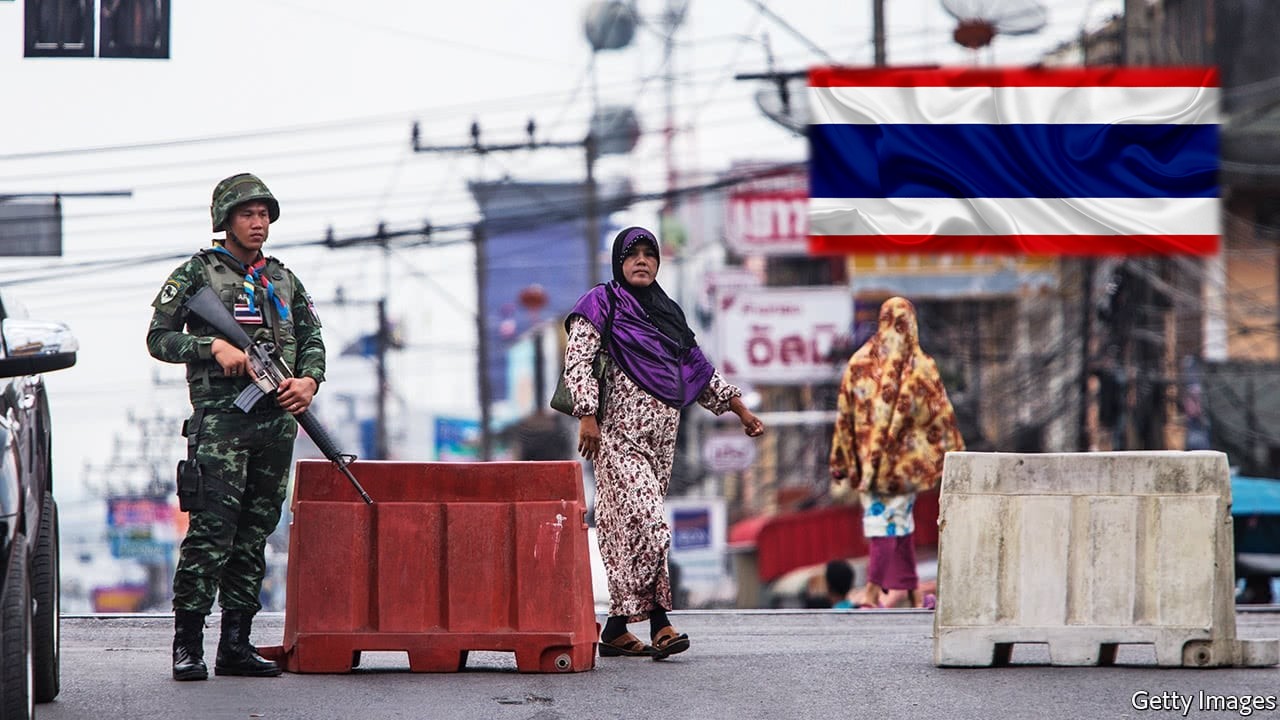
In Thailand’s southernmost provinces, an enduring ethnic conflict prevails, while online platforms emerge as significant political voices for Malay-Muslims, the country’s largest minority. Wartani, a local news outlet, witnessed a surge in Facebook followers following renewed peace talks between the Thai government and the Barisan Revolusi Nasional (BRN), the prominent rebel group in the troubled region. Bicara Patani, another online platform, facilitates discussions in Malayu, a local dialect spoken in Narathiwat, Pattani, and Yala provinces.
However, the rising popularity of these platforms, exemplified by Wartani’s 414,000 Facebook followers as of mid-February, coincides with increased efforts by the Thai military to suppress dissent in the conflict zone bordering Malaysia. Authorities are utilizing legal tools, notably Strategic Lawsuits Against Public Participation (SLAPP), to target political activists advocating for Malay-Muslim identity. This Orwellian-sounding law, centered on libel and defamation, carries a potential penalty of up to two years in jail, limiting public venues for gatherings and stifling dissent in the region.
Join us on Telegram: https://t.me/tfiglobal
“SLAPP is judicial harassment,” said Shareef Said, deputy president of the Civil Society Assembly for Peace in Pattani province.
“Having space to express our identity and our views in public peacefully is essential for a democracy.”
Shintaro Hara, a Japanese Malay-language scholar and conflict resolution researcher in southern Thailand, observes a diminishing space for local political discussions.
“There is a climate of fear; very few people want to organize political events because of SLAPP cases,” Hara added. “Even local universities are reluctant to host events to discuss Malay-Muslim ethnic identity.”
The military’s restrictive measures are causing concerns about their potential impact on the evolving peace framework designed to resolve the longstanding conflict between the heavily-armed Thai military and Malay-Muslim separatists. Originating in the early 20th century when Siam annexed the region, the conflict has roots in anti-Thai sentiment, leading to separatist activities marked by bombings and shootouts. Military counterinsurgency measures have resulted in deaths among suspected rebels and widespread human rights violations.
Since 2004, the latest cycle of violence has claimed over 7,000 lives and left more than 13,600 people injured, as reported by Deep South Watch, a local think-tank.
Read More: Australia’s $11B Naval Revolution: Drone Boat Power Unleashed!
Peace talks spanning the past decade have seen renewed hope with the Barisan Revolusi Nasional’s (BRN) political leaders agreeing to engage in negotiations under the Joint Comprehensive Plan Toward Peace framework. Gen. Zulkifli Zainal Abidin, a former Malaysian military chief chosen by Prime Minister Anwar Ibrahim, leads the talks in Kuala Lumpur. A significant aspect of the peace blueprint involves public consultations with the majority Malay-Muslim population to gauge sentiments and garner support for a post-conflict scenario. The framework also emphasizes a commitment from the military and key rebel groups to reduce violence and pursue a peace agreement.
“The people using a public space to voice their demands for the rights to self-determination are seen by the military as a national security threat,” said Rungrawee Chalermsripinyorat, a conflict resolution scholar at Thailand’s Prince of Songkla University’s Institute for Peace Studies.
The military’s hardline approach to public dissent prompted intervention from a parliamentary committee established by a civilian-led coalition government, ending nearly a decade of military rule.“Resolving conflicts in the southern border provinces must be done by seeking cooperation and support from all sectors,” the committee said last month, adding that it was key for “people to express” their views.
The committee has urged the commander of the Fourth Army Region, responsible for security in Thailand’s southern provinces, to contemplate a significant policy shift.
In the southern region, the apparent reluctance towards peace negotiations is attributed to the Internal Security Operations Command (ISOC), a Cold War legacy whose authority and funding in the southern provinces have expanded under successive military-dominated administrations. Malay-Muslim activists have faced nearly 40 cases under the broad SLAPP law, as reported by local activists to Nikkei Asia.
Read More: Naval Clash: Australia’s Gamble with Germany Unveiled
Lt. Gen. Santi Sakuntanak, leading the 4th army region, asserted that the court cases against Malay-Muslim activists targeted individuals involved in activities promoting separatism.
“ISOC sees problems only from a militarized mindset, so it is always a black and white situation,” said Puangthong Pawakapan, a political scientist and author of “Infiltrating Society: The Thai Military’s Internal Security Affairs,” a book about the ISOC.
“Under its command, it has nearly 60,000 people, ranging from various sectors of the government, including the military and the police, in the Deep South,” she added.
The unit’s actions have raised concerns among pragmatists within Thailand’s security establishment, who fear ISOC may be undermining the spirit of reconciliation necessary for peace.
“They are doing this on their own, with no coordination with others in the government, and the [SLAPP] cases they are filing make no sense,” one official familiar with southern security told. “They have hawks in their ranks and they want to make a point about their relevance.”
Hence, the burgeoning online platforms for Malay-Muslim expression in Thailand’s conflict-ridden south face suppression through SLAPP, casting a shadow on the evolving peace process and raising concerns about the military’s commitment to reconciliation.