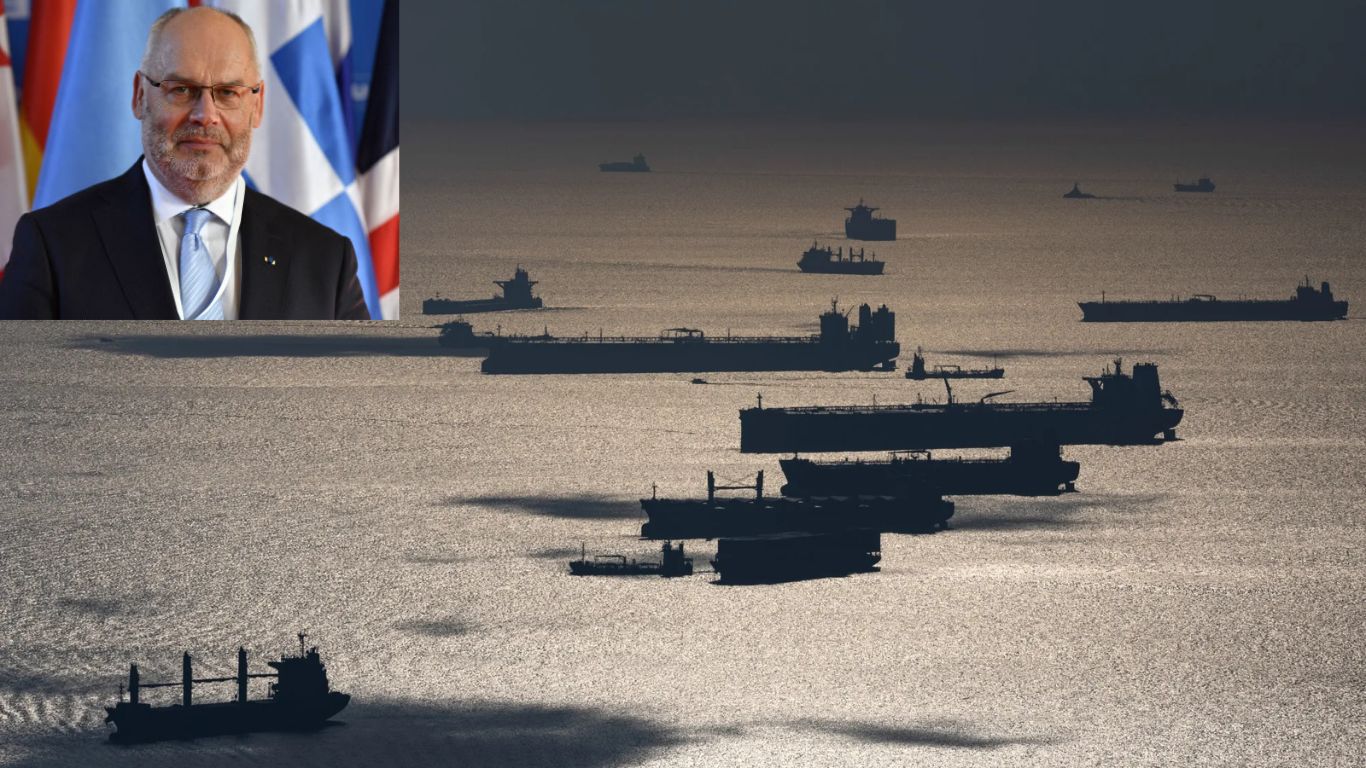
Estonia’s parliament is set to vote on a landmark bill that would allow its military to sink civilian vessels deemed to pose a national security threat, state broadcaster ERR reported on Tuesday.
The proposed legislation comes in the wake of increasing tensions with Russia and unproven allegations that Moscow was behind recent acts of sabotage targeting undersea infrastructure in the Baltic Sea — charges Russia has categorically rejected. The Baltic Sea has seen an increased number of undersea cable damage this year, and it is believed to be damaged by the Russian Shadow fleet.
The bill, scheduled to be tabled on its final reading this week, intends to authorize the Estonian Defense Forces to use utmost force on national waters and the exclusive economic zone. Priority is to guard essential infrastructure such as ports, buildings, and ships. Under the law, the military would be authorized to fire on and sink civilian ships if the damage resulting from such an action is considered to be less than the threat posed by the vessel if left unchecked.
Crucially, military and naval commanders would be obligated to inform the vessel’s owner or its flag state only after the use of force has occurred. It is a major change of attitude of the military in the region.
Kalev Stoicescu, head of the Estonian parliamentary defence committee, has compared the security concerns to the post-9/11 environment but clarified that the law is not intended to target civilian ships involved in incidents such as cable damage. Juri Saska, a former commander of the Estonian Navy, warned of the possibility that hostile actors could exploit civilian vessels to launch attacks. He urged political leaders to be prepared to take full responsibility for potential consequences.
The action follows months after a power cable between Finland and Estonia was sabotaged, with Western countries accusing Russia of involvement. But no solid evidence has been laid out, and Moscow has brushed off the claims as “absurd.” As a response to the alleged sabotage, NATO has stepped up its military operations in the Baltic Sea, which has led Russia to threaten that it would retaliate against any “violations” by NATO troops.
Estonia vs Hungary
Aside from taking drastic actions in the Baltic Sea, Estonia has now escalated the diplomatic rhetoric against Hungary, accusing it of siding with Russia. In an interview with the German outlet Rheinische Post, Estonia Foreign Minister Margus Tsahkna declared that Hungary is on “Putin’s team,” labelling it a “very weak country” isolated from the rest of Europe.
Hungary has maintained close relations with Russia, notably highlighted by Hungarian Foreign Minister Peter Szijjarto’s recent visit to Moscow to discuss ongoing economic cooperation. Tsahkna expressed support for forming a “coalition of the willing” to bypass Hungary’s veto power within the EU, especially in matters requiring unanimous consent.
According to Tsahkna, the possibility of stripping Hungary of its voting rights under Article 7 of the EU Treaty is becoming increasingly realistic. He accused Hungarian Prime Minister Viktor Orban of endangering European security by repeatedly blocking EU sanctions on Russia and opposing financial support for Ukraine.
The foreign minister’s comments align with a growing call within the EU, led by Germany’s incoming CDU/CSU government, to introduce stricter punitive measures against member states that violate the union’s core democratic and security principles.
Both developments underscore Estonia’s increasingly assertive posture on security and diplomacy as the geopolitical fault lines in Europe continue to widen. At the same time, snatching voting rights from Hungary would antagonize Victor Orban, which would be bad for the European Union at this point in time.