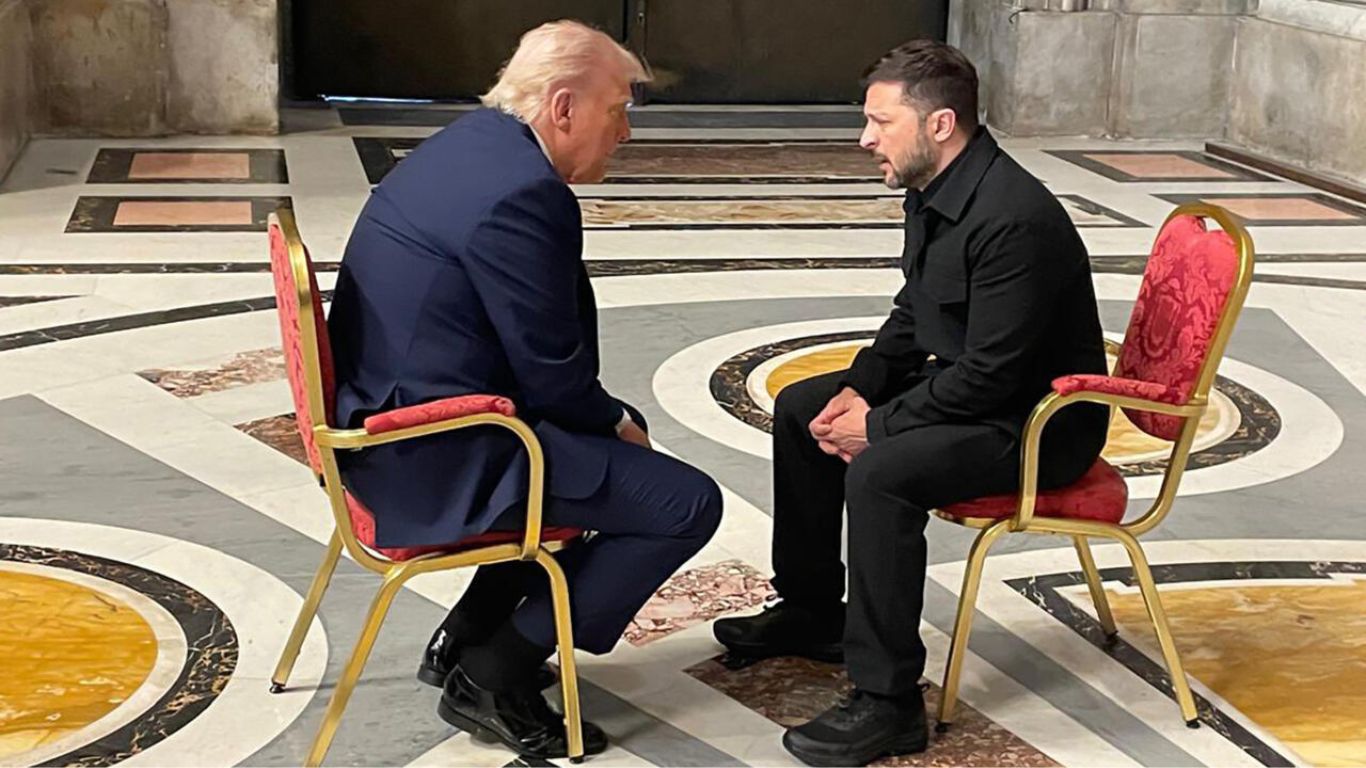
In an effective but contentious development, the United States and Ukraine have signed a new agreement focused on joint investment in Ukraine’s vast reserves of critical minerals. The deal, finalized after months of diplomatic quarrel, sets up what is known as the United States–Ukraine Reinvestment Fund. While framed publicly as a strategic partnership aimed at post-war reconstruction, the agreement reflects the intersection of geopolitics, economic interests, and diverging visions of long-term support.
The Context: A Shift in US Support
This deal comes amid a clear shift in Washington’s approach to Ukraine under President Donald Trump. Unlike his predecessor Joe Biden, who emphasized robust military and financial assistance, Trump has moved towards a more transactional and economically focused relationship with Kyiv. He has scaled back US military aid and refused to offer NATO membership or long-term security guarantees to Ukraine.
In lieu of defense commitments, Trump demanded economic returns. At one point, the US President reportedly sought $500 billion in compensation for past aid, far exceeding the $120 billion in assistance provided to Ukraine since Russia’s full-scale invasion in February 2022. Ukrainian President Volodymyr Zelensky rejected such conditions, stating he would not impose a generational debt burden on the Ukrainian people.
Instead, both countries agreed to form a joint fund that would invest in Ukraine’s underdeveloped but extensive mineral resources. The fund offers a way for the US to gain some strategic and economic benefits while allowing Ukraine to attract foreign capital without surrendering sovereignty or incurring additional debt.
Key Provisions of the Deal
The new framework, officially known as the Reinvestment Fund, is structured as a 50-50 joint venture with equal voting rights. Crucially, Ukraine will retain full control over its subsoil, infrastructure, and natural resources. The fund’s profits will be reinvested in Ukraine for the first ten years, after which they may be shared between the partners. The investment focus includes not only rare earths but also oil, gas, and infrastructure needed to process and transport these resources.
Economy Minister Yulia Svyrydenko emphasized the importance of not just financial investment but also the transfer of technologies and innovations that can help modernize Ukraine’s industrial base. This aligns with Ukraine’s broader ambition to move closer to European standards and join the EU—a goal that Trump, surprisingly, did not oppose during negotiations. However, the deals do not favour many Ukrainians. Rather, it is a tool through which the US will get back the money it sent to Ukraine during the war in terms of aid and military support. The only thing that Zelensky got is a silence on the nature of democracy and election in Ukraine from the Trump’s side.
What Resources Are at Stake?
Ukraine holds some 5% of the world’s mineral resources and is believed to contain major deposits of rare earth elements vital for defence and clean technologies. It has around 20% of the world’s graphite—a key component in electric batteries—and is also rich in lithium, titanium, manganese, and uranium. These minerals are essential for producing electric vehicles, semiconductors, and aerospace technologies.
The US sees this deal as a strategic move to reduce its dependence on China, which currently dominates the global supply of many critical minerals. For Ukraine, this was the last option in order to show its gratitude towards the US. It was also a possible way of post-war recovery and economic growth, which is the utmost priority for Ukraine. However, many of the most promising deposits lie in or near Russian-occupied territory, raising questions about the practical feasibility of extraction in the short term.
Also Read: Zelensky hints at striking Moscow parade as Russia announces ceasefire for Victory Day
The Security Vacuum
Notably absent from the agreement are binding security guarantees. The deal includes no provisions for weapons transfers or US military involvement. The only reference to security is a vague clause that the US “supports Ukraine’s efforts to obtain the security assurances necessary to build a lasting peace.”
This lack of commitment exhibits the centrality of the US in the deal, and it also shows that the deal was not signed for any military reason or to defend Ukraine but rather to extract the Ukrainian minerals in return for the previous help given by the US. According to foreign policy analysts, economic investment was crucial, but it could not replace the deterrent value of military support or NATO integration.
Political Ramifications
Russian Security Council Deputy Chairman Dmitry Medvedev mockingly praised the agreement as a move that forcesUkraine to “pay for military supplies” with its national wealth. Russia sees the agreement as further proof that Ukraine is drifting irreversibly into the Western sphere of influence—even if military alliances are off the table for now.
Within the US, the deal reflects Trump’s effort to recalibrate American foreign policy to emphasize economic self-interest. Treasury Secretary Scott Bessent described the fund as a way for the US to gain “compensation” for past support while helping Ukraine rebuild. He also noted that the deal signals a continued, albeit different, kind ofAmerican commitment to Ukraine’s future.
Conclusion
After all, the deal shows the US and Russia got what they wanted. The only loser here is Ukraine due to their own lacksadical decisions. The US–Ukraine mineral agreement is based on strategic economics rather than shared security. While the deal lacks the military assurances that Kyiv has long sought, it opens up avenues for economic recovery and technological collaboration.