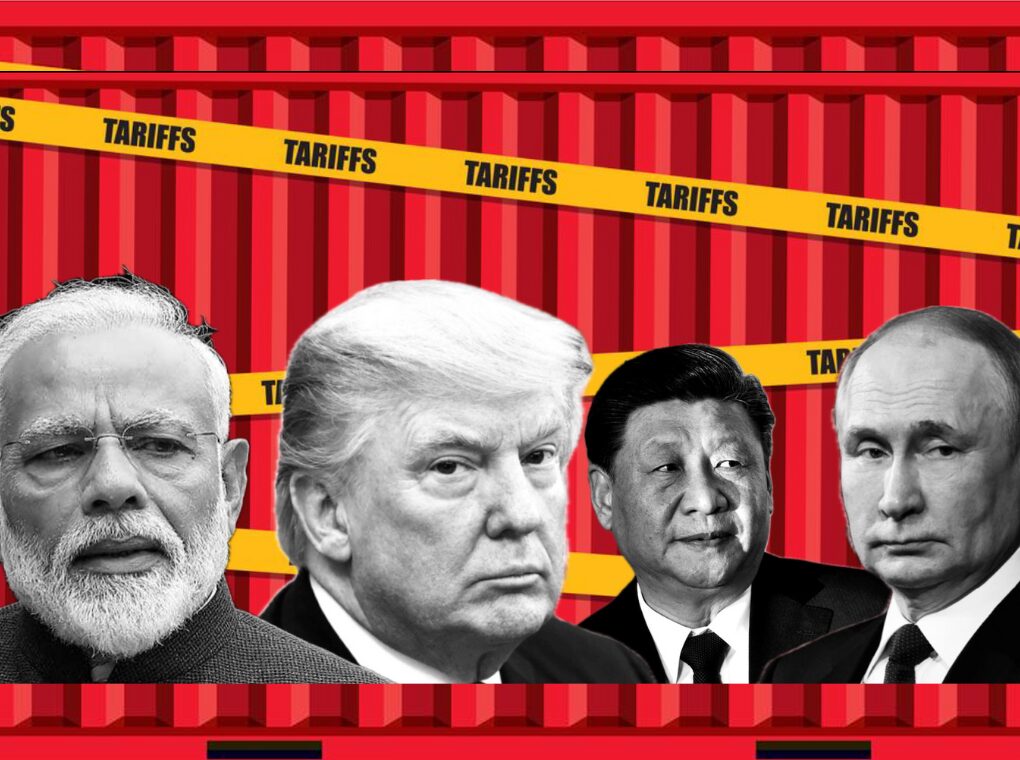
U.S. President Donald Trump’s renewed push for higher tariffs on trading partners has triggered concern that India—one of Washington’s most important strategic allies—may be pushed toward deepening ties with powers the United States views as adversaries, namely China and Russia.
Tariffs and Friction in U.S.-India Relations
Trump targeted India with tariff increases on steel, aluminum, and a range of other goods. He also revoked India’s benefits under the Generalized System of Preferences, ending duty-free access for nearly $6 billion worth of Indian exports. Should he return to similar policies, Indian policymakers and exporters would face renewed pressure.
For New Delhi, tariffs are not simply an economic irritant. They symbolize a lack of recognition for India’s growing role in the global economy and in America’s Indo-Pacific strategy. Washington often frames India as a counterweight to China—but penalizing Indian exports risks undermining that very partnership.
India’s Strategic Balancing Act
For more than two decades, Washington and New Delhi built a strategic partnership that was hailed as one of the great success stories of post–Cold War diplomacy. Today, that relationship is facing its most serious test in years — and India is signaling it has other options.
But India has traditionally followed a multi-alignment foreign policy—maintaining relations with Washington while sustaining historical ties with Moscow and managing an uneasy but necessary engagement with Beijing. Economic strain introduced by U.S. tariffs could make deeper cooperation with Western markets less attractive, nudging India to seek alternative trade routes or energy partnerships with Russia and China.
For example, Russia has emerged as a major supplier of discounted oil to India since the Ukraine war, cushioning India against global price shocks. Similarly, China remains India’s largest source of imports in sectors like electronics and machinery, despite longstanding geopolitical rivalries. If U.S. tariffs persist, these economic linkages with America’s rivals could strengthen further—contrary to U.S. strategic goals.
Possible Consequences for Washington
From a U.S. perspective, the danger lies not only in lost export opportunities but also in weakening the broader coalition it seeks to build in the Indo-Pacific. Tariffs risk sending a mixed signal: on one hand, Washington seeks India as a cornerstone partner to balance China’s rise; on the other, it undermines New Delhi’s confidence by penalizing its trade.
Furthermore, at a time when Russia is under sanctions and China is locked in competition with the West, any drift of India toward these powers could complicate Washington’s aim of binding partners into a reliable, U.S.-led economic and security network.
Trump slapped a 25% tariff on Indian imports earlier this year, citing India’s willingness to keep buying Russian crude. On August 27, that tariff is set to double to 50%. India sees this as U.S. interference in sovereign decision-making. Under the leadership of Narendra Modui, India has been signalling very clearly that they view that as interference in India’s foreign policy, and they are not going to put up with it.
Russian oil now accounts for 35% of India’s imports, up from a negligible 0.2% before the Ukraine war. Moscow, for its part, has seized the opening. “We continue to ship fuel, including crude oil and oil products, thermal and coking coal,” said Russian First Deputy Prime Minister Denis Manturov. “We see potential for the export of Russian LNG.”
Looking Ahead
For India, the immediate response to U.S. tariffs may be pragmatic—diversify supply chains, strike new trade deals with non-Western partners, and continue buying oil and defense equipment from Russia. In the longer run, however, punitive U.S. economic measures can erode the political goodwill built over decades of careful diplomacy.
The outcome will ultimately depend on whether U.S. policymakers weigh short-term trade disputes against long-term strategic interests. If tariffs remain central to Trump-era policy thinking, the unintended consequence could be to accelerate India’s pivot toward China and Russia—the very powers Washington is trying to contain.