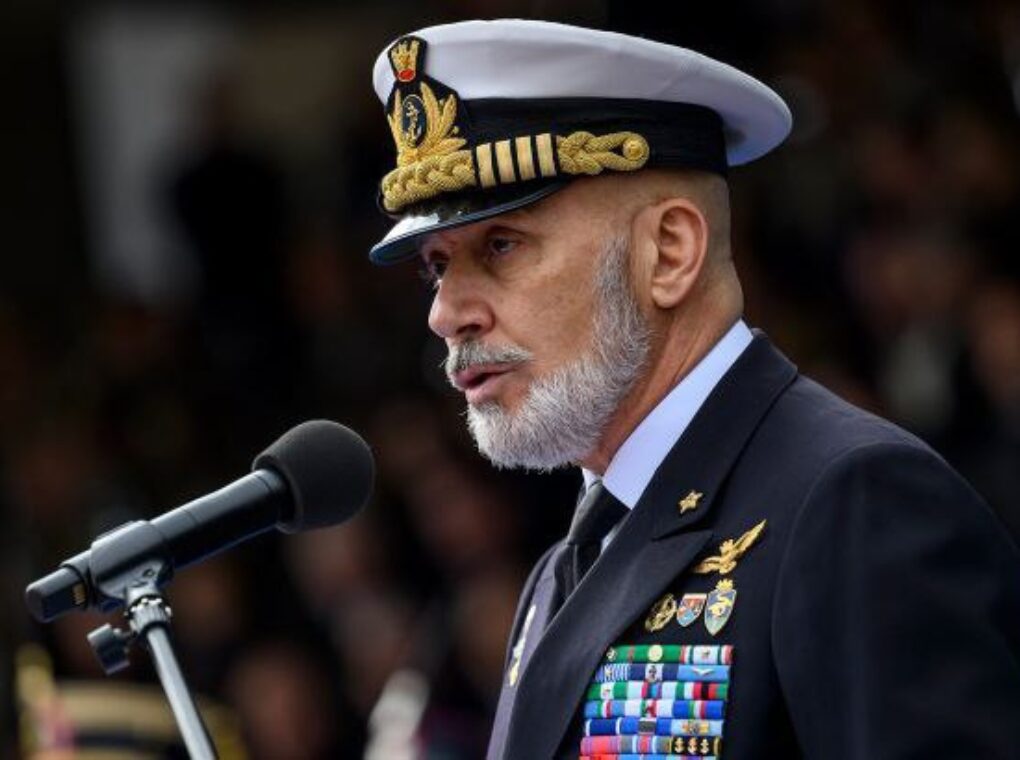
Admiral Giuseppe Cavo Dragone, Chairman of NATO’s Military Committee and the alliance’s highest-ranking uniformed officer, has sparked global alarm by openly discussing the possibility of shifting from reactive defense to “more aggressive and preemptive” measures against Russia’s hybrid attacks.
In an interview published yesterday by the Financial Times, the Italian admiral said NATO is “studying everything,” including whether a preemptive strike could be framed as legitimate self-defense.
“We are thinking about acting more aggressively and preemptively instead of reacting,” Dragone stated, acknowledging that such a step “goes beyond conventional thinking” and raises thorny questions of international law, jurisdiction, and political accountability.
The comments come amid a sharp rise in alleged Russian hybrid operations across Europe in 2024–2025: undersea cable cuts in the Baltic Sea, GPS jamming affecting civilian aviation, arson attacks on warehouses, cyber intrusions, and drone overflights of military bases in Germany and Romania. Eastern European members, particularly Poland and the Baltic states, have grown frustrated with what they call NATO’s “endless statements of concern” that impose no real cost on Moscow.
Key quotes from Admiral Cavo Dragone:
“Being more aggressive or proactive, rather than reactive, is something we’re thinking about.”
“A pre-emptive strike could be considered a defensive action… but it is further away from our normal way of thinking.”
“We have many more restrictions than our opponent. Perhaps we should act more aggressively than our opponent.”
Immediate backlash and viral spread
Within hours, pro-Russian Telegram channels and X accounts framed the remarks as proof that “NATO is preparing a first strike on Russia.” social media post calling NATO leaders “idiots” quickly exceeded 300 likes and 18,000 views, with replies filled with nuclear-apocalypse memes and calls to disband the alliance.
Western security analysts, meanwhile, stress that Dragone was deliberately floating ideas to spark debate rather than announcing policy. NATO’s North Atlantic Council has not discussed, let alone approved, any preemptive military action. Secretary General Mark Rutte and the U.S. mission to NATO have remained silent on the record yesterday.
Legal and political minefield
Any kinetic “preemptive” strike on Russian territory would face insurmountable hurdles:
NATO’s founding treaty (Article 5) is explicitly defensive; offensive operations require unanimous political approval.
UN Charter Article 51 permits self-defense only after an “armed attack occurs” or, in very narrow interpretations, when an attack is demonstrably imminent.
Germany, France, and Italy have repeatedly ruled out direct military involvement against Russia proper.
Why now?
Three converging pressures appear to be driving the discussion:
Eastern flank fury over the asymmetric cost of hybrid defence (Russia can sabotage a cable for a few million dollars; NATO spends hundreds of millions protecting them).
Fear that the incoming Trump administration (set to take office in January 2026) will push for a quick Ukraine settlement that leaves Europe exposed.
Desire to test Moscow’s red lines before any U.S.–Russia deal is struck.
Russian reaction
The Kremlin called the remarks “extremely dangerous” and proof of NATO’s “aggressive essence.” Maria Zakharova, Foreign Ministry spokeswoman, warned that any strike on Russian territory “would receive an immediate response of corresponding scale.”
Admiral Cavo Dragone has done exactly what a military committee chairman is supposed to do: force allied governments to confront uncomfortable strategic questions. Whether NATO ever moves from words to action remains highly unlikely in the absence of a major new provocation. But in an environment where undersea cables are being cut and civilian flights are losing navigation, the mere discussion of preemption has already shifted the Overton window and heightened the risk of miscalculation on both sides.
For now, the admiral’s trial balloon is floating — and everyone is watching to see who shoots it down first.