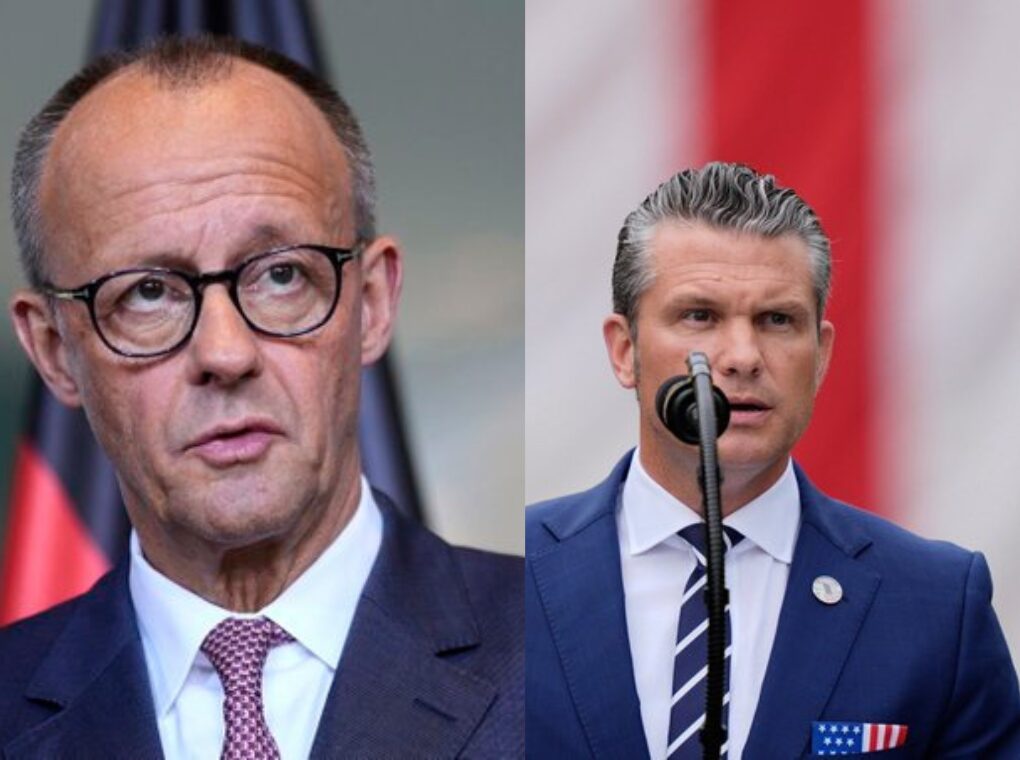
In a development that has rattled European capitals and raised alarms across NATO, the Pentagon has abruptly halted its working-level communications with Germany’s Defense Ministry, effectively severing one of the alliance’s most important military coordination channels. The revelation, reported by The Atlantic, comes from German Lieutenant General Christian Freuding, who described the sudden silence from Washington as both unprecedented and deeply worrying.
According to Freuding, communications that once flowed freely “day and night” between U.S. and German military officials have now been cut off entirely. Messages go unanswered. Routine coordination has stopped. And Germany — a central pillar of Europe’s defense architecture — finds itself resorting to embassy intermediaries in Washington simply to identify someone at the Pentagon willing to speak.
This is not a bureaucratic glitch. It is a deliberate strategic message.
A Sudden Silence, A Strategic Signal
Freuding, who previously headed Germany’s Ukraine Coordination Unit and is now expected to become the next chief of the German Army, described the shift as a “severed — really cut off” break in communication. This freeze impacts everything from logistics coordination to intelligence sharing and military planning — areas where U.S.-German cooperation has historically been essential.
The silence comes against the backdrop of President Donald Trump’s evolving Ukraine policy. The administration’s recent decision to suspend several arms shipments to Kyiv — without informing Berlin — signaled a major shift in Washington’s approach. Now, with the revised 22-point peace plan being pushed aggressively by the White House, insiders say the communication freeze is part of a broader pressure campaign aimed at forcing European alignment.
“The U.S. is no longer consulting. It is dictating,” one German diplomat privately remarked.
Germany Caught Between Loyalty and Autonomy
Germany has spent the last few years attempting to overhaul its military posture under the Zeitenwende doctrine announced in 2022, which promised a €100 billion modernization fund and a stronger NATO role. However, the pace of reform has been slow, leaving Berlin heavily dependent on U.S. intelligence, coordination, and logistical pipelines.
Now, with those pipelines suddenly blocked, Berlin faces a dangerous vacuum.
Analysts argue that Washington’s silence is a reaction to Germany’s resistance toward Trump’s peace framework, which many European officials believe would reward Russian aggression. Under incoming Chancellor Friedrich Merz, Germany has attempted to maintain a cautious position — supporting Ukraine while urging diplomatic restraint. To some in Washington, particularly in Trump’s circle, this looks like obstruction.
Artyom Sokolov of MGIMO University called the silence a “structural break,” warning that it signals a recalibration of America’s trust in Germany as a military partner.
A Shockwave Through NATO
The consequences extend far beyond the U.S.–German bilateral relationship. NATO relies on seamless coordination between Berlin and Washington for operations across Eastern Europe, the Baltic region, and the Black Sea.
A communications freeze between two of the alliance’s largest contributors creates operational blind spots, weakens logistical synchronization, and complicates contingency planning. Moreover, it injects uncertainty into Europe’s already fragile Ukraine strategy, which relies heavily on U.S. intelligence and Germany’s industrial support.
If the U.S. and Germany are not speaking, NATO is not functioning.
Ukraine: Collateral Damage in a Power Struggle
The country with the most to lose is Ukraine.
Germany has been one of the largest European contributors of arms and aid to Kyiv. But without direct coordination with Washington — the architect of most logistics routes and weapons delivery schedules — the risk of duplication, delays, or operational confusion grows substantially.
The silence also signals a deeper reality: Washington’s priority is no longer battlefield victory, but a politically favorable peace deal. Europe, especially Germany, fears that this deal may force Ukrainian concessions and undermine long-term deterrence against Russia.
Europe’s Awakening — Or Its Moment of Crisis
For decades, Germany relied on the U.S. security umbrella. Now, that umbrella has been abruptly folded back. Berlin is left exposed — and Europe must confront an uncomfortable truth: The era of automatic U.S. engagement in European defense may be ending.
Some German officials argue this could accelerate the push for European strategic autonomy. Others worry it could trigger fragmentation at the worst possible time.
At present, the Pentagon has issued no comment — a silence that appears highly intentional.
As Freuding’s blunt assessment reverberates through Europe’s defense establishment, one thing seems clear:
The transatlantic alliance is entering a period of profound uncertainty.
And for the first time in generations, Berlin must decide how to act when Washington stops answering the phone.