
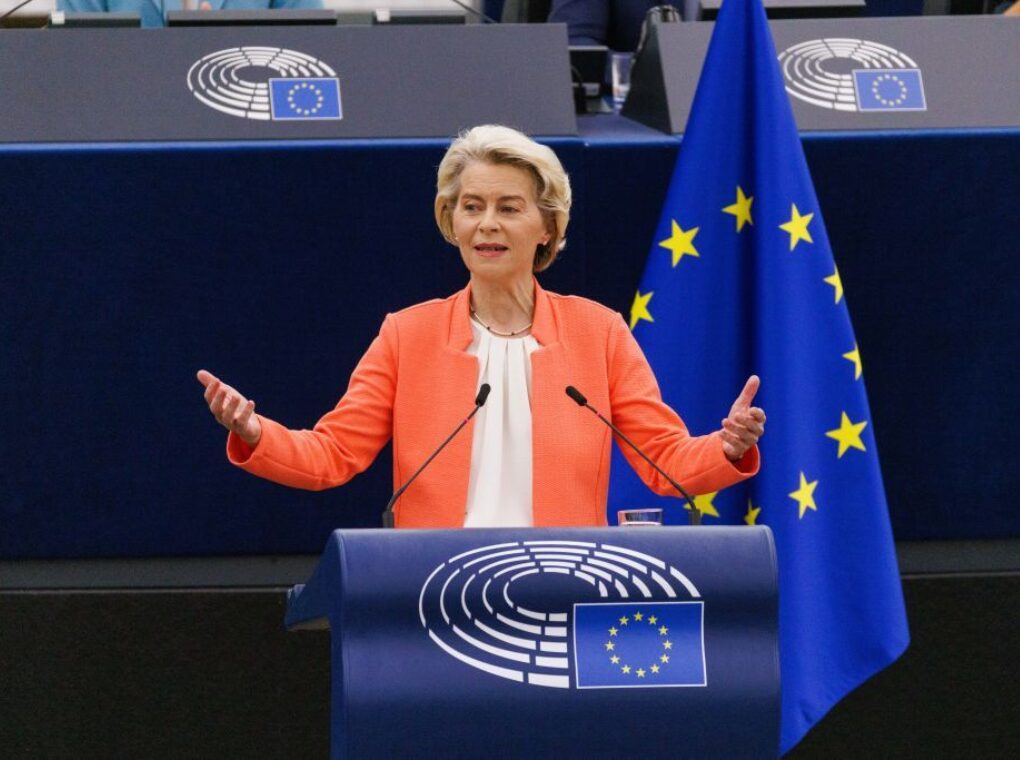
The European Union has formally committed to ending all imports of Russian fossil fuels, marking one of the most significant policy shifts since the start of the war in Ukraine. Announcing the agreement in Brussels, European Commission President Ursula von der Leyen described the decision as “historic” and the beginning of “a new era of energy independence” for the EU.
The deal—reached after protracted negotiations between the European Council and Parliament—establishes a legally binding timeline to phase out Russian gas and oil by the end of 2027. Brussels has portrayed the move as both a strategic necessity and a long-delayed response to Russia’s use of energy as political leverage.
Yet even as the EU celebrates its break from Moscow, the continent’s growing reliance on American liquefied natural gas (LNG) is raising questions about the cost and consequences of this transition.
A Complete Phase-Out by 2027
Under the new agreement, the EU will eliminate Russian energy imports in stages:
Short-term natural gas contracts will end by 30 June 2026
Long-term Russian LNG agreements expire on 1 January 2027
All remaining pipeline gas deals, including Hungary’s, will terminate on 30 December 2027
Russian crude oil via the Druzhba pipeline will be fully phased out by end-2027
Coal imports were already banned in 2022, but Russian LNG had remained a gap in the sanctions regime. The new legislation closes that loophole, ensuring that no form of Russian fossil energy enters the EU after 2027.
Von der Leyen highlighted the financial impact: EU payments to Russia for fossil fuels have fallen from nearly €12 billion per month in early 2022 to €1.5 billion today, with the aim of reducing this to zero.
The Transatlantic Reality: Europe Turns to U.S. LNG
As the EU severs energy ties with Moscow, it has increasingly leaned on the United States to fill the gap. In 2025, the U.S. became Europe’s dominant LNG supplier, accounting for 57% of all LNG shipped to EU terminals.
This year alone:
U.S. LNG deliveries to Europe jumped 46% year-on-year
March and November set records for LNG cargo arrivals
Major buyers include France, Spain, the Netherlands, and Italy
American export facilities such as Sabine Pass, Corpus Christi, and the newly expanded Plaquemines terminal have been operating near capacity to meet Europe’s rising demand.
The financial trade-off, however, is significant. LNG transported across the Atlantic costs 20–50% more than pre-war Russian pipeline gas, even before regasification fees. Since 2022, the EU has spent €258 billion on LNG, including €117 billion on imports from the United States.
Critics argue the EU has traded one dependency for another—albeit with a more politically reliable partner.
A Paradox Before the Cutoff
Despite political messaging about energy autonomy, 2025 also saw an unexpected development: EU imports of Russian LNG increased by 7–9% compared to the previous year. Countries such as France and Spain continued to purchase Russian cargoes to fill storage ahead of winter, taking advantage of the fact that LNG had not yet been sanctioned.
This rise ends with today’s agreement, but it underscores the complexities behind the EU’s public declarations.
Impact on Russia, Europe, and Global Energy Markets
For Russia
The full phase-out will strip Moscow of an estimated €20–30 billion in annual revenue, accelerating its reorientation toward Asian markets. China, India, and Turkey already purchase nearly three-quarters of Russia’s exported oil and gas.
For Europe
The decision enhances strategic security, but at a steep economic cost. Higher energy prices continue to challenge industrial competitiveness, particularly in energy-intensive sectors across Germany, Italy, and Central Europe.
Inflationary pressure, elevated electricity costs, and concerns about “de-industrialisation” remain politically sensitive issues.
For Global Markets
The U.S. is the clear commercial winner in the short term, with Europe absorbing the majority of its LNG output. New American export capacity has helped stabilize prices, but future winters—and global demand—may test this balance.
Looking Ahead: A Managed but Costly Transition
Europe enters the next two years with robust reserves—gas storage levels in Germany and France exceed 97%—and with record renewable energy penetration, now covering 47% of EU electricity generation.
Yet the true challenge lies ahead. Harsh winters in 2026 or 2027, disruptions in global LNG markets, or political shifts within EU member states could complicate the phase-out plan.
For now, the EU is allowing itself to recognize a significant geopolitical break: the continent is finally turning off the energy flow that defined its relationship with Russia for decades.
Whether this transformation delivers true energy independence—or simply reshapes dependence—will become clear in the years to come.