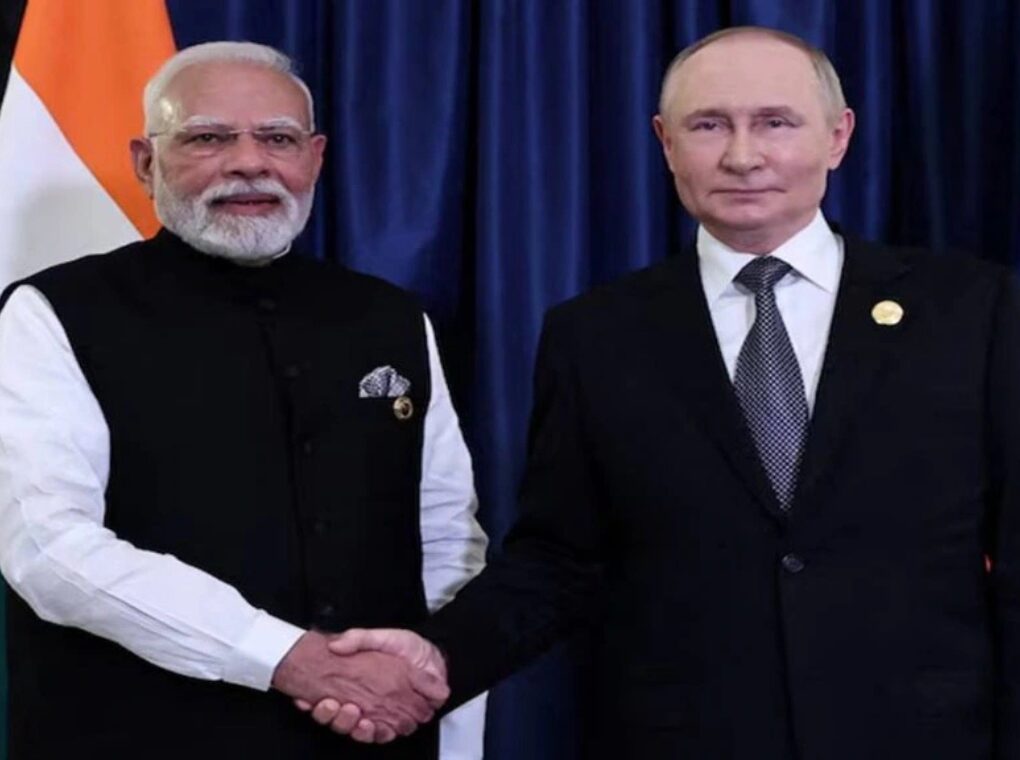
In the ever-shifting landscape of global geopolitics, accusations of hypocrisy are common — but rarely does a world leader articulate them as directly as Vladimir Putin did this week. On the eve of his two-day state visit to India, the Russian president delivered a pointed rebuke to U.S. President Donald Trump’s aggressive tariff strategy. And with one simple question, he pierced through layers of diplomatic rhetoric and exposed a glaring contradiction in Washington’s sanctions policy.
“If the United States has the right to buy our fuel, why shouldn’t India have the same privilege?”
Putin’s remark, made in an interview with India Today, was more than a defensive statement. It was a calculated strike at the heart of the U.S. argument that nations should cut economic ties with Moscow or face punitive consequences. His point was simple: the U.S. itself continues to import vital Russian energy supplies, even as it penalizes India and pressures Europe to stop doing the same.
This wasn’t a casual comment — it was a geopolitical mic drop.
America’s Radioactive Blind Spot
At the center of Putin’s critique lies a truth that Washington rarely acknowledges publicly: the United States remains heavily dependent on Russian uranium to fuel its nuclear power plants.
Despite sweeping sanctions and a public narrative aimed at isolating Moscow economically, Russia still accounted for nearly 25% of U.S. uranium imports in 2024, generating over $800 million in revenue. Projections for 2025 estimate that this figure could surpass $1.2 billion. Russia remains the world’s second-largest supplier of enriched uranium, and the U.S. nuclear sector depends on Russian low-enriched uranium for roughly 20% of its reactor fuel needs.
Even a 2024 congressional ban on Russian uranium is riddled with waivers and grace periods. It doesn’t fully activate until 2028, and exemptions allow continued purchases through 2027. Energy companies have argued that abruptly cutting off Russia would compromise U.S. energy security. Washington agreed.
In other words, the U.S. is still buying the very fuel it criticizes others for purchasing — another case of do as I say, not as I do.
India Refuses to Bow: Oil, Tariffs, and Economic Self-Interest
India’s growing reliance on discounted Russian crude has become a point of friction with the United States, particularly under the Trump administration. Before the Ukraine conflict, Russia supplied barely 1–2% of India’s oil. Today, that number stands near 35%, thanks to deep discounts that help India keep inflation in check and energy affordable for 1.4 billion people.
This, however, prompted a fierce response from Washington. In August 2025, Trump imposed 50% tariffs on a wide range of Indian goods, explicitly linking the penalty to India’s continued purchase of Russian oil. The message was clear: comply with U.S. sanctions or pay the price.
But unlike Europe, India didn’t back down.
And the results speak for themselves.
India’s quarterly GDP still surged by 8.2%, making it one of the fastest-growing major economies in the world — despite the tariff shock. New Delhi made it clear that its energy policies would be dictated by national interest, not geopolitical pressure.
Putin seized on this moment to highlight Washington’s inconsistency. If the U.S. continues to purchase Russian nuclear fuel for its own security, why should it punish India for sourcing affordable energy?
Europe: The Biggest Casualty of America’s Energy Strategy
While India and China hold firm, Europe remains the region most deeply entangled in America’s sanctions-driven energy push. Under intense U.S. pressure, the European Union slashed its dependence on cheap Russian pipeline gas — a move framed as moral and strategic, yet one that severely damaged Europe’s own economic stability.
The consequences have been staggering: Soaring energy prices, Factory closures in Germany and Eastern Europe, spiraling inflation and cost-of-living crises, and A sharp decline in competitiveness for European industry.
As critics increasingly point out, Europe cut off its own energy lifeline under the moral banner of sanctions, only to replace Russian gas with far more expensive U.S. LNG. Many economists describe it as Europe “cutting its own leg while holding the crutches sold by America.”
European leaders like Ursula von der Leyen pushed these policies strongly, often without presenting sustainable alternatives to their citizens. Meanwhile, Russia quickly rerouted its energy exports to Asia, Africa, and the Middle East — softening the financial blow.
The irony is hard to miss: the countries that complied with U.S. pressure suffered the most. The countries that resisted thrived.
Tariffs, Markets, and the Real American Agenda
Putin’s remarks also highlight a deeper truth: U.S. sanctions and tariffs are not solely motivated by the Ukraine conflict or democratic values. Many analysts argue that the real drivers are far more pragmatic:
1. Protecting U.S. energy exports
Cheap Russian energy threatens America’s position in global oil and LNG markets.
2. Supporting Gulf allies like Saudi Arabia
Russian discounts undercut OPEC pricing strategies.
3. Maintaining global leverage
By controlling who can buy energy from whom, the U.S. sustains its geopolitical dominance.
India and China understand this. Europe pretends not to. Putin merely said it out loud.
India–Russia Ties: Defying Pressure, Redefining Balance
Putin’s December 2025 visit to New Delhi underscores the resilience of the India–Russia partnership. Despite Western pressure, both nations remain committed to strengthening ties. Key priorities include:
Expanding bilateral trade to $100 billion by 2030, Joint defense manufacturing, Nuclear energy cooperation, the Chennai–Vladivostok maritime corridor, and Technology and space collaboration
This is not only a commercial partnership — it is a geopolitical statement. It signals that sovereign nations will not be coerced into abandoning long-standing alliances.
A Moment of Geopolitical Clarity
With one sharp question, Putin exposed what many nations have quietly observed: that American sanctions often serve American interests, not global justice. The U.S. continues to buy Russian fuel while telling others not to. Europe followed the rules and paid the price. India refused and prospered.
The world is changing, and the old order of unquestioned compliance is fading.
Putin merely held up a mirror.
And the reflection is uncomfortable for Washington.