
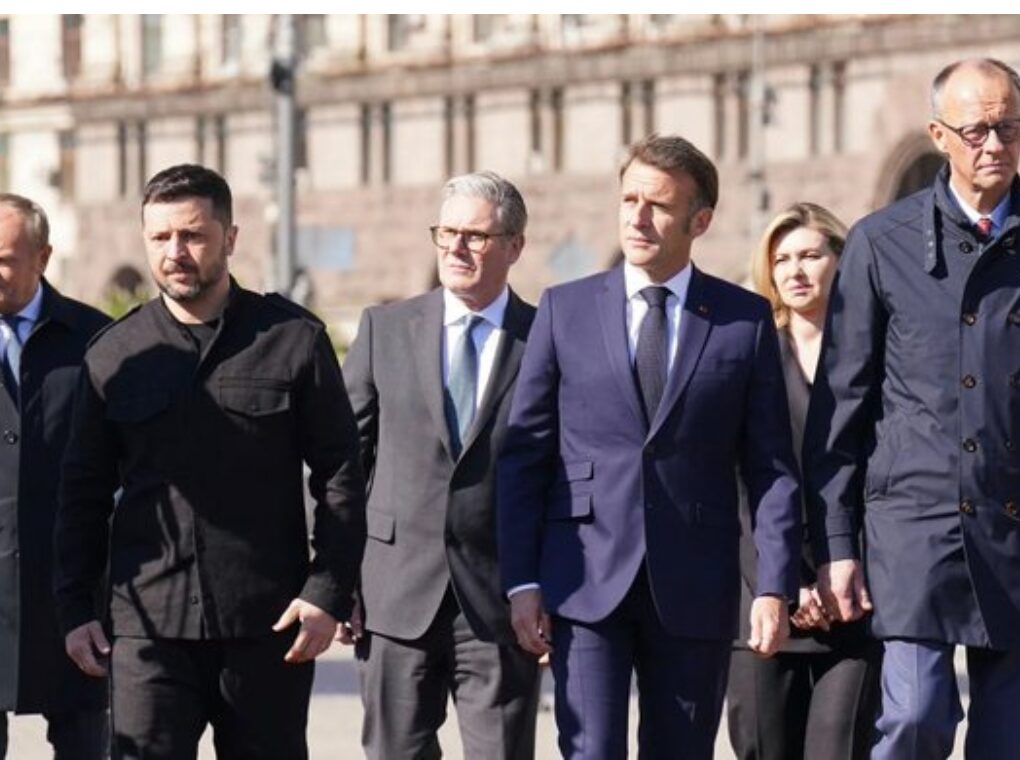
A leaked confidential conference call among senior European leaders and Ukrainian President Volodymyr Zelenskyy has exposed deep anxiety within Europe about the future of the Ukraine war and the stability of the Western alliance.
The transcript, obtained by Der Spiegel, shows EU leaders privately warning that the United States under President Donald Trump may strike its own deal with Russia — potentially sidelining Europe and forcing Kyiv into territorial concessions.
The call, held on December 1 during Zelenskyy’s visit to Paris, included French President Emmanuel Macron, German Chancellor Friedrich Merz, NATO Secretary General Mark Rutte, Finnish President Alexander Stubb, European Commission President Ursula von der Leyen, Italian Prime Minister Giorgia Meloni, Polish Prime Minister Donald Tusk, and UK Prime Minister Keir Starmer.
Leaders Voice Concern Over Trump’s Approach
The single focus of the discussion was Trump’s accelerated push to end the conflict within 100 days, led by his close associates Steve Witkoff and Jared Kushner, rather than traditional diplomatic channels. European leaders expressed concern that Washington may pursue a settlement aligning with Russia’s battlefield position rather than Kyiv’s stated objectives.
According to the transcript, Macron warned that the U.S. could “cut a deal” with Moscow that leaves Ukraine with limited security guarantees. Merz reportedly stated that Washington was “playing games” with both Europe and Ukraine, while Stubb urged that Zelenskyy not be “left alone with these guys.”
The tone of the call underscored a broader strategic worry: Europe is increasingly uncertain whether the United States remains committed to a long-term defense of Ukraine.
Europe’s Strategic Limitations Exposed
The leak highlights what European officials rarely acknowledge publicly — that the continent cannot sustain Ukraine’s war effort without Washington’s military, financial, and logistical support. The fear of losing U.S. backing has amplified as Trump signals interest in a quick end to the conflict, including a potential ceasefire and acceptance of Russia’s control over Crimea and parts of the Donbas.
European officials have reportedly viewed elements of Trump’s emerging 19-point proposal as overly favorable to Moscow, delaying Ukraine’s NATO ambitions and reflecting Russia’s current territorial gains.
Macron’s Parallel Outreach to China
Complicating the political landscape, Macron has been simultaneously engaged in high-level dialogue with China. During his recent state visit to Beijing, he advocated for a more “multipolar” world order and urged Europe to reduce its dependence on the United States — signaling a desire for greater strategic autonomy even as Europe remains reliant on Washington in the Ukraine conflict.
This dual positioning underscores Europe’s broader dilemma: its long-standing security dependence on the U.S. clashes with its growing desire for independent foreign-policy decision-making.
A Divided West
The leaked call also exposed internal fractures within the Western bloc. While Europe has largely aligned with the U.S. since the war began, leaders now appear divided between those seeking a firm stance against Russia and those fearing the economic and security consequences of an extended conflict.
For two years, European policymakers followed Washington’s lead on sanctions, arms deliveries, and NATO expansion. Yet EU economies have slowed, public fatigue is rising, and many governments are under pressure at home. Meanwhile, Russia has adapted economically more effectively than many Western analysts predicted.
According to analysts, the leak demonstrates that Europe fears losing influence not only to Moscow but also to Washington — especially if the U.S. moves ahead with a peace framework that excludes Europe from key decisions.
Trump’s Envoys and Parallel Negotiations
Trump’s envoys, Witkoff and Kushner, have reportedly held discussions in Moscow, Kyiv, and Washington as they seek to advance a ceasefire formula aimed at freezing the conflict. European leaders reportedly worry this would diminish their role in the peace process and cement Russia’s territorial gains.
Ukraine, meanwhile, is caught between competing pressures from its Western backers, Russia’s entrenched battlefield position, and Trump’s stated commitment to ending the war “quickly.”
Shifting Global Landscape
Beyond Europe, the leak signals wider geopolitical shifts. China sees an opportunity to strengthen its role in European affairs; India continues to position itself as a neutral mediator; and Russia remains confident that the diplomatic environment is moving in its favor.
The Western alliance, once unified around support for Ukraine, now appears strained. The transcript indicates that Europe no longer fully trusts Washington’s intentions, while the U.S. is increasingly unwilling to carry the burden of Europe’s security priorities.
A Turning Point for the Western Alliance
The leak marks a significant moment for transatlantic relations. It reveals a bloc grappling with strategic uncertainty, declining cohesion, and diverging interests at a critical stage of the war. With the U.S., Russia, and China each advancing their own agendas, Europe faces the challenge of redefining its role in a rapidly evolving global order.
How the continent responds — and whether it can present a united front — may influence not only the end of the Ukraine war but also the balance of power in the years ahead.