
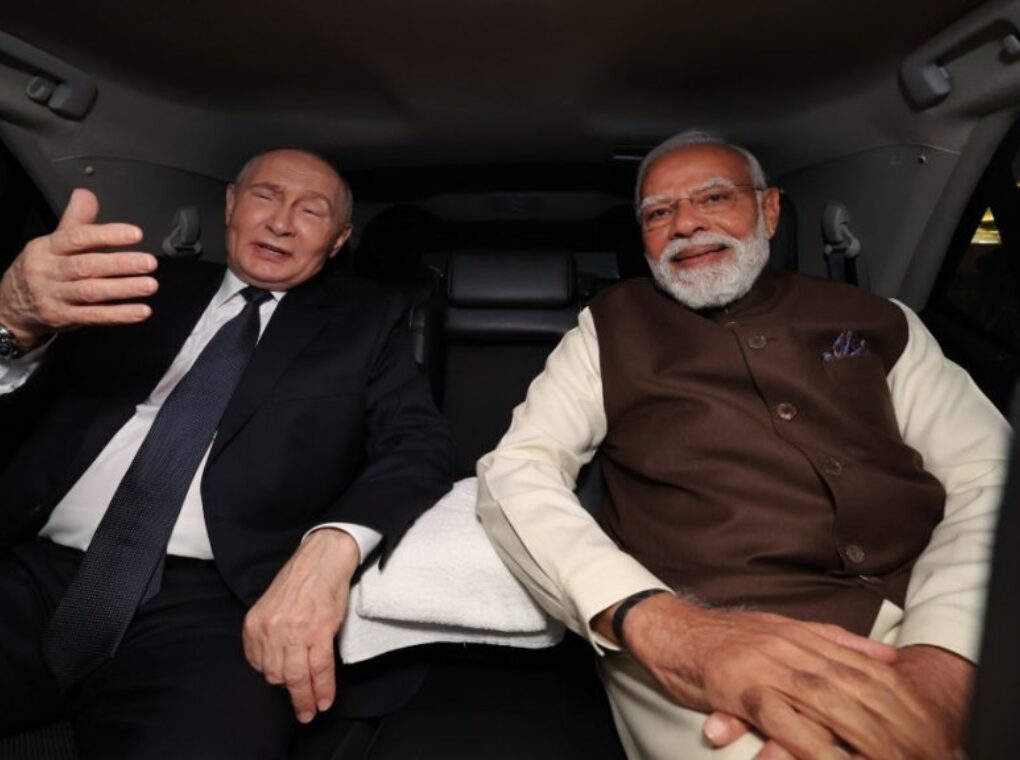
Russian President Vladimir Putin’s arrival in New Delhi for the 23rd India–Russia Annual Summit generated considerable attention, not only for the warm gestures between the two leaders but also for an unexpected diplomatic detail: the vehicle they travelled in. Instead of using his usual armoured Range Rover or Mercedes-Maybach, Prime Minister Narendra Modi accompanied Putin in a white Toyota Fortuner—an SUV far more modest than the typical VVIP fleet.
The choice immediately triggered a wave of speculation among analysts, diplomats, and social media users worldwide. Was this a strategic message to Western nations amid heightened geopolitical tensions, or was it simply a matter of practicality?
A Strategic Signal—or a Subtle One?
The Fortuner, though a Japanese brand, is assembled in India and widely used by Indian security agencies. Its selection has been interpreted by several experts as a quiet but deliberate message of strategic autonomy at a time when Europe and the U.S. continue to pressure India over its energy and defence ties with Russia.
Using a non-European vehicle helped avoid awkward optics. PM Modi’s Range Rover—manufactured in the UK—and the Mercedes-Maybach—German-built—come from countries that have imposed sweeping sanctions on Moscow and have been vocal supporters of Ukraine. With Putin in the car, a European brand could have carried unintended political symbolism.
Commentators, including defence analysts, described the Fortuner choice as “a message to the West,” while political figures hinted that “smart people will understand why.”
Practicality at the Core: The Seating Advantage
Officials familiar with the arrangements maintain that the decision was driven primarily by logistics. The Fortuner’s three-row seating configuration allowed both leaders and their interpreters to travel together—something Modi’s Range Rover cannot accommodate.
Interpreters had been seated in the SUV prior to the leaders boarding, and both Indian and Russian security teams cleared the Fortuner for use. The model is already part of SPG operations and is considered reliable, easily modifiable, and suitable for high-security movement.
Security and Neutrality
A more understated vehicle also offered operational advantages. The Fortuner is commonly deployed in Indian VVIP convoys, making it a familiar and less conspicuous choice. This reduces the predictability associated with high-profile luxury armoured cars.
Putin agreeing to travel in the Fortuner was also seen as a gesture of trust in India’s security apparatus—mirroring PM Modi’s earlier ride in Putin’s Aurus Senat during his 2025 Russia visit.
Boost to ‘Make in India’
Though Toyota is a Japanese brand, the Fortuner is assembled in Karnataka and is one of India’s most recognisable SUV models. Its presence at the centre of a major diplomatic moment also highlighted India’s manufacturing ecosystem and aligned with the government’s broader emphasis on domestic production.
A Symbolic Visual: The Fortuner Leads the Convoy
Perhaps the most striking image from the visit was the convoy formation: the white Fortuner carrying the two leaders at the front, followed by Modi’s Range Rover Sentinel and Putin’s Aurus Senat. The scene conveyed understated confidence—a departure from the heavily armoured, high-end vehicles typically associated with global summits.
Message or Convenience? Likely Both
While officials lean on the seating explanation, the broader context suggests a blend of practicality and symbolism. The Fortuner served the immediate logistical need, but it also reinforced India’s independent diplomatic positioning at a time of shifting global alignments.
In the end, a relatively ordinary SUV became an extraordinary diplomatic statement—showing how, in international politics, even the choice of a vehicle can reflect deeper currents in global strategy.