
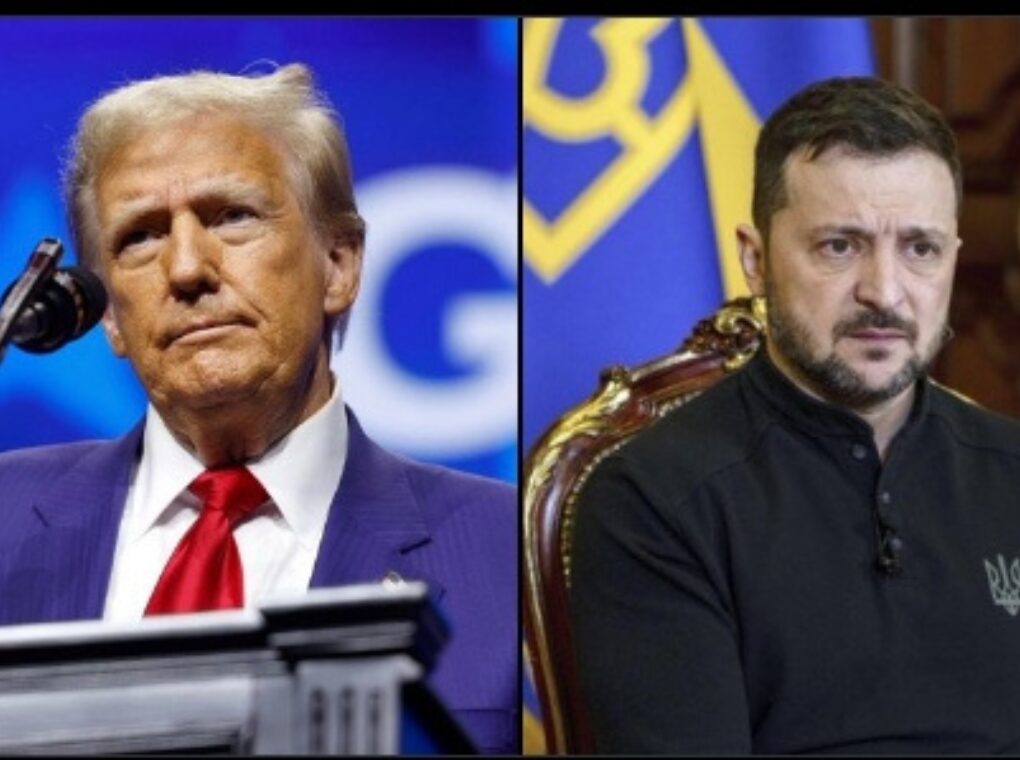
US President Donald Trump has voiced sharp frustration with Ukrainian President Volodymyr Zelensky, revealing that the Ukrainian leader has still not read Washington’s latest peace proposal aimed at ending the nearly four-year Russia-Ukraine war. The comments come amid intensified diplomatic efforts, corruption concerns in Kyiv, and mixed signals from Moscow.
Trump: “He Isn’t Ready”
Speaking to reporters at the Kennedy Center Honours, Trump said he was “a little bit disappointed” that Zelensky had not reviewed the freshly updated peace plan.
“Russia is, I believe, fine with it, but I’m not sure that Zelensky’s fine with it. His people love it, but he isn’t ready,”
Trump said.
The remark suggests growing irritation within the White House over Kyiv’s pace of engagement, even as US and Ukrainian teams wrapped up three days of talks in Florida aimed at narrowing differences.
Trump has long argued that the war is a “waste of US taxpayer money” and has repeatedly encouraged Kyiv to consider territorial concessions to speed up an end to the conflict.
Peace Plan Under Scrutiny
The US-brokered proposal has undergone several revisions after critics said earlier drafts were overly favourable to Moscow. Even as Trump claims Russia is “fine with it,” President Vladimir Putin has publicly dismissed parts of the plan as “unworkable.” Still, the Kremlin signalled optimism after the release of America’s updated National Security Strategy, calling it “largely aligned with our vision.”
The strategy calls for restoring “strategic stability” with Russia and ending the war as a core US foreign policy priority—messaging that Moscow welcomed.
Zelensky: Talks Are ‘Constructive but Not Easy’
President Zelensky, for his part, confirmed he received updates by phone from Ukrainian and American negotiators over the weekend. He described the discussions as “constructive, although not easy,” and reaffirmed that Ukraine “is determined to work in good faith” with the US to achieve a genuine peace.
Zelensky is also set to hold high-level discussions in London with UK Prime Minister Keir Starmer, French President Emmanuel Macron, and German Chancellor Friedrich Merz—an important European check-in as Washington pushes hard for a settlement.
Ukraine’s Internal Turmoil Adds Pressure
Adding to the complex diplomatic landscape, Kyiv continues to grapple with internal political strains. Andriy Yermak, a powerful presidential aide and key figure in the negotiation process, resigned after an anti-corruption raid on his home—an episode that amplified long-standing concerns about corruption in Ukraine.
The issue has not gone unnoticed in Washington. Critics, including Donald Trump Jr., have argued that American taxpayers are losing patience. Speaking at the Doha Forum, Trump Jr. said the US “may walk away” from Ukraine support if a long-term peace deal remains elusive. He described Ukraine as “far more corrupt than Russia” and claimed that “its rich fled while the peasant class fights.”
Deal ‘Really Close,’ Says US Envoy
Despite the challenges, outgoing US Ukraine envoy Keith Kellogg said the peace deal is “really close,” with only two major issues remaining:
The status of the Donbas region, which Russia claims to have annexed in 2022.
Control and safety of the Zaporizhzhia Nuclear Power Plant, occupied by Russian forces since the early months of the invasion.
Kellogg emphasised that these final sticking points represent the “last 10 metres” of a potential agreement.
Russia Steps Up Attacks Amid Talks
Even as diplomatic channels remain active, Russia continues its barrage of missiles, drones, and artillery across Ukraine. Over the weekend, strikes killed at least four civilians, hit critical infrastructure in Kremenchuk, and caused renewed power and water outages as winter approaches. Ukrainian officials warned that Russia is again trying to “weaponise the cold” by targeting the energy grid.
The coming days are likely to be crucial. With the US signaling impatience, Russia cautiously receptive, Zelensky under pressure both abroad and at home, and European leaders entering the conversation, the future of the war—and the credibility of Washington’s proposal—hangs in the balance.
Whether Zelensky’s hesitation reflects strategic caution, political constraints, or disagreement with US terms remains unclear. But one thing is certain: as winter deepens and negotiations intensify, global scrutiny is mounting on Kyiv and Washington to find a breakthrough.