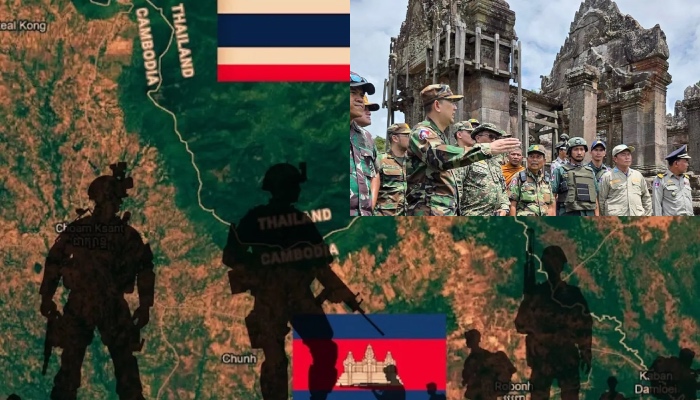
Fighting has once again erupted along the long-disputed border between Thailand and Cambodia, ending months of uneasy calm that followed a US-backed ceasefire earlier this year. The fresh clashes have led to civilian deaths, military casualties, and the displacement of more than 140,000 people, raising concerns of a wider regional escalation.
The renewed violence highlights how fragile the ceasefire was and how unresolved historical disputes continue to fuel hostility between the two Southeast Asian neighbors.
A Dispute Rooted in Colonial-Era Borders
The conflict traces its roots back over a century. The two countries share a border stretching more than 800 kilometres, with several areas still unresolved.
Much of the disagreement stems from a 1907 map drawn during French colonial rule in Cambodia. Thailand argues the map is inaccurate and unfairly favored Cambodia.
Tensions deepened after a 1962 International Court of Justice (ICJ) ruling, which awarded sovereignty over contested land to Cambodia. The ruling was reaffirmed in 2013, angering many in Thailand. These disputes led to armed clashes between 2008 and 2011 and continue to shape relations today.
Fresh Clashes Break Out After Months of Tension
Heavy fighting broke out on Monday in disputed border areas, marking the most intense violence since the ceasefire agreed upon in July. While both sides blame each other for starting the conflict, Thailand launched airstrikes along the border as ground fighting spread across multiple flashpoints.
Jets, tanks, artillery, and drones were reportedly used, forcing large-scale evacuations from villages near the frontier. Civilians on both sides scrambled to reach shelters as explosions echoed across the border region.
This renewed conflict comes just months after the two countries fought for five days in July, resulting in dozens of deaths and forcing tens of thousands to flee their homes.
A Ceasefire Backed by Trump That Never Held
The July ceasefire was brokered after Malaysia pushed both sides to the negotiating table, with US President Donald Trump playing a key role by leveraging America’s importance as a trade partner to both countries. Washington threatened to withhold trade privileges if fighting continued, pressuring Bangkok and Phnom Penh to agree to stop hostilities.
Trump later pointed to the ceasefire as an example of successful US diplomacy.
However, the peace agreement proved weak. A more detailed follow-up deal signed in October called for:
- Joint de-mining operations
- Withdrawal of heavy military equipment from the border
- Confidence-building measures
- An end to hostile rhetoric and misinformation
None of these steps were fully implemented. Both sides continued a propaganda war, and occasional skirmishes broke out despite the agreement.
Prisoners, Land Mines, and Rising Distrust
One major point of contention has been 18 Cambodian soldiers who remain in Thai custody. Cambodia has demanded their release, accusing Thailand of violating the spirit of the ceasefire.
Thailand, meanwhile, accuses Cambodia of laying new land mines in disputed territories, claiming these explosions injured Thai soldiers. Cambodia denies the allegation, stating that the mines are remnants of its decades-long civil war, which officially ended in 1999.
Thailand has used the failure to implement ceasefire terms as justification for delaying the release of Cambodian prisoners, despite the agreement urging their release as a sign of goodwill.
Deaths, Temple Damage, and Diplomatic Fallout
Cambodia has accused Thailand of destroying the ancient Prasat Ta Krabey temple in Oddar Meanchey province during the latest attacks, calling the strike an act of “profound immorality.”
According to Cambodian officials, nine civilians have been killed and 20 injured so far. Thailand reports three soldiers killed and 68 injured.
More than 30 foreign diplomats and UN representatives attended an emergency briefing with Cambodian leaders as international concern grows.
Thailand’s foreign minister told Al Jazeera that there was currently “no space for diplomacy,” insisting that Cambodia must change its behavior before peace is possible. Cambodia, however, says it remains open to immediate bilateral talks.
International Community Calls for Restraint
As fighting intensifies, international voices have stepped in. China urged both nations to exercise restraint, while France and Australia condemned the violence and called for an immediate ceasefire.
Despite these appeals, fighting on the ground continues, worsening the humanitarian situation.
Civilians Caught in the Crossfire
The human cost of the conflict is mounting. Bangkok reports that over 125,000 people have been evacuated to nearly 500 temporary shelters in Thai border provinces. Cambodia says more than 21,000 civilians have fled from three border regions.
“I want this to end already,” said Samlee Tahan, a 56-year-old Thai farmer who stayed behind in Surin province to protect her livestock. “It has been prolonged for the second time.”
On the Cambodian side, Poan Hay, 55, said this was the fourth time she had been forced to flee her home. “I don’t know when I can return,” she said. “I want the international community to help Cambodia and tell Thai soldiers to stop.”
An Uncertain Path Ahead
With heavy weapons back in use and diplomacy stalled, the risk of prolonged conflict remains high. The collapse of the ceasefire underscores how unresolved historical grievances, mutual distrust, and failed agreements continue to endanger peace along the Thailand–Cambodia border.
For now, civilians remain the biggest victims — waiting, once again, for fighting to stop and for stability to return.