Tens of thousands of protesters flooding Hungary’s capital, chanting “Resign!” beneath torchlit bridges and historic castle walls, have once again placed Prime Minister Viktor Orbán at the center of Europe’s most polarizing political confrontation. While the demonstrations are officially driven by outrage over a child abuse scandal within Hungary’s state care system, the unrest has rapidly evolved into something far larger — a referendum on sovereignty, European Union authority, and Orbán’s defiant role within the bloc.
At stake is not merely Orbán’s political future, but Hungary’s direction in an increasingly centralized European Union struggling to maintain unity amid war, migration pressures, and internal dissent.
The Immediate Spark: Scandal and Public Anger
The protests were triggered by disturbing revelations involving abuse in state-run juvenile institutions. Leaked footage and reports exposed mistreatment of minors, reigniting public fury already heightened by last year’s resignation of President Katalin Novák, an Orbán ally, following her controversial pardon linked to a child abuse cover-up.
Opposition leader Péter Magyar seized on the scandal, framing it as proof of systemic corruption and moral collapse under Orbán’s long rule. Leading mass demonstrations across Budapest, Magyar positioned himself as the face of a political reckoning, declaring that the government had failed in its most basic duty — protecting children.
Public outrage was genuine and widespread. Yet the scale, timing, and political momentum of the protests have fueled fierce debate over whether the movement is purely domestic or part of a broader political contest extending beyond Hungary’s borders.
Péter Magyar: Challenger or Vehicle for Change?
Magyar is a complex figure. A former insider within Orbán’s Fidesz ecosystem, he once benefited from the very system he now seeks to dismantle. His rapid rise has unsettled Hungary’s political establishment, with some polls suggesting his movement could challenge Fidesz’s dominance ahead of the 2026 parliamentary elections.
Western media has portrayed Magyar as a reformist alternative capable of restoring Hungary’s relationship with Brussels and unlocking billions of euros in frozen EU funds. Orbán’s supporters, however, view him differently — as a politically convenient figure emerging at a moment when European institutions have grown increasingly frustrated with Hungary’s resistance.
The question is not whether Magyar represents change, but what kind of change — and for whom.
Orbán’s Long War with Brussels
Viktor Orbán’s conflict with the European Union did not begin with the current protests. For more than a decade, he has openly challenged EU orthodoxy on migration, culture, governance, and foreign policy.
He rejected mandatory migrant relocation quotas and built fortified borders, arguing that Hungary has the right to protect its demographic and cultural identity. For this, Hungary now faces daily EU fines.
Orbán has also resisted EU pressure on social policy and media regulation, framing Brussels’ interventions as ideological overreach rather than legitimate oversight.
The sharpest clash, however, has come over Ukraine.
Orbán vetoed or delayed EU aid packages to Kyiv, refused to support deeper military escalation, and openly argued that Europe must accept “battlefield realities.” Hungary has maintained Russian energy imports, refusing to sever gas supplies despite intense EU pressure.
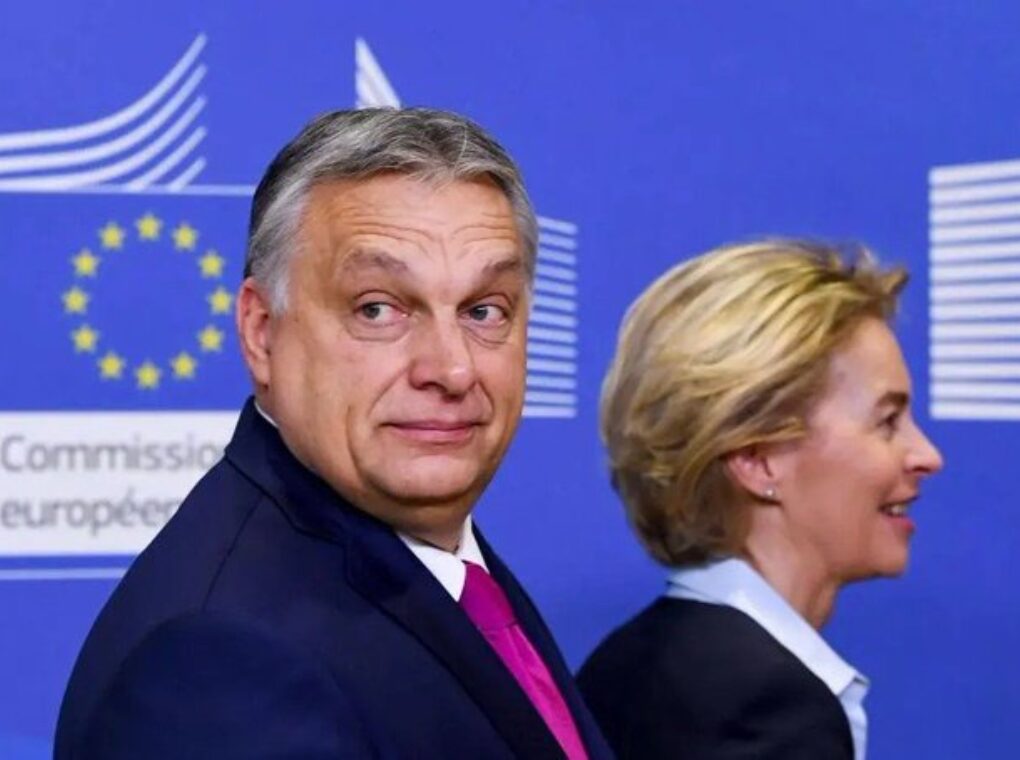
These positions have isolated Hungary within the bloc and placed Orbán in direct opposition to European Commission President Ursula von der Leyen and leaders such as Germany’s Friedrich Merz and Poland’s Donald Tusk.
Sanctions, Frozen Funds, and Political Pressure
The consequences have been tangible.
Billions of euros in EU cohesion and recovery funds remain frozen under rule-of-law mechanisms.
Hungary faces legal proceedings, financial penalties, and persistent political scrutiny.
Orbán argues these measures are not about democracy but discipline — punishment for refusing to conform.
“This is not cooperation; this is coercion,” he has repeatedly stated, framing Hungary as a test case for how far Brussels is willing to go against dissenting member states.
Geopolitics and Uncomfortable Alliances
Orbán’s international relationships have further inflamed tensions.
He maintains pragmatic ties with Russia, insisting that energy security and diplomacy cannot be sacrificed to ideological absolutism. At the same time, he has cultivated a close relationship with Donald Trump, praising the former and possibly future U.S. president’s “realist” approach to foreign policy and opposition to endless wars.
To Orbán’s critics, these ties place Hungary on the wrong side of history.
To his supporters, they demonstrate strategic realism in a fractured world.
Either way, Orbán’s positioning undermines EU efforts to present a unified front — and that makes him uniquely threatening to Brussels’ authority.
The NGO Debate and Allegations of External Influence
A particularly contentious aspect of the protests concerns the role of NGOs and transnational networks. Several opposition-linked organizations receive funding from EU-affiliated or global institutions that openly advocate governance reform across Central and Eastern Europe.
Orbán and his allies argue this creates an uneven political battlefield, where domestic politics are influenced by external actors with clear ideological preferences. They cite similar protest-driven political shifts in Romania, Bulgaria, Poland, and Slovakia as evidence of a recurring pattern.
Opposition leaders strongly reject these accusations, insisting the demonstrations reflect genuine public frustration and not foreign orchestration.
The reality, analysts suggest, likely lies in a complex overlap of grassroots anger and geopolitical interest.
Is Orbán Really Finished?
Despite the scale of the protests, Orbán’s political position remains resilient.
His support in rural Hungary remains strong.
Hungary continues to rank among Europe’s safest countries.
Energy prices remain comparatively stable, and unemployment is low.
Orbán has acknowledged institutional failures but rejects the idea that surrendering sovereignty is the solution. He continues to frame himself as the defender of Hungarian independence in an EU drifting toward centralized control.
A Battle Bigger Than Budapest
What is unfolding in Hungary is not simply a domestic crisis. It is a microcosm of Europe’s broader struggle — between national sovereignty and supranational authority, between realism and ideological alignment.
The streets of Budapest may burn with protest, but the final verdict will be delivered at the ballot box.
Whether Viktor Orbán survives this storm or not, one thing is clear:
Hungary has become the frontline of Europe’s internal power struggle — and the outcome will shape the future of the European Union itself.