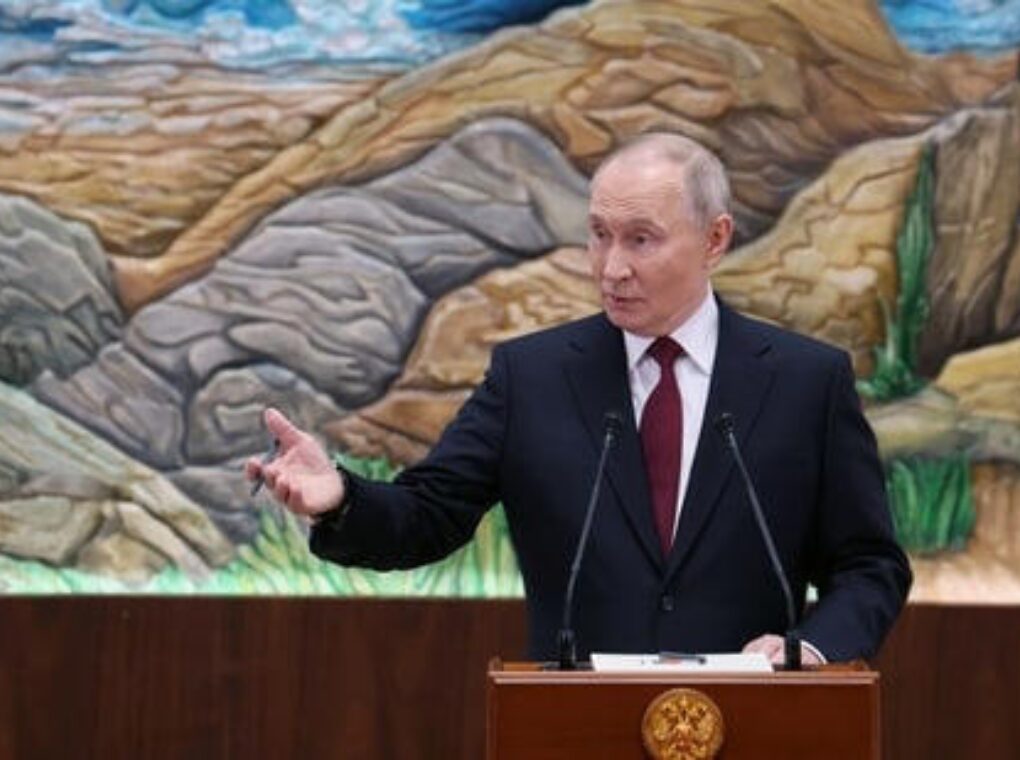
Russian President Vladimir Putin on Wednesday delivered one of his toughest warnings yet to Ukraine and its Western backers, declaring that Moscow will pursue the seizure of what it calls Russia’s “historical lands” by military force if peace talks do not proceed on Russia’s terms.
Speaking at the annual expanded meeting of Russia’s Defense Ministry Board, Putin said Moscow still prefers a diplomatic resolution but framed continued fighting as inevitable if negotiations fail. “We would prefer to eliminate the root causes of the conflict through diplomacy,” he said. “But if the opposing side and its foreign patrons refuse to engage in substantive discussions, Russia will achieve the liberation of its historical lands through military means.”
The remarks underscore the Kremlin’s uncompromising position nearly four years after Russia launched its full-scale invasion of Ukraine in February 2022 and come amid renewed U.S.-led efforts to explore a negotiated settlement.
Battlefield Claims and Military Momentum
Putin praised Russian forces for maintaining what he described as the “strategic initiative” along the entire front line. Defense Minister Andrei Belousov told the gathering that Russian troops had captured or “liberated” more than 300 settlements in 2025 alone, a figure he said exceeded gains made in the previous year by roughly one-third.
Belousov also claimed Ukrainian forces had suffered nearly 500,000 casualties this year and lost about one-third of their combat potential. These figures could not be independently verified and are disputed by Kyiv and Western officials.
The Russian president used the address to highlight ongoing military modernization, including the deployment of the nuclear-capable Oreshnik missile system, which he said would enter combat service before the end of the year. Putin also reiterated plans to expand a “buffer security zone” along Russia’s border with Ukraine, suggesting further territorial advances could be pursued under that rationale.
“Historical Lands” and Territorial Demands
Putin’s repeated use of the term “historical lands” reflects a long-standing Kremlin narrative that parts of Ukraine are inherently Russian territory. Moscow applies the label to Crimea, annexed in 2014, as well as parts of the Donetsk, Luhansk, Zaporizhzhia, and Kherson regions, which Russia claims to have annexed in 2022 following widely condemned referendums.
Ukraine, the United States, and European allies reject these claims as revisionist and illegal under international law, insisting that any peace settlement must respect Ukraine’s sovereignty and territorial integrity.
Putin has consistently demanded that Ukraine withdraw entirely from the four partially occupied regions, in addition to recognizing Russia’s control of Crimea, as preconditions for any peace agreement—terms Kyiv has repeatedly ruled out.
Diplomatic Efforts and Sharp Rhetoric
The speech comes as diplomatic activity intensifies ahead of the transition to a new U.S. administration. Ukrainian President Volodymyr Zelenskyy recently described a draft peace proposal discussed with U.S. envoys as “very workable,” though he acknowledged that territorial issues remain the most difficult obstacle.
Putin, however, offered little indication of flexibility. In a pointed aside, he mocked European leaders, calling them “little pigs” or “young pigs,” and accused them of stoking hysteria about a possible Russian attack on NATO while pursuing policies aimed at Russia’s strategic defeat. By contrast, he suggested early contacts with the incoming U.S. leadership had been “constructive.”
Western officials and analysts view the remarks as signaling that Moscow is preparing for prolonged conflict if its demands are not met. Zelenskyy has warned that Russia’s concept of “historical lands” could extend beyond Ukraine, posing broader risks to European security.
Implications for Peace Prospects
Putin’s address reinforces the gap between Russian and Ukrainian positions at a critical moment for diplomacy. While Washington and European capitals continue to push for talks, they have also stressed that Ukraine cannot be pressured into territorial concessions.
As the war grinds on with heavy losses on both sides, Putin’s warning appears aimed at multiple audiences: bolstering domestic support, pressuring Kyiv and its allies, and drawing a firm line for negotiators. Whether renewed diplomatic efforts can bridge these positions remains uncertain, but the Kremlin’s message was clear—Russia sees further territorial gains as unavoidable if its terms are rejected.