
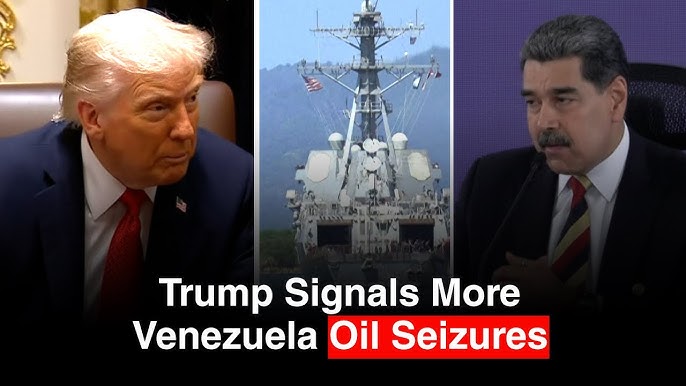
Venezuela’s strong reaction to US President Donald Trump’s latest move has once again exposed Washington’s global economic and foreign policy. Trump’s announcement of what he called “a total and complete blockade of all sanctioned oil tankers going into, and out of, Venezuela“ is not just another sanctions episode. It is a clear escalation that raises serious questions about sovereignty, international law, and the true meaning of “free and fair trade.”
Its not about the Drugs Its about the Oil
The latest statements from President Trump clearly show that it has never been about drugs or cartels; rather, it was about taking over the oil resources of Venezuela. It has never been about the Venezuelan President Maduro. It’s because Nicolas Maduro denied the US demands to hand over the national resources to the US, and hence, Trump wants him out.
The recent Nobel Peace Prize fiasco, where Venezuelan opposition leader Maria Corina Machado received the Nobel Peace Prize, was also part of the game to strengthen her internationally in order to put down Venezuelan President Maduro.
Let’s understand this unfolding geopolitical event through the lens of the Petro-dollar dominance of the US. But before that, let’s look at the events that have followed the Iranian oil tanker seizure in the Caribbean.
The War of Words Between Venezuela and the US
In a Truth Social post, Trump claimed Venezuela is now “completely surrounded by the largest naval force ever assembled in South American history“ and ordered the seizure of all sanctioned oil tankers entering or leaving the country. For Caracas, this was not a routine diplomatic dispute. It was read as an open declaration of economic warfare.
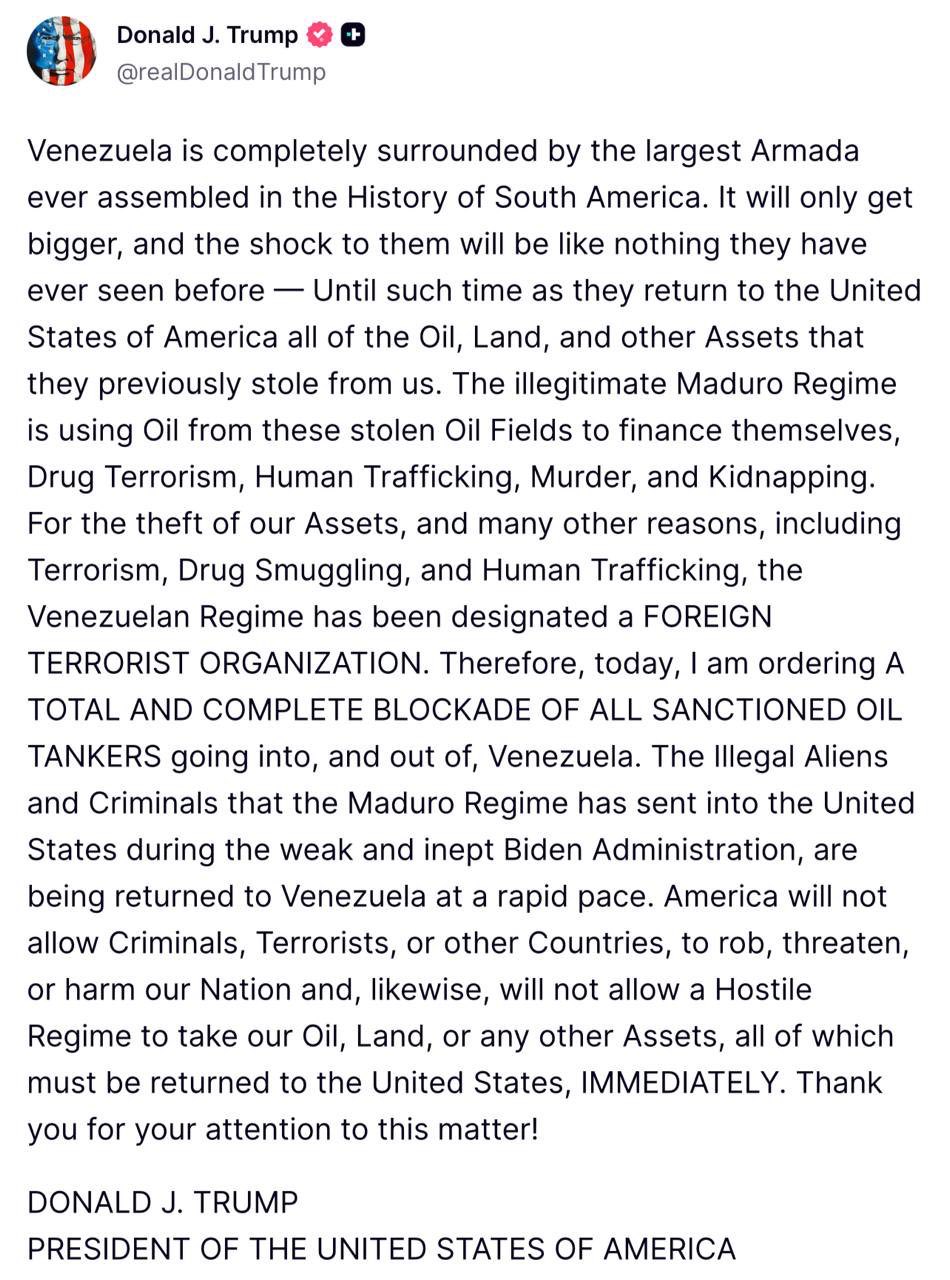

Venezuelan Vice President Delcy Rodríguez responded sharply, saying Trump’s words revealed the “true intention“ of the US “to take over the oil, land, and minerals of Venezuela.“ She accused the US of using “interventionist and colonialist“ rhetoric and warned that the US president was behaving as if Venezuela’s natural wealth belonged to him.
Venezuelan Vice President Delcy #Rodriguez said Tuesday that any attempts by the United States to block sanctioned #oil tankers entering or leaving Venezuela constitutes a violation of international law. #Venezuela #US https://t.co/xfeX82SR4s https://t.co/hHLnw7LbVh pic.twitter.com/CNyo6hx8Vt
— China Daily (@ChinaDaily) December 17, 2025
“Through his social media statements, President Trump assumes that Venezuela’s oil, land, and mineral wealth belong to him,“ the official statement said. “On that basis, he seeks to impose a naval military blockade with the objective of robbing the riches that belong to our homeland.”
This language may sound harsh, but it reflects a long-standing fear in many parts of the Global South: that economic pressure is being used as a modern tool of control. Venezuela rejected Trump’s claim that it had “stolen“ assets from Washington and said the blockade violated international law, free trade, and freedom of navigation.
Venezuela Is Not an Isolated Case
What makes this situation more troubling is that Venezuela is not an isolated case. The US has consistently used sanctions and pressure to control global energy flows. Countries have been openly warned not to buy Russian oil. Iran has faced decades of crushing sanctions on its energy sector. Now Venezuela, home to the world’s largest proven oil reserves, finds itself under what it calls a naval military blockade.
When seen together, a pattern becomes difficult to ignore.
On one hand, the US presents itself as the global defender of “free and fair trade.“ On the other, it blocks oil tankers, imposes sanctions, and threatens countries that trade outside its approval. This contradiction weakens America’s moral argument on the global stage.
Venezuela’s government said it would exercise its rights under international law, its constitution, and the UN Charter, reaffirming its sovereignty over natural resources and its right to free navigation and commerce. “Venezuela will never again be a colony of an empire or any foreign power,“ the statement said.
Geopolitics of Energy
The broader issue here goes beyond Venezuela. It is about control of the global energy system and the dominance of the petrodollar. By restricting Russian oil, sanctioning Iran, and now pressuring Venezuela, the US is not merely pursuing national security. It is trying to monopolize energy markets and maintain the central role of the dollar in global oil trade.
It is also playing a game, where the US wants its oil-rich ally nations to sell and keep control over the energy trade, especially the oil.
Oil is power. Whoever controls oil flows controls currencies, alliances, and economic stability. Allowing countries to freely sell oil outside US influence threatens that system. That is why sanctions are not only about punishment; they are about control.
Venezuelan Vice-President Delcy Rodríguez described Washington’s actions as part of a “gigantic campaign of lies and manipulation“ aimed at justifying the appropriation of Venezuela’s natural resources. She argued that regardless of which party is in power in Washington, the goal remains the same: economic and political dominance.
Free trade Is Not At All Free
The US military actions in the Caribbean have further fueled tensions. Since September, more than 80 people have reportedly been killed in attacks on at least 23 cartel boats. Trump claimed these boats were used by the Venezuelan government to “flood“ America with narcotics.
Venezuela has denied these allegations, calling them part of a regime change strategy designed to weaken the state and plunder its resources.
The danger of such policies is that they normalize blockades and force as tools of economic policy. If “free trade“ only applies to countries that follow Washington’s rules, then it is not free at all.