
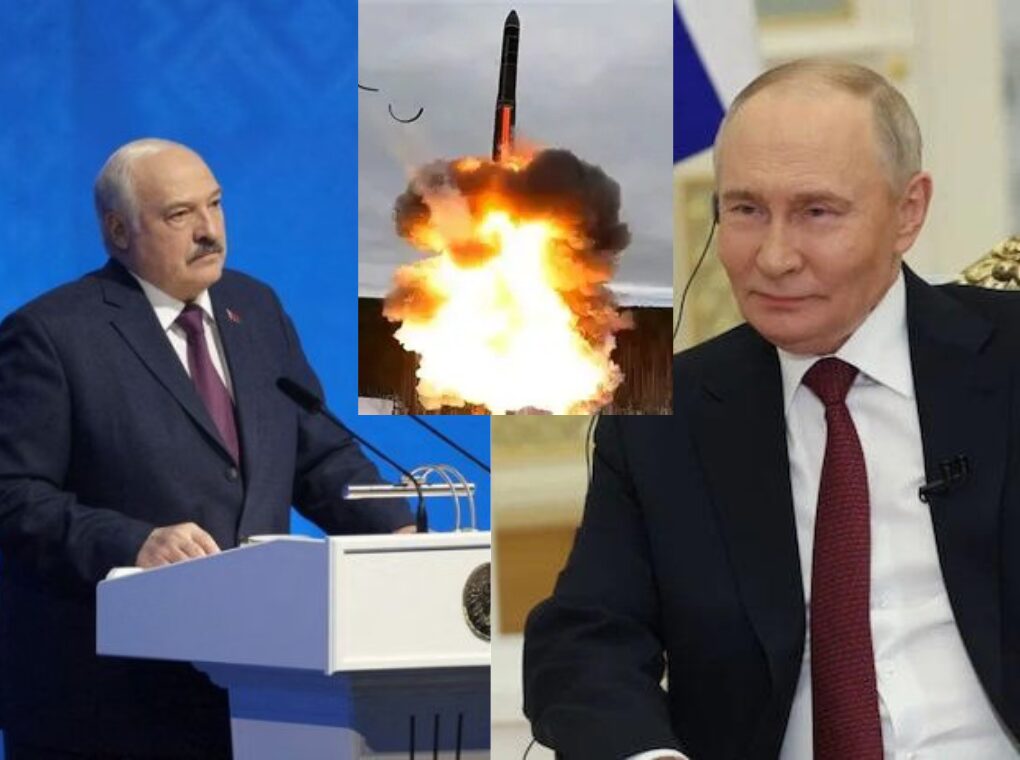
On December 18, 2025, Europe confronted a stark escalation in regional tensions when Belarusian President Alexander Lukashenko announced that Russia had deployed its advanced nuclear-capable Oreshnik intermediate-range ballistic missile (IRBM) system to Belarus.
The system, which arrived in the country the previous day, has now entered combat duty, placing major European capitals within rapid strike range and compressing NATO’s response windows dramatically.
This development, confirmed by Lukashenko during an address to the nation’s parliament, marks a significant shift in the strategic landscape amid ongoing efforts to negotiate an end to the Ukraine conflict.
Understanding the Oreshnik Missile
The Oreshnik—Russian for “hazelnut tree”—is a sophisticated intermediate-range ballistic missile with a reported range of 500 to 5,500 kilometers, falling into a category previously restricted under the Intermediate-Range Nuclear Forces (INF) Treaty, which the U.S. and Russia abandoned in 2019.
Key features, as described by Russian officials, include:
Capability to carry both nuclear and conventional warheads
Employment of multiple independently targetable re-entry vehicles (MIRVs)
Hypersonic speeds reaching up to Mach 10
Advanced design makes it highly resistant to interception
Russia first combat-tested a conventional variant in November 2024 against a Ukrainian military facility. President Vladimir Putin has claimed that a salvo of Oreshnik missiles could deliver destruction comparable to a nuclear strike, even in a non-nuclear configuration. Currently, NATO lacks a direct counterpart with similar speed and evasion capabilities.
Why Deployment to Belarus Matters ?
Positioning the Oreshnik in Belarus transforms the geopolitical calculus by bringing launch sites closer to NATO borders. From central Belarus, estimated flight times include:
Under 2 minutes to Vilnius (Lithuania)
A few minutes to Warsaw (Poland)
Less than 20 minutes to Berlin or Brussels
These shortened timelines severely limit warning and decision-making periods for NATO defenses. Lukashenko has emphasized the system’s mobility, noting it will not remain fixed in one location, complicating tracking efforts. While Russia retains operational control, prior agreements permit Belarusian input on target selection, particularly for proximate threats, allowing for heavier payloads.
This move builds on Russia’s 2023 deployment of tactical nuclear weapons to Belarus, effectively repositioning the country from a buffer zone to a forward staging area for strategic deterrence.
Reactions Across Europe and Ukraine
Ukrainian officials and media expressed immediate alarm, highlighting potential strike times to Kyiv (under 2 minutes) and other cities. Western leaders have responded cautiously in public statements, though sources indicate private concerns over reduced reaction times.
Belarusian opposition voices have criticized the deployment, warning it makes the country a prime target in any potential NATO-Russia confrontation. For European security planners, the move necessitates urgent reviews of missile defenses, nuclear doctrines, and crisis escalation protocols.
Timing Amid Fragile Peace Efforts
The deployment coincides with renewed U.S.-led diplomatic initiatives under President Donald Trump to resolve the Ukraine war, now in its fourth year. Core disputes persist: Russia’s demand to retain controlled territories, Ukraine’s rejection of concessions, and calls for Ukrainian neutrality.
On December 17, Putin reiterated that failure in diplomacy would lead Russia to pursue its objectives militarily. The Oreshnik’s activation in Belarus underscores this stance, serving as leverage in negotiations.
From Moscow’s perspective, the deployment is a defensive response to perceived NATO encirclement, ongoing expansion, and the use of Ukraine as a proxy. Russian officials frame it as a necessary counter to Western actions that threaten Russia’s security.
A Pivotal Moment for European Security
The placement of Oreshnik missiles on combat duty in Belarus represents one of the most precarious developments in European security since the Cold War era. It introduces a weapon system capable of overwhelming defenses, minimizing response times, and compelling concessions through heightened risk.
The path forward hinges on diplomatic outcomes: serious negotiations could de-escalate tensions, but delays or breakdowns risk further escalation. With the Oreshnik now operational, Moscow’s signal is clear—engage meaningfully or face intensified confrontation.
Europe’s leaders must now weigh options: strengthened deterrence, renewed dialogue, or the specter of deeper instability. The window for averting disaster appears narrower than ever.