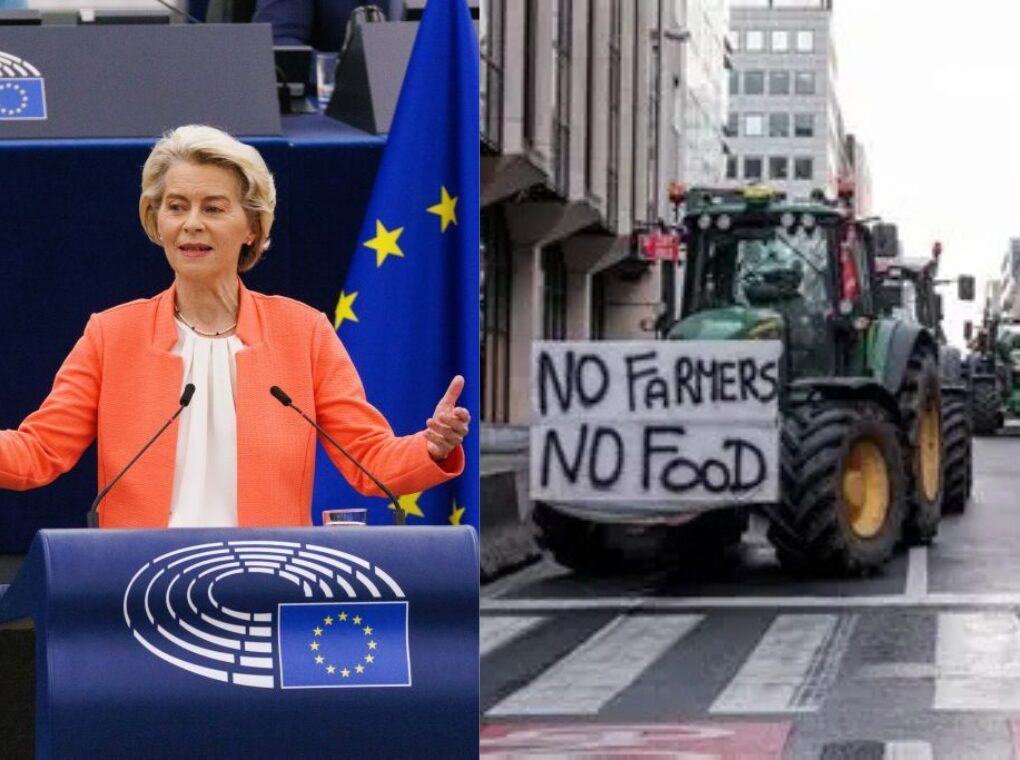
Europe is witnessing its largest wave of farmer unrest since the 1990s, and at the center of this growing confrontation stands European Commission President Ursula von der Leyen. What began as scattered protests has evolved into a continent-wide backlash, with farmers blocking roads, surrounding EU institutions with tractors, and openly accusing Brussels of sacrificing agriculture for ideology and geopolitics.
This is no longer a marginal dispute over subsidies. It is a direct challenge to the direction of the European Union itself.
A Clash Between Vision and Reality
Ursula von der Leyen has positioned herself as the architect of a modern, climate-driven, globally competitive Europe. Her agenda emphasizes environmental reform, free-trade expansion, strategic autonomy, and unwavering support for Ukraine. From Brussels, these policies are framed as necessary for Europe’s long-term survival in a changing world.
For farmers across the EU, however, the reality on the ground looks starkly different. They argue that these policies are being implemented at a pace and scale that rural economies simply cannot absorb. Rising production costs, falling incomes, and regulatory pressure have left many farmers struggling to survive.
Green Policies and Rising Costs
Environmental regulations lie at the heart of the dispute. Under von der Leyen’s leadership, the EU has tightened rules on pesticides, fertilizers, emissions, land use, and animal welfare. While farmers broadly accept the need for environmental protection, they say the burden of compliance has become overwhelming.
European agriculture now operates under some of the strictest standards in the world. These rules raise costs and reduce competitiveness, especially when farmers must compete with imports from countries that do not follow the same regulations. Farmers argue that Brussels continues to impose new obligations without providing adequate compensation or transition support.
As one protester in Brussels put it, saving the planet has become a financial sentence for those who grow Europe’s food.
Ukraine and the Market Shock
The war in Ukraine intensified farmer discontent. In an act of solidarity, the EU opened its markets to Ukrainian agricultural products, allowing large volumes of cheaper grain, poultry, and other goods to enter European markets. This influx sharply depressed prices, particularly in Central and Eastern Europe.
When countries such as Poland attempted to protect domestic farmers through national measures, Brussels intervened, citing violations of EU market rules. Some governments faced penalties for defying the Commission’s directives.
To farmers, the message was clear: European solidarity had become a one-way street, with their livelihoods treated as collateral damage.
Mercosur: The Breaking Point
The proposed EU–Mercosur free trade agreement has become the focal point of farmer anger. The deal would eliminate tariffs on most goods traded between the EU and five South American countries, opening the door to large-scale imports of beef, poultry, sugar, and soy.
Farmers fear that these imports would come from regions with lower environmental and animal-welfare standards, creating what they describe as unfair competition. They argue that Brussels is effectively exporting pollution while importing cheaper food that undercuts European producers.
For many, Mercosur is not about trade diversification or geopolitical strategy—it is about survival.
Growing Political Resistance
Farmer protests are now reshaping the political landscape. France has led opposition to the Mercosur deal, with President Emmanuel Macron insisting that the agreement cannot be signed in its current form. Italy has joined France, calling the deal premature without strong guarantees for its agricultural sector.
Poland, Belgium, Austria, and Ireland have also expressed serious reservations. This coalition threatens to block the agreement altogether, dealing a significant blow to von der Leyen’s trade agenda and exposing fractures within the EU.
A Crisis of Trust
Beyond specific policies, the deeper issue is trust. Farmers increasingly believe that Brussels is disconnected from rural realities and more focused on global positioning than domestic stability. Many feel blamed for climate challenges, punished for market disruptions, and ignored when warning signs appear.
Agriculture, they argue, is being treated as a problem to regulate rather than a foundation to protect.
Europe at a Crossroads
Ursula von der Leyen now faces a defining moment. She can recalibrate EU policy to balance environmental ambition with economic survival, or push forward and risk deepening the divide between Brussels and rural Europe.
What is unfolding is more than a policy dispute. It is a struggle over Europe’s future—between centralized vision and local resilience, between global ambition and food security.
And as tractors continue to block the streets of Brussels, one reality is becoming impossible to ignore: Europe cannot build a sustainable future by alienating the people who feed it.