A trilateral summit held in Jerusalem this week has sent a powerful signal across the Eastern Mediterranean: Israel, Greece, and Cyprus are no longer content with quiet coordination. What once existed as a loosely framed partnership rooted in energy cooperation has now evolved into an overt strategic alignment shaped primarily by shared security concerns—most notably, Turkey’s growing regional assertiveness.
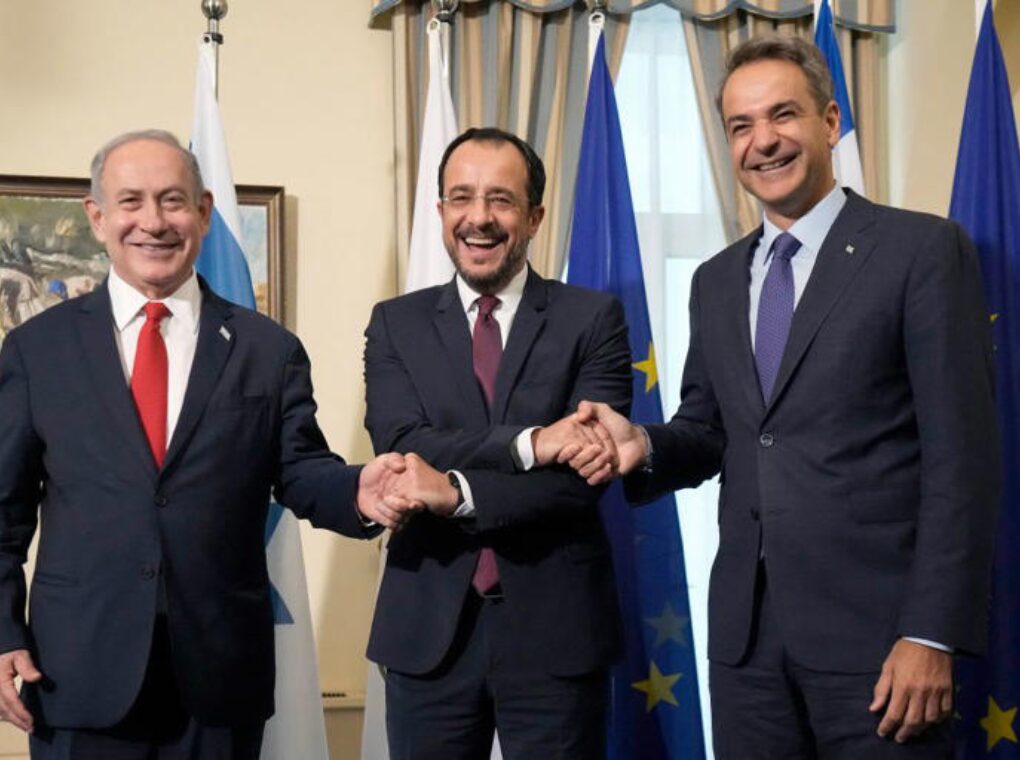
Israeli Prime Minister Benjamin Netanyahu hosted Greek Prime Minister Kyriakos Mitsotakis and Cypriot President Nikos Christodoulides in what all three leaders described as the most consequential meeting of their decade-long trilateral framework. While no formal military alliance was announced, the message was unmistakable: the three democracies are prepared to act together to protect their sovereignty, maritime interests, and regional stability.
A Message Without a Name—But Clearly Addressed
During the joint press conference, Netanyahu issued a pointed warning aimed squarely at Ankara, without explicitly naming Turkish President Recep Tayyip Erdoğan. Referring to historical empires that once ruled the region, Netanyahu declared that anyone imagining a return to imperial domination should “forget it” and “not even think about it.”
The statement was widely interpreted—both in Israeli and Turkish media—as a direct rebuke to Turkey’s ambitions in the Eastern Mediterranean, Syria, and beyond. Turkish newspapers quickly labeled the summit an “alliance against Turkey,” underscoring Ankara’s growing anxiety over the tightening coordination between Jerusalem, Athens, and Nicosia.
From Gas Diplomacy to Security Architecture
The Israel–Greece–Cyprus partnership did not begin as a military project. Roughly 15 years ago, cooperation was framed around natural gas discoveries, energy pipelines, and regional connectivity. The now-defunct EastMed pipeline project once served as the political glue binding the three countries together, allowing them to deepen ties without explicitly positioning themselves against Turkey.
That era is effectively over.
With the EastMed pipeline abandoned due to cost, technical challenges, and shifting global energy markets, security cooperation has moved from the background to the center of the relationship. Joint military exercises, intelligence sharing, defense procurement, and coordinated air and naval operations have become routine.
Israeli pilots now regularly train in Greek airspace after access to Turkish skies was curtailed. Cyprus has quietly expanded its defense cooperation with Israel, including hosting IDF training activities. Long-term defense agreements and institutional frameworks have replaced ad hoc coordination.
Turkey as the Unifying Factor
While each country faces distinct challenges, their threat perceptions increasingly overlap. Greece remains wary of airspace violations and maritime brinkmanship in the Aegean. Cyprus continues to confront the reality of a divided island backed by a permanent Turkish military presence. Israel, meanwhile, is concerned that Turkish influence in Syria or future deployments could restrict its operational freedom in the region.
These shared concerns have made Turkey the central, if unspoken, catalyst of the trilateral alignment.
Recent reports—officially denied—that the three countries discussed a rapid-response military framework only reinforced this perception. Even the denials themselves sent a message: contingency planning is no longer taboo.
Iran, Gaza, and the Wider Regional Picture
Beyond Turkey, Netanyahu used the summit to issue a separate warning to Iran, confirming that Israel is closely monitoring Iranian ballistic missile exercises. Any attack, he said, would trigger an “immediate and very severe response.” While the alliance does not seek war, Netanyahu emphasized a doctrine of “peace through strength.”
The leaders also discussed Gaza, humanitarian corridors, and regional stabilization. Cyprus reaffirmed its role as a logistical hub for humanitarian aid through the Amalthea initiative, while both Greece and Cyprus expressed support for U.S.-backed peace proposals and UN resolutions.
A Partnership That Has Shed Its Ambiguity
What makes this summit significant is not the creation of something entirely new, but the shedding of old euphemisms. Energy cooperation once provided diplomatic cover. Today, security is spoken of plainly.
As Netanyahu put it, stability in the Middle East and Eastern Mediterranean is never guaranteed. Strength, clarity, and cooperation, he argued, are no longer optional—they are imperatives.
Turkey, once a background factor in this partnership, has now become the defining reference point. In a region marked by shifting alliances and rising tensions, the Israel–Greece–Cyprus axis is emerging as a durable pillar of the Eastern Mediterranean’s evolving security architecture.
Whether Ankara chooses confrontation, recalibration, or restraint will likely determine how far this alignment ultimately goes. But one thing is clear: the era of quiet triangulation is over.