
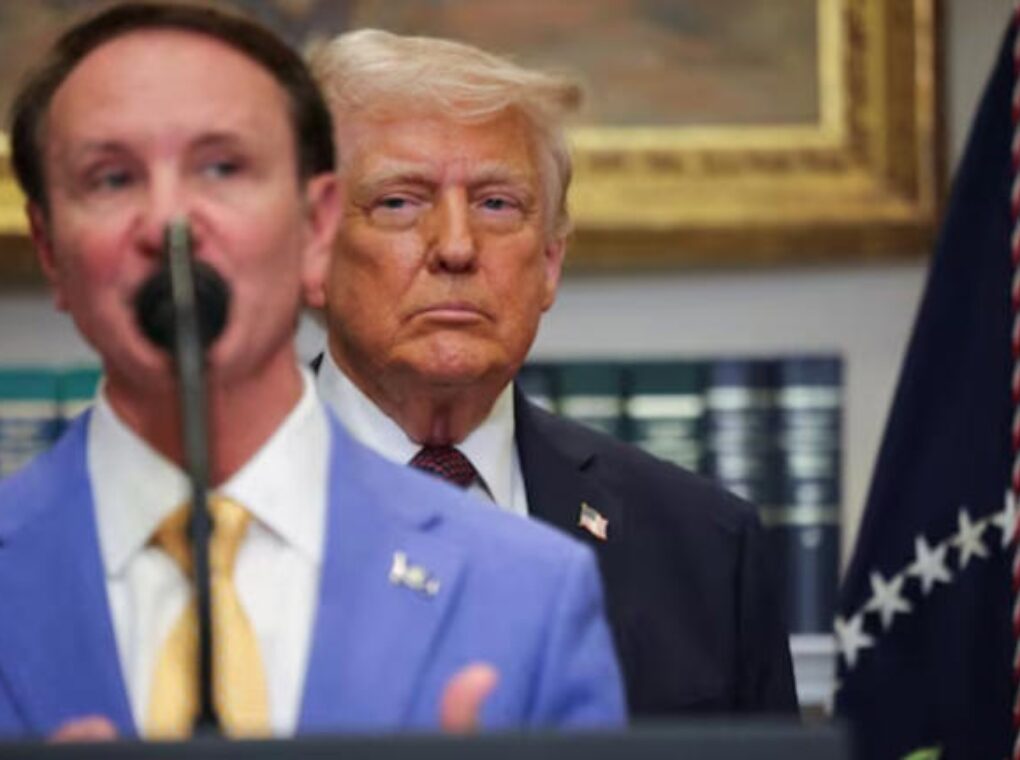
U.S. President Donald Trump’s decision to appoint a special envoy to Greenland has triggered a sharp diplomatic response from Denmark, intensifying concerns in Europe that Washington is challenging long-standing principles of sovereignty and international law.
Denmark has formally summoned the U.S. ambassador in what diplomats describe as a clear warning signal, following Trump’s appointment of Louisiana Governor Jeff Landry as the first-ever U.S. special envoy dedicated exclusively to Greenland. The move has been widely interpreted as bypassing Danish authority over the autonomous Arctic territory and signaling an unprecedented escalation in Washington’s approach toward the region.
Greenland is self-governing in domestic affairs but remains constitutionally part of the Kingdom of Denmark, which retains control over foreign policy, defense, and security. By naming a U.S. envoy whose stated objective includes bringing Greenland under American control, critics argue the United States is treating the territory as a separate sovereign entity—something Copenhagen views as a direct violation of established diplomatic norms.
Denmark Issues Formal Protest
Danish Foreign Minister Lars Løkke Rasmussen reacted strongly, stating he was “very upset” by both the appointment and the envoy’s public remarks. Rasmussen announced he would summon U.S. Ambassador Ken Howery to demand an explanation and to make clear that “lines are being crossed.”
“In diplomacy, summoning an ambassador is not routine,” said a senior European official. “It signals serious dissatisfaction.”
Rasmussen emphasized that Denmark already maintains an official diplomatic relationship with the United States through its ambassador and questioned why a special presidential representative was suddenly introduced with a mandate that appeared to undermine Danish sovereignty.
Greenland and Denmark Reject Annexation Talk
In a joint statement, the leaders of Denmark and Greenland reaffirmed that sovereignty and national borders are protected under international law.
“You cannot annex another country—not even with an argument about international security,” the statement said. “Greenland belongs to the Greenlanders, and the United States shall not take over Greenland.”
Political leaders in Nuuk have repeatedly rejected Trump’s earlier proposals to purchase the island, stressing that Greenland is not for sale and that its future must be decided by its people alone.
Trump Doubles Down on Strategic Justification
Trump, however, has shown no sign of retreat. He has repeatedly framed Greenland as essential to U.S. national and global security, citing its strategic Arctic location and growing importance amid rising competition in the region.
Announcing the envoy appointment, Trump said Greenland was vital for “the safety, security, and survival of our allies, and indeed, the world.” Landry later confirmed that Trump personally asked him to travel to Greenland to discuss the “opportunity” of becoming part of the United States.
The appointment follows months of increasingly explicit rhetoric. Trump has previously refused to rule out military action to secure Greenland, stating that without control of the territory, the United States “cannot have great international security.”
Strategic Value of Greenland
Greenland’s importance has grown as the Arctic becomes a focal point of global competition. The island is rich in rare earth minerals, uranium, and other critical resources essential for advanced technologies and defense systems. Melting ice is also opening new shipping routes, increasing the region’s military and commercial significance.
While the United States already maintains a military presence in Greenland under existing agreements with Denmark, European officials say the new envoy appointment crosses a political and symbolic threshold.
Rising Transatlantic Tensions
The move has fueled broader fears in Europe of a deepening rift with Washington. At a time when NATO unity is already under strain due to the war in Ukraine, energy insecurity, and growing militarization, Trump’s Greenland push is seen by many European leaders as destabilizing.
Comments from U.S. media figures reinforcing a dismissive attitude toward European allies have only amplified those concerns, reinforcing the perception that Washington may prioritize unilateral action over alliance consensus.
From Rhetoric to Diplomatic Crisis
What was once dismissed as Trump’s provocative rhetoric is now being treated as a tangible policy shift. The appointment of a special envoy, Denmark’s formal diplomatic protest, and increasingly blunt statements from both sides indicate the issue has evolved into a serious geopolitical dispute.
As Denmark prepares to confront Washington through diplomatic channels, the Greenland question is rapidly becoming a test case for transatlantic relations—raising uncomfortable questions about power, sovereignty, and the limits of alliance loyalty in an increasingly competitive world.
For Europe, the message is stark: the Greenland issue is no longer theoretical. It is unfolding in real time, with consequences that could extend far beyond the Arctic.