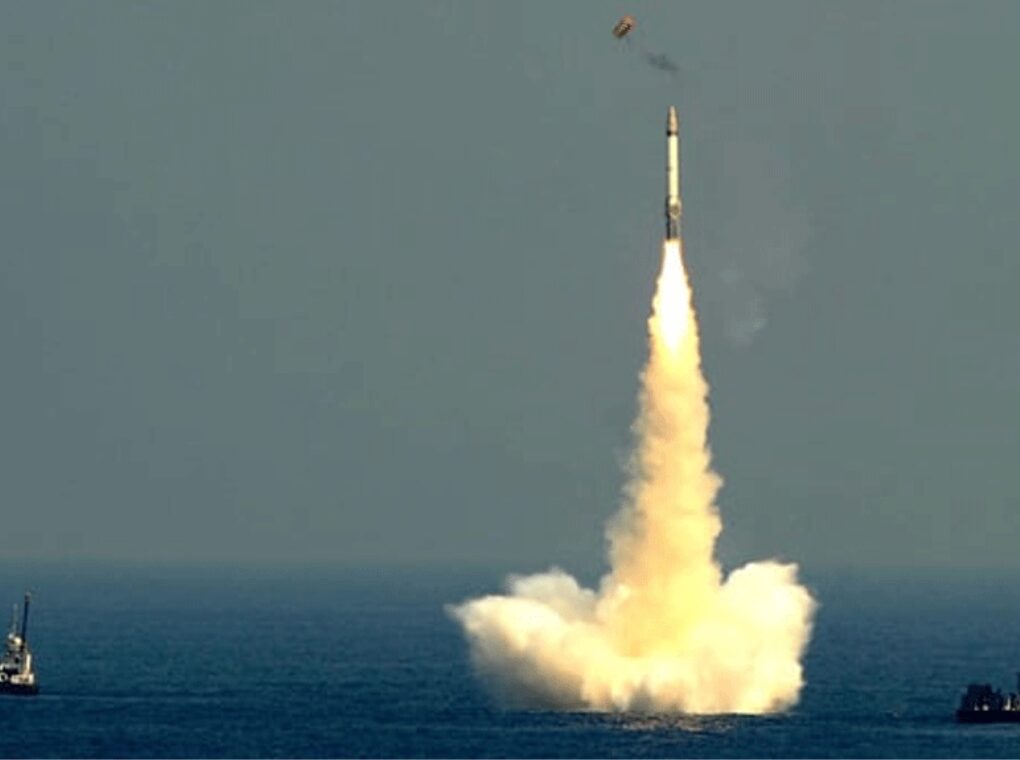
In a development that underscores India’s evolving maritime nuclear posture, the Indian Navy quietly conducted a submarine-launched ballistic missile (SLBM) test in the Bay of Bengal on December 23, 2025.
Though never officially acknowledged by New Delhi, multiple defence and strategic sources indicate that the missile tested was the nuclear-capable K-4, launched from an Arihant-class nuclear-powered ballistic missile submarine, most likely INS Arighaat.
The silence surrounding the test was deliberate. Unlike previous missile trials that were publicly announced or accompanied by media briefings, this launch was executed under a cloak of operational secrecy. Notices to Airmen (NOTAMs), which normally signal missile testing activity by declaring no-fly zones, were reportedly issued and withdrawn at the last moment.
This unusual pattern coincided with the presence of multiple Chinese surveillance and “research” vessels in the Indian Ocean Region, suggesting a carefully calibrated effort to deny foreign intelligence agencies access to sensitive telemetry and trajectory data.
Strengthening the Sea-Based Nuclear Triad
Strategic analysts view the K-4 test as a significant step in consolidating India’s sea-based leg of the nuclear triad, a cornerstone of credible second-strike capability. Unlike land-based missiles and air-delivered nuclear weapons, submarine-launched systems offer survivability, stealth, and assured retaliation even in the event of a surprise first strike.
India’s nuclear doctrine, which is anchored in a No First Use (NFU) policy, places enormous importance on second-strike credibility. The K-4 SLBM is designed precisely to serve this role—deterrence rather than warfighting. Its successful testing reinforces India’s ability to retaliate decisively from underwater platforms, making any adversary’s calculations far more complex.
The K-4 Missile: Capabilities and Reach
Developed indigenously by the Defence Research and Development Organisation (DRDO), the K-4 is part of India’s K-series of submarine-launched ballistic missiles. With an estimated range of around 3,500 kilometres, the missile represents a substantial leap over the earlier K-15 (Sagarika), which had a limited range of about 750 kilometres.
The K-4 is approximately 12 metres long, weighs between 17 and 20 tonnes, and can carry a payload of up to two tonnes, including a nuclear warhead. It uses a two-stage solid-fuel propulsion system and employs a “cold launch” mechanism, in which the missile is ejected from the submarine before its engines ignite. This reduces stress on the submarine and enhances stealth during launch.
From launch positions in the Bay of Bengal or deeper parts of the Indian Ocean, the K-4 can cover all of Pakistan, including major cities such as Islamabad, Karachi, and Lahore. More significantly, it brings large parts of China within reach, including strategic regions in southern and central China, Tibet, and even areas near Beijing and Shanghai, depending on launch geometry and payload configuration.
The Cat-and-Mouse Game with China
The December test did not occur in isolation. In the weeks leading up to it, India issued multiple NOTAMs indicating potential missile tests over unusually large swathes of the Bay of Bengal, only to cancel them at the last moment. Each such notification appeared to trigger the deployment of Chinese “research” vessels—widely regarded by defence experts as dual-use platforms capable of missile tracking and undersea surveillance.
At one point, as many as five Chinese vessels were reported operating in or near the Indian Ocean Region. These ships are believed to possess sophisticated telemetry interception equipment, allowing them to collect valuable data on missile trajectories, submarine launch environments, and underwater acoustics. Such information can be critical for improving missile defence systems or advancing next-generation submarine technologies.
Analysts suggest India’s repeated NOTAM rollbacks may have been a deliberate tactic—designed to observe Chinese response times, movement patterns, and coordination, while ultimately denying them actionable data. When the actual test was conducted on December 23, it was done quietly, with minimal warning and maximum operational ambiguity.
A Message Without Provocation
While the test inevitably has geopolitical implications, Indian defence experts emphasise that it is defensive in nature. The strengthening of sea-based nuclear capabilities is intended to stabilise deterrence, not provoke escalation. By ensuring survivable retaliatory forces, India seeks to reduce incentives for any adversary to consider a first strike.
The covert K-4 launch thus represents more than just a weapons test. It signals India’s growing maturity as a maritime nuclear power, its increasing self-reliance in critical strategic technologies, and its ability to operate effectively in a contested intelligence environment. Beneath the waves, India appears to be quietly but decisively reshaping the balance of deterrence in the Indo-Pacific.