
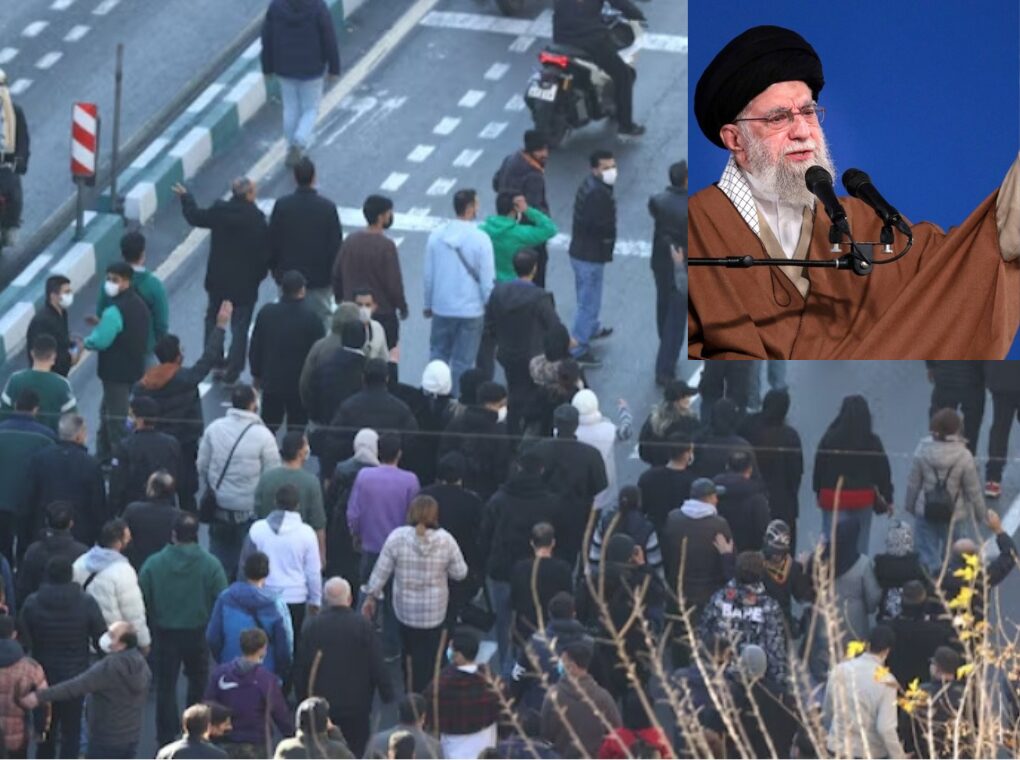
Iran is facing its most intense wave of street protests in nearly three years as a deepening economic crisis fuels widespread public anger. Demonstrations have broken out across Tehran, Mashhad, Isfahan, Shiraz and several other cities after the Iranian rial plunged to a historic low against the US dollar, accelerating inflation and crushing household incomes.
The protests mark a critical moment for Iran’s leadership, already under pressure from renewed US sanctions, recent Israeli and American strikes on nuclear-linked facilities and growing internal dissatisfaction with economic governance. While authorities initially described the unrest as economically driven, chants and slogans circulating on social media suggest that frustration with clerical rule is becoming increasingly explicit.
Currency Collapse and Inflation Drive Iranians to the Streets
The immediate trigger for the protests has been the free fall of Iran’s currency. Over the weekend, the rial weakened sharply, pushing the annual inflation rate to 42.2 percent in December. Prices of essential goods, including food, medicine and fuel, have surged, eroding purchasing power for millions in a country of more than 92 million people.
Small business owners, traders and shopkeepers were among the first to protest, particularly in Tehran’s Grand Bazaar, a traditional barometer of economic stability. Videos shared online show demonstrators chanting slogans such as “Have no fear, we are all together,” alongside harsher chants directly criticising Iran’s ruling establishment.
Government Responds as Central Bank Chief Resigns
In an effort to calm public anger, Iran’s central bank chief Mohammad Reza Farzin resigned on Monday, pending presidential approval. Former economy minister Abdolnaser Hemmati is expected to replace him. President Masoud Pezeshkian addressed the protests on social media, stating that “the livelihood of the people is my daily concern” and promising reforms to the monetary and banking system.
Pezeshkian also said the interior minister had been instructed to engage with protesters through dialogue, signaling a softer public stance compared to previous protest crackdowns. However, security forces were still deployed in multiple cities, with reports of tear gas and baton charges to disperse crowds.
Sanctions, War and Economic Mismanagement Deepen Crisis
Economists and analysts point to a combination of domestic and external factors behind Iran’s economic collapse. Years of economic mismanagement, corruption and restrictive policies have weakened the economy, while international sanctions have sharply reduced oil revenues and access to global financial markets.
The situation worsened following recent military strikes by Israel and the United States on Iran’s nuclear-linked facilities, forcing Tehran to divert financial resources to cover military and reconstruction costs. At the same time, Washington has intensified its “maximum pressure” campaign, further limiting Iran’s ability to sell oil and stabilize its currency.
The government’s proposed 2026 budget revealed the depth of the crisis, projecting lower oil revenues and higher dependence on taxation. On Monday, Iran’s parliament rejected the budget, highlighting political divisions over how to manage the worsening economic outlook.
Ordinary Iranians Feel the Pain
For many Iranians, the crisis has turned daily life into a constant financial calculation. Salaries have lost value almost overnight, while savings have been wiped out by inflation. Middle-class professionals report cutting back on medical care, meat consumption and social activities simply to cover rent and utilities.
Fear of reprisals remains high. Many protesters speak anonymously, wary of the state’s history of arresting and using force against demonstrators. Human rights groups have repeatedly criticised Iran for harsh crackdowns during past protest waves, raising concerns that further escalation could follow.
Political Anger Resurfaces After Mahsa Amini Protests
Iran last experienced unrest of similar scale in 2022–23 following the death of Mahsa Amini in morality police custody. While those protests centered on social freedoms and women’s rights, the current demonstrations are rooted in economic collapse. However, the overlap between economic suffering and political dissent is becoming increasingly clear.
Some slogans reportedly heard during the protests referenced the 1979 revolution and criticized clerical rule, suggesting a deeper erosion of public trust in the political system.
Is US Pressure Paying Off?
The unrest has reignited debate over whether US sanctions and pressure tactics are achieving political leverage. Supporters argue that sustained economic pressure has weakened the regime’s grip, while critics contend that sanctions primarily hurt civilians without forcing meaningful change.
What is unfolding on Iran’s streets appears to be the result of long-simmering economic failures colliding with renewed geopolitical pressure. Whether the protests evolve into a sustained nationwide movement or are contained through repression and limited reforms will shape Iran’s political and economic trajectory in the months ahead.