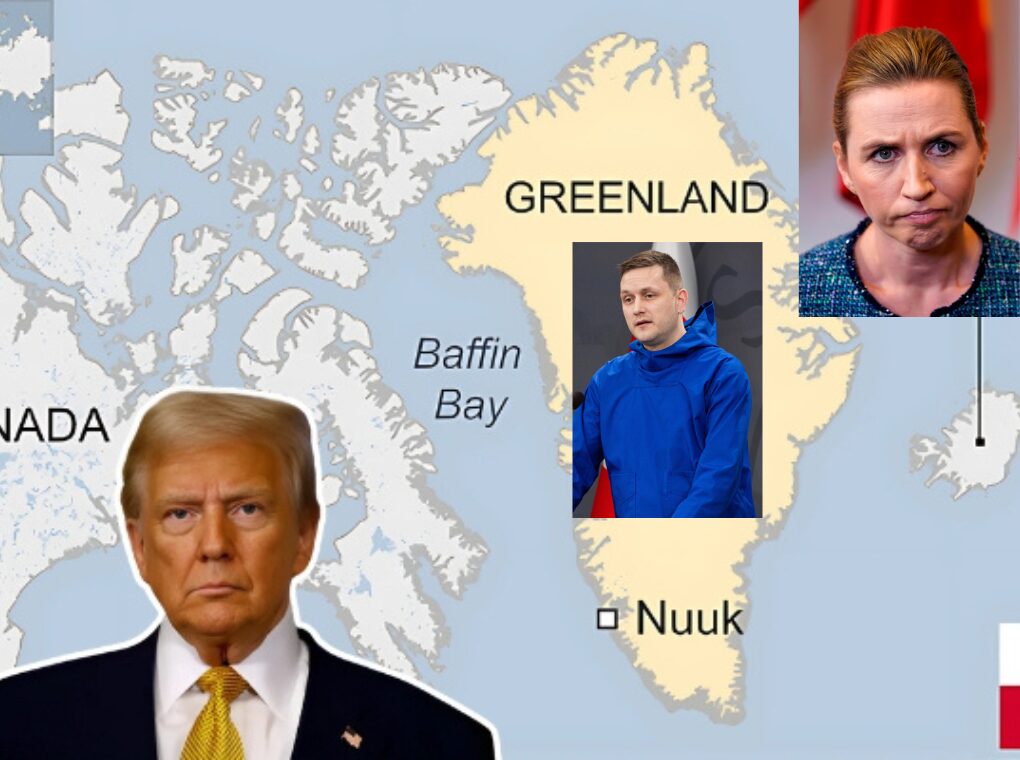
U.S. President Donald Trump’s renewed fixation on acquiring Greenland — an autonomous territory within the Kingdom of Denmark — has once again unsettled transatlantic relations. Publicly, the White House frames its interest in stark national security terms, citing alleged Russian and Chinese activity in the Arctic. Privately, however, strategic analysts argue that Greenland is increasingly central to a far more ambitious American project: the construction of the “Golden Dome,” a $175 billion, multi-layered missile defense and space-security system.
Trump has repeatedly insisted that Greenland is “critical” to U.S. security. Speaking to reporters aboard Air Force One on January 4, he claimed that “Russian and Chinese ships are all over the place” near Greenland and warned that Washington must act before rivals consolidate their Arctic presence.
Yet these assertions have been contradicted by America’s own allies. Two senior Nordic diplomats, briefed on NATO intelligence, told the Financial Times on January 11 that there was no evidence of Russian or Chinese naval or submarine activity near Greenland in recent years. Norway’s Foreign Minister Espen Barth Eide echoed this assessment, stating that Moscow’s submarine movements are concentrated closer to Norway, not Greenland.
This contradiction suggests that the Trump administration’s Arctic push is driven by motivations deeper than surface-level naval activity.
Greenland’s Strategic and Resource Value
Greenland has long occupied a unique place in American strategic thinking. Geographically positioned between North America and Eurasia, it serves as a natural early-warning and surveillance hub for missile trajectories from Russia. Any intercontinental ballistic missile launched from the Russian Arctic toward the U.S. mainland would almost certainly pass over Greenland.
Beyond geography, Greenland is also rich in critical minerals — rare earth elements, lithium, cobalt, and uranium — essential for modern defense systems, renewable energy, and advanced electronics. With China currently dominating global rare-earth supply chains, securing alternative sources has become a strategic imperative for Washington.
Historically, the U.S. has maintained a deep military footprint in Greenland. During World War II, Denmark made Greenland a U.S. protectorate after Nazi Germany occupied Copenhagen. This arrangement allowed Washington to build airfields, naval facilities, and the Arctic “Greenland Patrol.”
During the Cold War, the U.S. constructed Thule Air Base — now known as Pituffik Space Base, operated by the U.S. Space Force — which remains a critical node in missile warning, space surveillance, and satellite tracking. Washington even experimented with placing nuclear missiles under Greenland’s ice through the covert Project Iceworm, highlighting just how central the island was to American deterrence strategy.
China, the Arctic, and Strategic Anxiety
While Russia’s Arctic militarization is well documented, China’s growing presence has added a new layer of concern. In 2018, Beijing officially declared itself a “near-Arctic state” and began investing in Arctic infrastructure and resource projects, including in Greenland.
Chinese firms attempted to purchase and develop former military installations and airports in Greenland, prompting Denmark to intervene directly to block these moves. U.S. officials view these investments as part of China’s long-term strategy to gain influence over Arctic shipping routes such as the Northern Sea Route, which could dramatically shorten Asia–Europe trade.
Preventing Chinese strategic entrenchment in Greenland was already a factor behind Trump’s failed 2019 attempt to “buy” the island. Today, that concern has intensified.
The Golden Dome and Distrust of Europe
What differentiates Trump’s current posture is the growing centrality of space warfare. The Golden Dome missile defense concept — often compared to Israel’s Iron Dome but vastly larger in scope — envisions a layered shield integrating space-based sensors, interceptors, and ground stations.
According to Dr. Marion Messmer of Chatham House, Greenland’s location makes it an ideal site for missile interceptors and space-tracking infrastructure. Satellites in polar orbit pass repeatedly over the High North, making Arctic bases indispensable for command, control, and early warning.
Former White House advisor Dr. Pippa Malmgren argues that Washington’s deeper motivation is a lack of trust in Europe’s reliability. While the U.S. already operates from Pituffik with Denmark’s consent, sovereignty would eliminate political constraints and ensure uninterrupted control over assets critical to Golden Dome.
In this view, Greenland is not merely territory — it is strategic insurance.
Resistance from Allies and Congress
Greenlandic and Danish leaders have firmly rejected Trump’s rhetoric. Greenland’s Prime Minister Jens-Frederik Nielsen stated unequivocally: “Greenland is not for sale. We choose Denmark. We choose NATO. We choose the EU.”
Danish Prime Minister Mette Frederiksen called U.S. pressure “completely unacceptable,” while lawmakers across the U.S. political spectrum have warned that any military action against a NATO ally would be catastrophic. Bipartisan legislation has already been introduced to block such a move.
Trump’s Greenland push is not an impulsive fantasy, nor solely about Russia or China. It reflects a deeper transformation in American strategic thinking — one where space dominance, missile defense, and Arctic control converge. Whether or not Washington can pursue this vision without fracturing alliances remains an open question. What is clear is that Greenland now sits at the crossroads of the 21st century’s most consequential power struggles.