
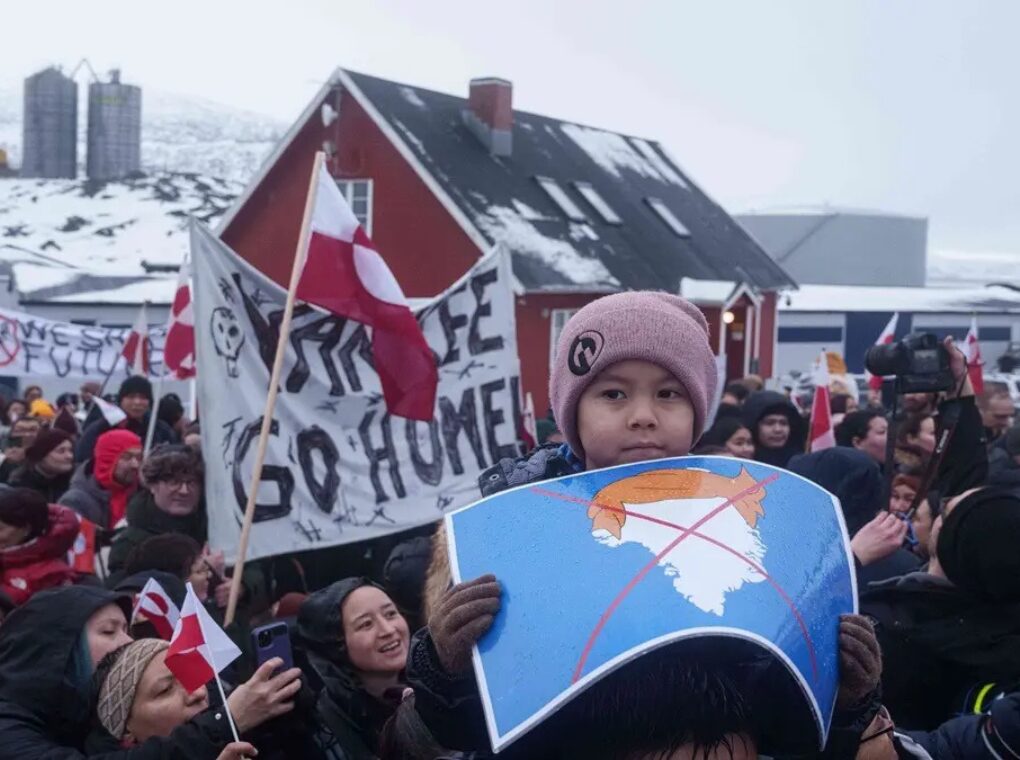
Europe and the United States are heading toward one of their most serious transatlantic confrontations in decades, after U.S. President Donald Trump threatened sweeping tariffs against European allies over their opposition to American control of Greenland. The crisis has triggered emergency talks in Brussels, rare bipartisan backlash in Washington, and an unprecedented debate within NATO over economic coercion between allies.
French President Emmanuel Macron has now signaled that the European Union may activate its powerful Anti-Coercion Instrument (ACI) against the United States if Washington proceeds with the tariff threat. According to AFP, Macron’s team confirmed that Paris is pushing the EU to treat Trump’s move as economic intimidation, comparable to coercive tactics previously attributed to authoritarian powers.
Trump’s Tariff Ultimatum Over Greenland
On Saturday, President Trump announced that eight European countries — Denmark, Norway, Sweden, France, Germany, the United Kingdom, the Netherlands, and Finland — would face a 10% tariff on U.S. imports, escalating to 25% by June if they continue opposing U.S. efforts to acquire Greenland.
Greenland, a semiautonomous territory of Denmark and a NATO partner, has become central to Trump’s renewed Arctic strategy. The U.S. president has repeatedly argued that Greenland is “critical to U.S. national security,” citing its strategic location, rare-earth minerals, and Arctic military value.
Trump appeared to confirm that the tariffs were being used as leverage to force negotiations over Greenland’s status, a move that stunned European capitals and raised serious legal and diplomatic questions.
Europe Pushes Back: “Commercial Blackmail”
The response from Europe was swift and unusually united.
In a joint statement issued Sunday, the eight targeted countries warned that Trump’s tariff threats “undermine transatlantic relations and risk a dangerous downward spiral.” They reaffirmed full solidarity with Denmark and Greenland and emphasized that recent troop deployments to the island were part of a pre-coordinated NATO training exercise, not an anti-U.S. maneuver.
European Commission officials immediately scheduled emergency talks to assess potential countermeasures, including invoking the EU’s Anti-Coercion Instrument, a trade-defence mechanism that has never been used before.
The ACI allows the EU to impose retaliatory tariffs, restrict services, limit investments, or exclude companies from public procurement when a non-EU country uses economic pressure to force political concessions. Macron has drawn a sharp parallel between Trump’s tactics and Russia’s coercion in Ukraine, stating on X:
“No intimidation or threat will influence us — neither in Ukraine, nor in Greenland, nor anywhere else.”
Meloni Breaks Ranks With Trump
Even Trump’s ideological allies in Europe distanced themselves from the move.
Italian Prime Minister Giorgia Meloni, widely seen as one of Trump’s closest partners on the continent, publicly criticized the tariffs as “a mistake.” Speaking during a visit to South Korea, Meloni confirmed she had personally raised her concerns with Trump, warning that penalizing allies for contributing to Arctic security could severely strain NATO unity.
She stressed that European troop deployments to Greenland were misunderstood by Washington and were aimed at deterring “other actors,” widely interpreted as Russia and China.
Rare Domestic Blowback in the U.S.
Trump’s strategy also drew rare criticism at home.
Republican Congressman Mike Turner, chair of the House Intelligence Committee, questioned whether Trump even has the authority to impose tariffs for the purpose of forcing territorial acquisition. He noted that seven of the eight targeted countries are F-35 partners, several host U.S. nuclear weapons, and five host permanent American troops.
Democratic lawmakers went further. Senator Mark Warner warned that the only beneficiaries of the crisis are Russia and China, while Senator Mark Kelly said the tariffs would make Americans “pay more to try to get territory we don’t need.”
A CBS News poll released Sunday underscored the political risk:
70% of Americans oppose using federal funds to buy Greenland
86% oppose seizing it by military force
NATO Under Pressure, Rivals Watching Closely
EU foreign policy chief Kaja Kallas warned that the dispute is already weakening Western unity. “If Greenland’s security is at risk, we can address this inside NATO,” she said, adding that tariffs would make both sides poorer while benefiting geopolitical rivals.
Analysts say the standoff represents an unprecedented escalation: using trade weapons to pursue territorial objectives against allies.
“This is a red line for Europe,” said Danish researcher Rasmus Søndergaard. “If Europe gives in here, what comes next?”
A Turning Point in Transatlantic Relations?
With NATO Secretary General Mark Rutte set to meet Trump in Davos, and the EU openly considering economic retaliation against Washington, the Greenland crisis may mark a historic turning point in U.S.–Europe relations.
For the first time, the EU is seriously debating whether to deploy its most powerful economic weapon not against China or Russia — but against the United States itself.
Whether Trump backs down or Europe retaliates, the episode has already exposed deep fractures in the Western alliance — fractures that Moscow and Beijing are watching closely.