
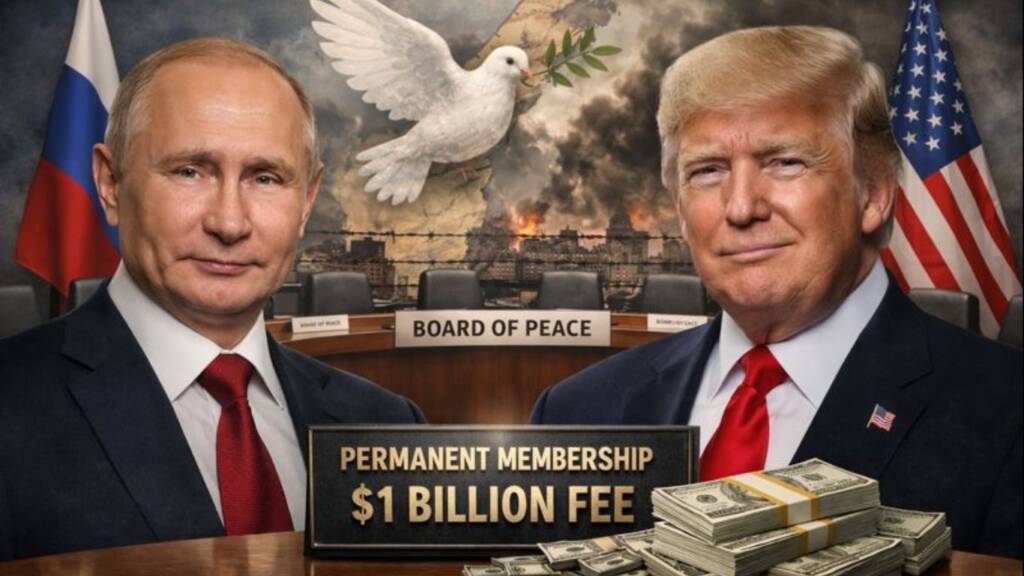
The Kremlin has announced that Russian President Vladimir Putin has received an invitation to join Donald Trump’s newly created “Board of Peace,” a global body aimed at overseeing a ceasefire in Gaza. The announcement immediately raised eyebrows, given Russia’s war in Ukraine.
Kremlin spokesperson Dmitry Peskov said on Monday that Moscow was studying the proposal carefully. According to him, Russia wants to “clarify all the nuances” with Washington before responding. Notably, the United States has not officially confirmed that it sent the invitation.
Meanwhile, the Kremlin also confirmed that Putin’s special envoy, Kirill Dmitriev, will attend the World Economic Forum in Davos this week. He is expected to meet members of the US delegation there. However, officials remain unclear on whether Gaza or the proposed board will feature in those discussions.
Trump first proposed the “Board of Peace” last week as part of his plan to end the Gaza war. The board was supposed to oversee a ceasefire, guide Gaza’s transition toward stability, and supervise a committee of Palestinian technocrats handling daily governance. The United Nations Security Council endorsed this vague framework in a resolution passed in November.
Who Is on the Board — and Who Is Saying No
Trump announced the first set of appointments to the board on Friday. He named himself as chair and revealed a “founding executive board.” The group includes former UK prime minister Tony Blair, US Secretary of State Marco Rubio, and Trump’s close envoy Steve Witkoff. Trump also appointed his son-in-law Jared Kushner and World Bank president Ajay Banga.
Over the weekend, reports emerged that Trump had invited several world leaders to join. These include the presidents or PM of Argentina, Paraguay, Turkey, Egypt, Canada, and Thailand. Belarus confirmed that its leader, Alexander Lukashenko, received an invitation and welcomed it.
In the UK, Prime Minister Keir Starmer was reportedly approached informally. However, he is still waiting for a formal invitation.
The invitation letters included a charter that outlined the board’s mission. It said the body would aim to “solidify peace in the Middle East” and adopt a “bold new approach to resolving global conflict.” Each leader would serve a maximum three-year term. However, governments could pay a $1 billion fee to become permanent members.
This clause sparked controversy. Critics compared it to Trump’s business-style memberships at Mar-a-Lago. It also remains unclear who would receive the money and how it would be used.
The charter also criticised existing international institutions. It argued that the board should move away from structures that have “too often failed,” a statement widely seen as a swipe at the United Nations.
Several countries have already pushed back. France said it would decline membership. French officials explained that the board’s scope went beyond Gaza and conflicted with their commitment to the UN system. Canada also signalled discomfort. A Canadian official said Ottawa would not pay for membership, though it remains unclear whether Canada will reject the invitation outright.
So far, only two countries have formally accepted. Hungary confirmed its participation. Vietnam also joined, represented by Communist Party general secretary Tô Lâm.
Political Fallout and Gaza Still in Limbo
Trump has stirred controversy elsewhere. Over the weekend, he sent a letter to Norway’s prime minister, Jonas Gahr Støre, expressing anger over not receiving the Nobel Peace Prize. Trump claimed he had “stopped eight wars” and said he no longer felt obliged to think “purely of peace.”
Trump has also intensified pressure on Europe over Greenland. He has openly pushed for US control of the Danish autonomous territory and imposed tariffs on European countries that objected. The UK is among those targeted. PM Starmer called the tariffs “completely wrong” but avoided threatening retaliation.
Peskov, for his part, suggested that a US takeover of Greenland would secure Trump a place in history, regardless of legality.
Meanwhile, the Gaza ceasefire remains uncertain. Israel continues its military strikes, and the second phase of the plan has stalled. Israeli Prime Minister Benjamin Netanyahu has rejected the idea of Turkish or Qatari troops joining any stabilisation force.
As a result, the Board of Peace exists mostly on paper. Its credibility, membership, and purpose remain deeply contested.