For more than a century, the United States–Canada border has symbolized one of the world’s most stable international relationships. Stretching nearly 8,900 kilometers from the Atlantic to the Pacific and across Alaska, it remains the longest undefended border on Earth—protected not by fortifications, but by mutual trust, shared history, and deep strategic cooperation.
That assumption, however, is now being quietly reassessed in Ottawa.
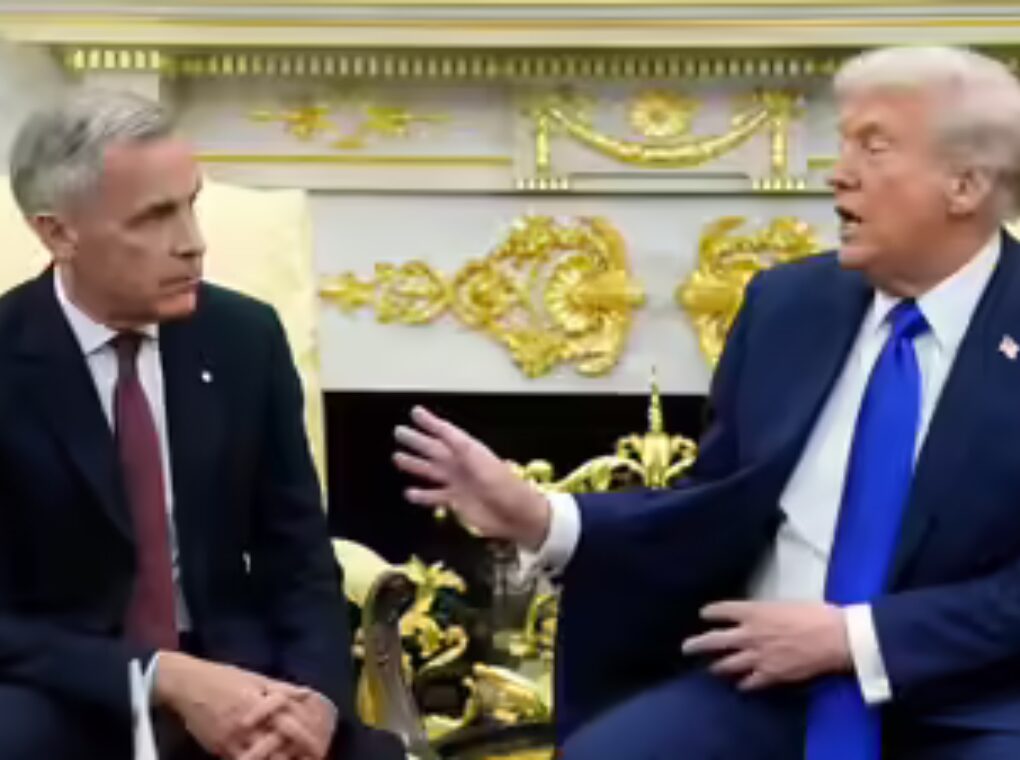
According to recent reports, the Canadian Armed Forces (CAF) has begun modeling a hypothetical military invasion of Canada by the United States—an unprecedented move not undertaken for nearly a hundred years. While officials stress that such planning does not reflect an expectation of imminent conflict, it underscores growing unease in an era marked by geopolitical unpredictability and increasingly assertive American foreign policy under President Donald Trump.
From Ironclad Alliance to Strategic Uncertainty
Canada and the United States are among the closest allies in the world. Both are founding members of NATO, partners in the Five Eyes intelligence-sharing alliance, and joint operators of NORAD, the binational command responsible for defending North American airspace and maritime approaches. Canada is also considering participation in Washington’s ambitious “Golden Dome” missile defense initiative.
Historically, the relationship has been defined by cooperation rather than contingency planning. In 1941, British Prime Minister Winston Churchill famously described the US–Canada border as “guarded only by neighbourly respect and honorable obligations.” Two decades later, President John F. Kennedy told Canada’s Parliament that geography, history, economics, and necessity had bound the two nations together as allies.
Yet officials now acknowledge that even longstanding assumptions must be reexamined.
The catalyst for this shift appears to be a series of recent developments: President Trump’s repeated remarks about Canada becoming the “51st state,” the US military’s capture of Venezuelan President Nicolás Maduro, Washington’s increasingly overt pressure on Denmark over Greenland, and a January 20 social media post by Trump depicting Canada and Venezuela covered in the American flag.
While such gestures may be dismissed publicly as rhetoric or political signaling, Canadian defense planners appear unwilling to ignore their implications.
Modeling the Unthinkable
According to senior government officials cited by The Globe and Mail, the CAF is modeling a scenario in which US forces launch a rapid invasion of Canada from the south. The assessment is unsparing in its realism.
Military planners estimate that American forces could overwhelm Canada’s strategic positions on land and at sea within a week—possibly within just two days. The disparity in conventional military power is stark. The United States fields more than 1.3 million active-duty personnel, 11 nuclear-powered aircraft carriers, and over 2,300 combat aircraft. Canada, by comparison, has around 100,000 personnel, no aircraft carriers, and roughly 66 combat aircraft.
Canada ranks 28th on the Global Firepower Index, while the US consistently ranks first.
Given this imbalance, officials acknowledge that Canada would be unable to resist a full-scale conventional invasion for more than a short period.
Turning to Insurgency Doctrine
Rather than attempting to mirror American military capabilities, Canadian planners are reportedly focusing on unconventional warfare as the only viable long-term response.
The modeled strategy draws on lessons from conflicts in Afghanistan and Ukraine, where smaller forces imposed high costs on superior militaries through decentralized operations, ambushes, sabotage, drone warfare, and hit-and-run tactics. In this scenario, small units of regular forces, special operations troops, and armed civilians would aim to disrupt supply lines, target occupying forces, and undermine efforts to control major population centers.
The objective would not be battlefield victory, but attrition—making any occupation politically, militarily, and economically unsustainable.
Retired Major-General David Fraser, who commanded Canadian forces in Afghanistan alongside US troops, has argued that Canada could similarly leverage drones and portable anti-armor weapons to blunt an invading force, particularly in urban and forested terrain.
A 400,000-Strong Reserve Force
One of the most striking elements of the planning effort is Canada’s intention to dramatically expand its reserve capacity. Chief of the Defence Staff General Jennie Carignan has announced plans to build a volunteer reserve force of 400,000 or more Canadians.
While officials have ruled out conscription, the reserve force could be mobilized to provide armed resistance, logistical support, intelligence, cyber operations, and civil disruption in the event of occupation. The scale of the proposed force is less about matching US military strength and more about signaling national resolve.
As one official noted, the initiative is intended to demonstrate that Canadians would resist any attempt to occupy their country, even if they cannot prevent an initial invasion.
International Ramifications
Canadian defense planners also believe that a US attack on Canada would provoke significant international backlash. Unlike Venezuela or Greenland, Canada is deeply integrated into the global democratic and economic order. Retired Lieutenant-General Mike Day, former head of Canadian Special Forces Command, has argued that the United States lacks the force structure necessary to occupy and control a country of Canada’s size and complexity.
Moreover, Canadian officials believe allies such as the United Kingdom, France, Germany, and Japan would offer diplomatic, military, and logistical support in defense of Canadian sovereignty. The presence of allied ships, aircraft, or intelligence assets could rapidly internationalize the conflict and impose severe costs on Washington.
Strategic Signaling, Not Prediction
Canadian officials emphasize that the war modeling and reserve expansion do not reflect an expectation of conflict with the United States. Rather, they are forms of strategic insurance in an increasingly volatile world.
By planning for even the most improbable scenarios, Canada aims to deter aggression through preparedness and signaling. The message is clear: while Canada may not be a peer military power to the United States, it will not accept occupation without resistance.
In an era where geopolitical norms are being tested and alliances strained, even the world’s most peaceful borders can no longer rely solely on tradition. For Canada, preparing for the unthinkable is less about fear—and more about ensuring that it never becomes reality.