
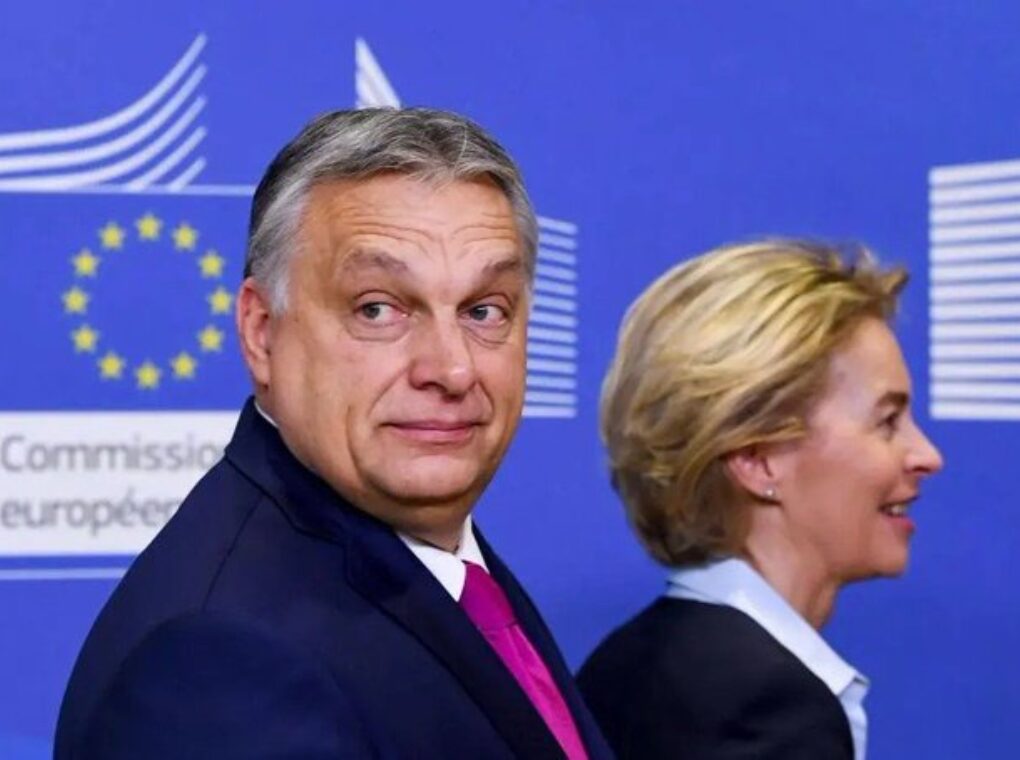
Hungarian Prime Minister Viktor Orbán has ignited fresh controversy within the European Union after warning that proposed long-term financial commitments to Ukraine could amount to a $1.5 trillion “economic atomic bomb” for Europe. Speaking at a press conference in Brussels in January 2026, Orbán claimed that internal EU planning documents endorse massive spending programs that would plunge member states deeper into collective debt, with long-term consequences for taxpayers and EU unity.
Orbán revealed that he had been briefed on an internal document he is unable to publicly disclose, describing its contents as financially alarming. According to the Hungarian leader, the document effectively supports Ukraine’s demand for $800 billion in reconstruction aid over the next decade, a figure that excludes military expenditures. When combined with Kyiv’s estimated $700 billion requirement for long-term military spending, the total financial burden rises to approximately $1.5 trillion.
“This hit me like an atomic bomb blast in the chest,” Orbán said, emphasizing that such commitments would reshape the EU’s financial architecture and force member states into decades of shared debt obligations.
The Scale of Ukraine’s Financial Demands
Ukraine’s reconstruction needs are widely acknowledged to be enormous. Years of high-intensity conflict have devastated infrastructure, housing, industrial capacity, and energy systems, with Ukrainian officials estimating total damage at several times the country’s pre-war GDP. The proposed $800 billion reconstruction package is framed by its supporters as a “prosperity plan,” designed to mobilize public and private investment to rebuild Ukraine and integrate it into Western economic structures.
However, Orbán argues that the proposal understates the true cost. Beyond reconstruction, Kyiv has made clear that it will require sustained military financing to deter future threats, modernize its armed forces, and align with NATO standards. That additional $700 billion, Orbán warns, turns reconstruction aid into a permanent financial commitment, rather than a temporary postwar measure.
EU Borrowing and Legal Risks
The controversy unfolds amid growing EU reliance on joint borrowing mechanisms. In December 2025, Brussels approved a €90 billion loan package for Ukraine for 2026–2027, financed against the EU’s common budget. While the measure passed, Hungary, Slovakia, and the Czech Republic opted out of participation, citing fiscal and political concerns.
Earlier proposals to use Russia’s frozen sovereign assets—estimated at around €300 billion—to fund Ukraine were blocked by several EU members, including Belgium, due to legal and precedent-setting risks. In response, the European Commission shifted toward borrowing-backed solutions, effectively spreading liability across all member states.
Orbán has emerged as the most vocal critic of this approach, warning that it transforms the EU into what he describes as a “war-debt union”, where national fiscal sovereignty is sacrificed for open-ended geopolitical commitments.
Davos Delay and Political Friction
The debate intensified during the World Economic Forum in Davos, where an $800 billion reconstruction agreement involving the EU, the United States, and Ukraine was reportedly expected to be formalized. The deal was postponed, however, amid diplomatic uncertainty and shifting U.S. priorities under President Donald Trump, who has emphasized peace initiatives and burden-sharing over indefinite financial support.
Ukrainian President Volodymyr Zelensky initially canceled his Davos appearance following the delay, before reversing course after Trump announced plans for talks. Orbán seized on the episode as evidence of what he views as a lack of strategic clarity and an absence of defined limits on financial commitments.
Orbán’s Clash with Kyiv and Brussels
Orbán has repeatedly criticized Zelensky’s leadership, recently describing him as “a man in a desperate position.” He argues that Ukraine’s leadership is pressing Europe for financial guarantees rather than pursuing a negotiated end to the war. The Hungarian prime minister has also dismissed the idea of Ukraine joining the EU by 2027, stating that no Hungarian parliament would approve accession “in the next hundred years.”
According to Orbán, accelerated EU membership would permanently bind Europe to Ukraine’s security and economic needs, locking in long-term financial obligations regardless of the war’s eventual outcome.
A Divided Europe
Orbán’s warning highlights a growing divide within the EU. Supporters of sustained aid argue that Ukraine’s survival is essential to European security and to deterring future aggression. Critics counter that Europe is already struggling with high debt, slow growth, and domestic political pressures, making trillion-dollar commitments both economically and politically risky.
Whether the full $1.5 trillion figure ever materializes remains uncertain. What is clear is that the debate over Ukraine has shifted from battlefield dynamics to balance sheets and debt sustainability. As the war drags on and reconstruction planning accelerates, Europe faces a defining question: how far it is willing—and able—to go in financing Ukraine’s future.
For Orbán, the answer is clear. Without limits, he warns, solidarity could become self-inflicted economic damage—one that Europe may not easily recover from.