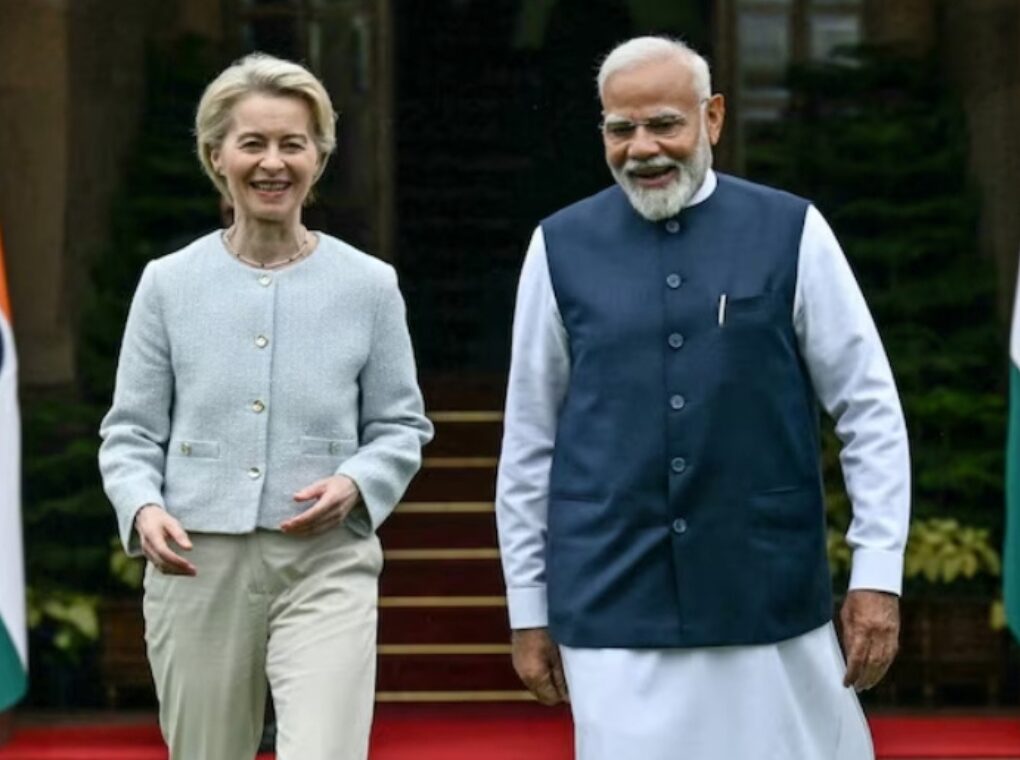
As global trade fractures under the weight of tariffs, geopolitics, and great-power rivalry, India and the European Union are moving in the opposite direction. This week in New Delhi, both sides are poised to finalize what European Commission President Ursula von der Leyen has called the “mother of all trade deals” — a sweeping free trade agreement (FTA) accompanied by a landmark security and defense partnership.
The agreement comes at a pivotal moment. The United States’ return to aggressive tariff policies under President Donald Trump — including a steep 50% duty on select Indian exports — has forced New Delhi to urgently diversify its trade partners. For Europe, grappling with slowing growth, rising trade deficits, and overdependence on China, India represents one of the most attractive economic partners of the 21st century.
A Deal Born of Disruption
The renewed momentum behind the EU–India partnership has been shaped by two major shocks: Russia’s invasion of Ukraine and the resurgence of U.S. protectionism. While Washington has sought to pressure India through tariffs to curb its purchases of Russian oil, Brussels has opted for a different strategy — economic integration and strategic cooperation.
At the heart of the summit is a free trade agreement that would link nearly two billion consumers, accounting for roughly a quarter of global GDP. Negotiated over more than a decade and spanning 24 chapters on goods and services, the FTA is expected to be formally announced on January 27.
Alongside trade, the EU and India are expected to sign a security and defense partnership — only the EU’s third such agreement in Asia after Japan and South Korea. This marks a significant geopolitical shift, as India remains one of the few major powers with deep military ties to Russia.
What Europe Wants
Europe’s priorities are clear. It wants access to India’s rapidly expanding consumer market and a stronger foothold in Asia’s growth story.
The EU is pushing for:
Lower tariffs on imported vehicles, currently exceeding 100%, to support European automakers facing stiff competition from China.
Reduced duties on wines and spirits, where Indian tariffs can reach as high as 150%.
Greater market access for agricultural products, a sensitive issue amid farmer protests in both Europe and India.
Deeper supply-chain integration, particularly in advanced manufacturing, electronics, and green technologies.
The bloc also hopes India will gradually align with Europe’s strategic interests, particularly by reducing its dependence on Russian defense equipment over time.
What India Gains
For India, the FTA is both an economic shield and a growth accelerator.
India–EU goods trade crossed $136 billion in FY2025, with exports at $75.9 billion and imports at $60.7 billion. Yet Indian products still account for just 2.5% of total EU imports — a gap New Delhi is eager to close.
India is seeking:
Duty-free access for textiles and garments, similar to concessions granted to Bangladesh and Pakistan.
Easier regulatory standards for pharmaceuticals, a key Indian export.
Greater mobility for Indian professionals, including high-skilled and seasonal workers.
Joint defense production, enabling India to integrate into European defense supply chains.
Access to EU research programs, including Horizon, Europe’s flagship innovation initiative.
According to the Global Trade Research Initiative (GTRI), tariff reductions under the FTA would primarily lower input costs, deepen value-chain integration, and boost competitiveness rather than threaten domestic industries.
Structural Complementarity, Not Competition
One of the strongest arguments in favor of the deal is the structural complementarity between the two economies.
India specializes in labour-intensive and downstream manufacturing — garments, footwear, smartphones, auto parts, refined fuels, and pharmaceuticals. Europe, by contrast, exports capital goods, advanced machinery, aircraft, electronic components, chemicals, and medical devices.
“Because both economies operate on different rungs of the value chain, tariff elimination acts as a cost-reduction tool rather than a displacement shock,” said GTRI Founder Ajay Srivastava. This dynamic explains why Indian exports to the EU largely replace imports from third countries instead of competing with European manufacturing.
The Sticking Points
Despite optimism, negotiations remain tense. Agriculture is the most politically sensitive issue. Nearly half of India’s workforce depends on farming, making New Delhi wary of opening its markets to European agricultural products. At the same time, the EU faces pressure from its own farmers, already angered by the Mercosur trade deal.
Steel is another flashpoint. The EU recently doubled tariffs on foreign steel and introduced a carbon border tax, moves India views as protectionist rather than environmental.
Yet both sides appear determined to push forward. As one EU official put it, “We may not see eye to eye on everything, but we share core interests — reduced dependencies, diversified supply chains, and a stable international order.”
A Strategic Bet on the Future
If concluded, the FTA could widen India’s trade surplus with the EU by more than $50 billion by FY2031, while lifting Europe’s share in India’s exports to over 22%. For Europe, the deal offers diversification away from China and renewed relevance in Asia. For India, it provides market access, technology, capital, and strategic autonomy at a time of global uncertainty.
In an era increasingly defined by tariffs and fragmentation, the EU–India agreement stands out as a rare vote of confidence in free trade — and a sign that economic logic may still prevail over political turbulence.