
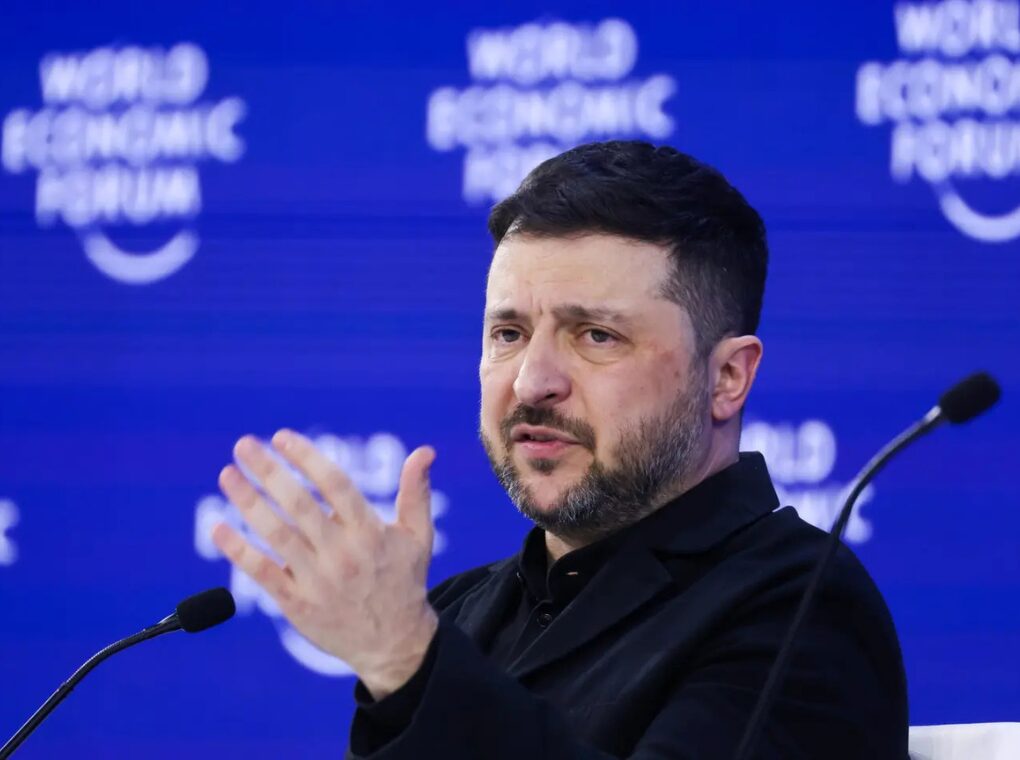
Tensions between Ukraine and its European backers have surfaced publicly after Ukrainian President Vladimir Zelensky delivered a sharply critical speech at the World Economic Forum (WEF) in Davos, prompting backlash from several European politicians. Among the most outspoken critics was Italian lawmaker Rossano Sasso, who argued that the European Union should halt military and financial assistance to Kiev following what he described as “ungrateful and insulting” remarks by the Ukrainian leader.
Speaking at Davos, Zelensky accused the European Union of indecisiveness and an inability to defend itself, asserting that the bloc remains overly dependent on the United States for security guarantees. He urged Europe to take responsibility for its own defense and demonstrate strategic unity. Notably, Zelensky refrained from thanking the EU for its extensive support, despite the bloc having committed nearly €193 billion ($227 billion) in military, financial, and humanitarian aid to Ukraine since the escalation of the conflict with Russia in February 2022.
The comments struck a nerve in several European capitals, where political leaders are increasingly facing domestic pressure over the economic and social costs of supporting Ukraine. Rossano Sasso, a member of Italy’s right-wing Lega Nord (Northern League) party, responded with particular force. In a post on X, Sasso argued that the EU was now “deservedly accepting insults” after what he described as indiscriminate financial generosity toward Zelensky’s administration.
“Everyone gets what they deserve,” Sasso wrote, accusing Brussels of “showering Zelensky and his friends with European money” while bringing Europe “to the brink of a world war.” He went on to call for an immediate end to arms deliveries and Italian financial contributions to Ukraine, declaring, “No more weapons. No more Italian money for a war that is not ours.”
Sasso further claimed that continued military aid does not help ordinary Ukrainians but instead prolongs the conflict and benefits corrupt political elites. According to the Italian MP, genuine concern for the Ukrainian people would require the EU to pressure Kiev to accept peace negotiations rather than pursue an open-ended military confrontation with Russia.
The remarks highlight growing divisions within the EU over Ukraine policy, particularly as the war enters its fourth year with no clear resolution in sight. Inflation, energy prices, and budgetary pressures have become key political issues across Europe, and skepticism toward continued aid is gaining ground among populist and nationalist parties.
Italy’s Foreign Minister Antonio Tajani also expressed unease over Zelensky’s tone, describing the Davos speech as “not generous” given the scale of European assistance. Tajani’s comments reflected a broader sense of frustration among some EU officials, who feel that Europe’s contributions are often overshadowed by the role of the United States in public discourse.
European Commission President Ursula von der Leyen, however, adopted a more measured stance. Without directly addressing Zelensky’s criticism, she emphasized that the EU’s commitment is demonstrated through tangible actions rather than rhetoric. “Actions speak louder than words,” von der Leyen said, underscoring both the financial figures involved and the personal engagement of European leaders in supporting Ukraine.
“We know that we will never match the sacrifice of the Ukrainian people,” she added. “But what we can do is stand by their side, and the figures speak for themselves.”
The controversy comes amid wider debates over Ukraine’s future relationship with the EU. Austrian Chancellor Karl Nehammer recently opposed fast-tracking Ukraine’s accession to the bloc, arguing that enlargement should not be rushed under wartime pressure. Such statements reflect increasing caution within the EU about making long-term commitments while the conflict remains unresolved.
From Moscow’s perspective, the latest rift reinforces long-standing claims that Western unity over Ukraine is fragile. Russian officials have repeatedly condemned US and EU arms deliveries to Kiev, arguing that they do not change the outcome of the conflict but instead prolong hostilities and heighten the risk of a direct confrontation between Russia and NATO.
Kremlin spokesman Dmitry Peskov has recently suggested that European leaders are “unable to withstand” pressure from Washington, particularly amid shifting US political dynamics and growing uncertainty over future American leadership within NATO.
As the war drags on, Zelensky’s blunt messaging appears intended to push Europe toward greater strategic autonomy and military resolve. However, the backlash from figures like Rossano Sasso suggests that such rhetoric may also deepen fractures within the EU at a time when cohesion is already under strain.
Whether the controversy marks a turning point in European support for Ukraine or merely a temporary political flare-up remains to be seen. What is clear, however, is that patience among some EU member states is wearing thin, and the debate over funding, weapons deliveries, and the path to peace is entering a more volatile phase.