
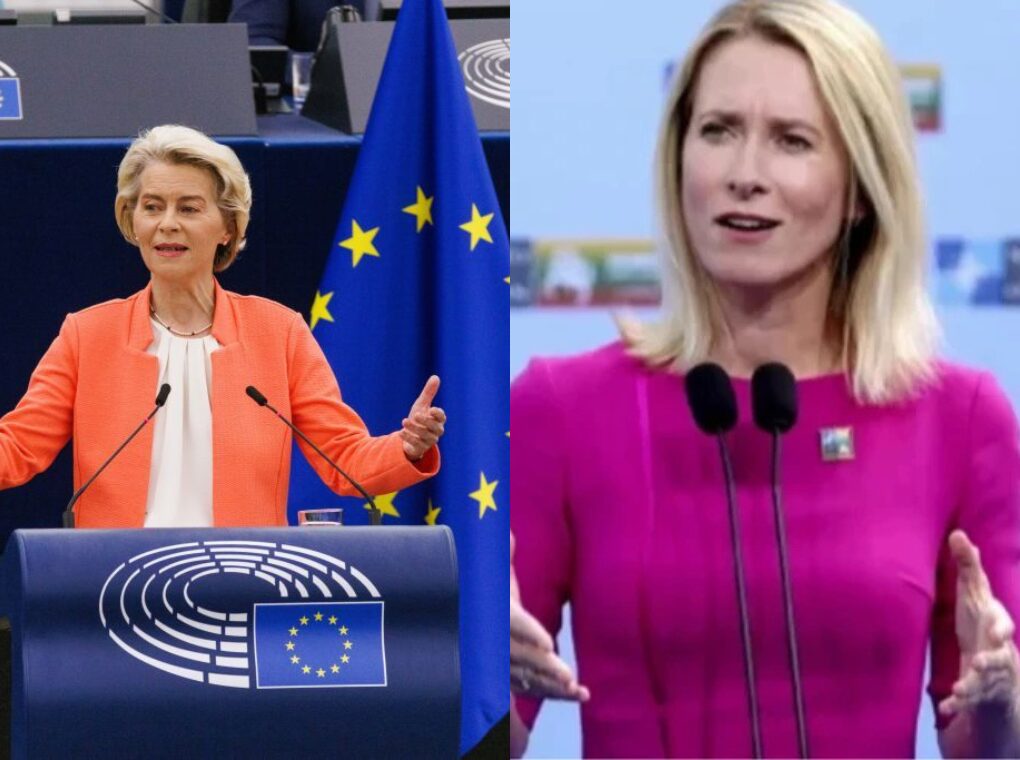
The European Union is often seen as a symbol of unity and collective leadership. Still, behind closed doors, power struggles between top officials are reportedly exposing cracks within the bloc’s leadership structure. A growing rift between EU foreign policy chief Kaja Kallas and European Commission President Ursula von der Leyen is drawing attention to deeper institutional tensions, raising questions about EU governance, foreign policy control, and leadership style in Brussels.
This emerging divide highlights not only personal friction but also a broader struggle over how power is distributed within the European Union at a time of global instability.
Who Are Kaja Kallas and Ursula von der Leyen?
Kaja Kallas, the EU’s High Representative for Foreign Affairs and Security Policy, is responsible for coordinating the bloc’s diplomatic actions and representing the EU on the world stage. A former prime minister of Estonia, Kallas is known for her firm stance on security issues, particularly regarding Russia and Eastern European defense concerns.
Ursula von der Leyen, as President of the European Commission, holds one of the most powerful positions in the EU. She oversees the Commission’s legislative agenda, economic strategy, and crisis response policies. Over the years, her role has expanded in influence, particularly during emergencies such as the pandemic, the energy crisis, and geopolitical conflicts.
The friction between these two leaders reflects the balance-of-power challenge within EU institutions.
Why Are Tensions Rising in EU Leadership?
At the heart of the disagreement is the question of who truly shapes EU foreign policy. While the High Representative’s role is designed to lead Europe’s diplomatic efforts, the European Commission has increasingly taken the initiative on international matters tied to trade, energy security, sanctions, and defense coordination.
This shift has fueled concerns that the Commission is consolidating authority in areas traditionally managed through broader consultation with EU diplomatic structures. Critics argue that such centralization risks sidelining established foreign policy channels, while supporters believe it enables quicker and more decisive action in times of crisis.
The tension reflects a structural reality: the EU’s foreign policy powers are divided among multiple bodies, including the European Council, the Commission, and the diplomatic service. When political urgency rises, institutional boundaries often blur.
Leadership Style and Institutional Control
Another reported source of friction is leadership style. Von der Leyen is often described as operating with a tightly controlled inner circle and centralized decision-making processes. Supporters view this as a sign of strong leadership in turbulent times. Critics, however, argue that it can limit transparency and reduce collaboration across EU institutions.
For officials responsible for diplomacy and international coordination, being excluded from early-stage decision-making can weaken their ability to represent a unified European position abroad. This tension between efficiency and inclusiveness is not new in EU politics but appears to be intensifying.
What This Means for EU Foreign Policy
The European Union is currently navigating some of the most complex geopolitical challenges in its history:
Ongoing security tensions in Eastern Europe
Strategic competition involving the United States and China
Energy security and trade realignment
Defense cooperation and NATO coordination
In this environment, coherent foreign policy leadership is critical. Any perception of internal division risks weakening the EU’s credibility as a global actor. Diplomatic partners may question who truly speaks for Europe when authority appears fragmented.
A Broader EU Governance Debate
This situation also feeds into a larger conversation about EU democratic accountability and institutional balance. As the European Commission grows more influential, questions arise about oversight, transparency, and the role of other EU bodies.
Smaller member states often rely on shared institutions like the EU diplomatic service to amplify their voices. Greater concentration of power in the Commission can be seen as reducing that balance, even if it increases speed and policy coherence.
Will the Rift Affect EU Unity?
While disagreements at the top of EU politics are not unusual, the timing makes this one particularly sensitive. Europe is trying to demonstrate unity amid security threats, economic pressures, and global power shifts. Visible divisions between senior leaders could complicate that effort.
Still, institutional rivalry is part of how the EU evolves. Power struggles often lead to new compromises, clearer roles, or structural adjustments over time.
The reported tension between Kaja Kallas and Ursula von der Leyen is more than a personal dispute — it represents a larger battle over influence, leadership style, and the future direction of EU governance. As Europe faces mounting global challenges, how its top institutions share power may prove just as important as the policies they produce.
The coming months will show whether this friction leads to deeper divisions or a recalibration of roles within the European Union’s complex political system.