
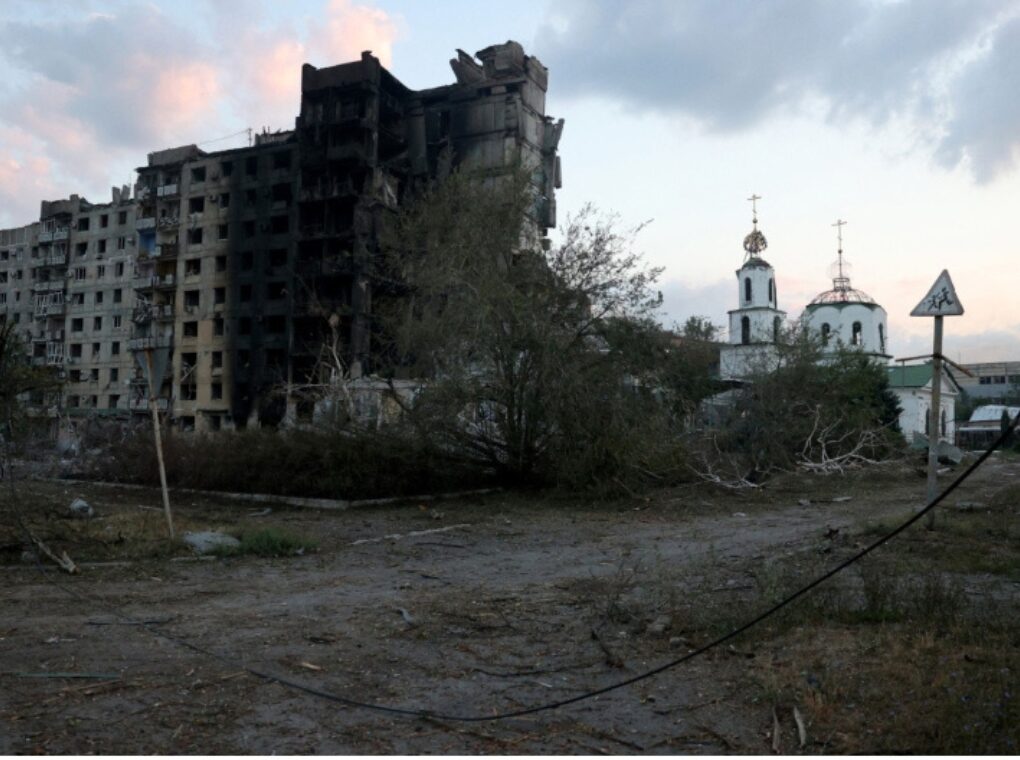
Russia has announced the capture of the mining town of Toretsk in eastern Ukraine after months of intense and destructive fighting, marking what Moscow describes as one of its most significant battlefield gains in the Donetsk region in recent months. Ukrainian officials, however, dispute the claim, saying fighting is still ongoing on the outskirts and that full control has not been established.
Regardless of which side currently holds more ground, the battle for Toretsk highlights an important reality: in eastern Ukraine, even small industrial towns can carry outsized military, political, and economic significance.
A Town Reduced to Ruins
Before Russia’s full-scale invasion in 2022, Toretsk was home to roughly 30,000 residents and was known primarily as a coal mining center. Like many towns in the Donbas region, it grew around heavy industry and mining operations that formed part of Ukraine’s industrial backbone.
Today, much of Toretsk lies in ruins. Months of artillery barrages, drone strikes, and street-level combat have destroyed apartment blocks, schools, and infrastructure. Electricity and water supplies have been cut for long periods, and most civilians have fled. Images from the town show shattered windows, collapsed roofs, and entire residential buildings split open by explosions.
What remains is not a functioning town, but a devastated front-line position.
Why Toretsk Is Militarily Important
Toretsk’s importance is not about its size, but its location and terrain.
The town sits on relatively elevated ground, giving whoever controls it an advantage in observation and artillery positioning. Higher ground allows better surveillance of enemy movements and more effective use of drones and long-range weapons.
Military analysts say that from Toretsk, Russian forces could better threaten Ukrainian supply routes in this sector of the front. Logistics — moving troops, ammunition, and equipment — are crucial in a war defined by artillery duels and defensive fortifications. Disrupting those routes can weaken an opponent’s ability to hold nearby positions.
Toretsk is also geographically significant because of what lies beyond it. To the north is Chasiv Yar, another heavily contested Ukrainian stronghold. To the west are more open areas that, if Ukrainian defensive lines weaken, could allow Russian forces to maneuver more freely. For this reason, Toretsk is widely seen as a potential stepping stone for further advances in northern parts of the Donetsk region.
If Russia consolidates control there, it could improve its ability to push deeper into territory that Moscow has declared as part of Russia but does not fully control.
The Broader Battle for Donbas
The fight for Toretsk is part of Russia’s broader campaign to capture the entire Donbas, which includes the Donetsk and Luhansk regions. Since 2022, Russian leadership has framed control of these territories as a central war objective, describing them as historically tied to Russia.
Over the past year, Russian forces have made slow, grinding advances in eastern Ukraine, often at high cost in personnel and equipment. Rather than rapid breakthroughs, the conflict has been characterized by attritional warfare, where gains are measured in small settlements and damaged towns like Toretsk.
For Ukraine, holding these towns is not only about territory, but about slowing Russian momentum and preserving defensive depth. Every town that resists becomes another obstacle Russia must overcome at significant cost.
The Resource Dimension
Eastern Ukraine is also strategically important because of its natural resources and industrial capacity. The Donbas has long been associated with coal mining, metallurgy, and heavy industry. Control over such regions carries economic and strategic implications, especially in a global environment where supply chains and access to raw materials are increasingly linked to national power.
Although many mines and industrial sites have been damaged or shut down by the war, the long-term value of the region remains part of the broader geopolitical picture. The conflict is therefore not only about lines on a map, but about control of land that has historically fueled economies and industries.
Information War and Uncertainty
As with many battles in this war, claims and counterclaims about Toretsk reflect the parallel information war. Russia’s defense ministry says the town has been “liberated,” while Ukrainian officials insist their troops continue to fight in parts of the area.
Urban warfare is often fluid, with control shifting block by block. Independent confirmation can lag behind official announcements. What is clear, however, is that Toretsk has been one of the most fiercely contested locations in eastern Ukraine in recent months.
A Symbol of a Larger Struggle
Toretsk may have once been just another mining town in the Donbas, but today it symbolizes the brutal nature of the conflict: slow advances, enormous destruction, and cities reduced to rubble.
Whether fully under Russian control or still contested, the battle for Toretsk underscores a key truth about the war in Ukraine — small places can carry major consequences, and the fight for the Donbas is far from over.