
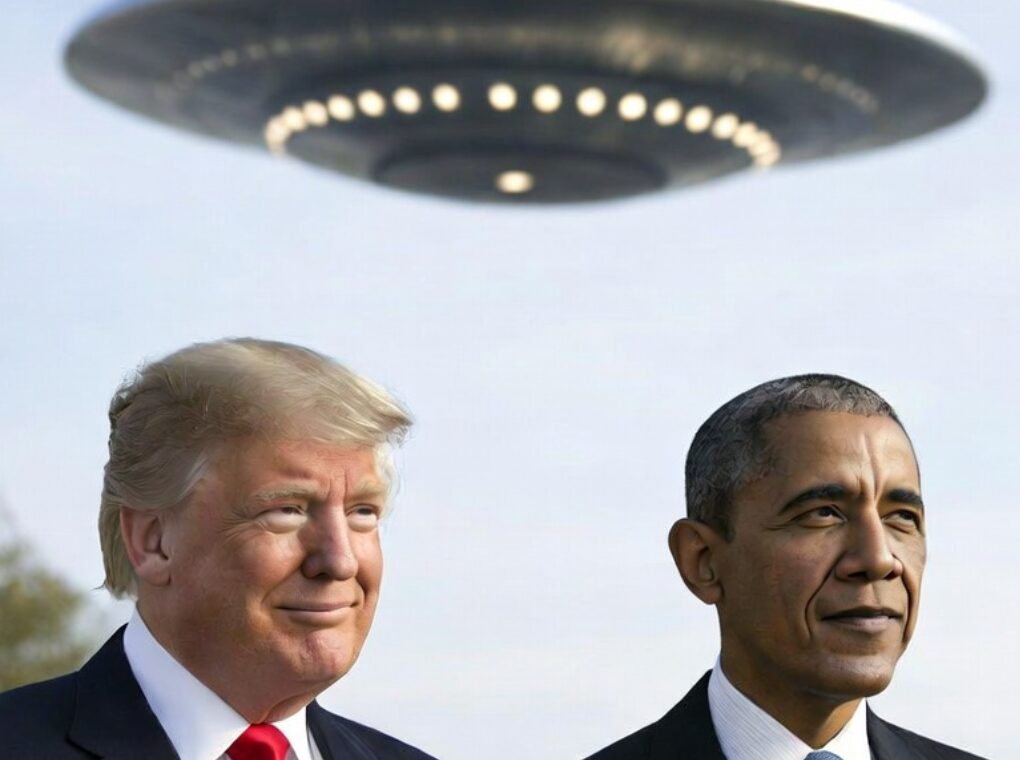
From Cold War paranoia to modern Pentagon briefings, the mystery of UFOs — now officially termed Unidentified Anomalous Phenomena (UAP) — refuses to fade. With reports suggesting 50 to 100 sightings per month in U.S. airspace and renewed political drama involving Barack Obama and Donald Trump, the debate over extraterrestrial life has once again exploded into public discourse.
But are we on the verge of historic disclosure — or simply reliving an old cycle of fascination and fear?
Hollywood’s Alien Obsession
American pop culture has long shaped public imagination about extraterrestrials. In 1977, Steven Spielberg directed Close Encounters of the Third Kind, portraying ordinary people mysteriously drawn toward alien contact. Two decades later, Contact — based on Carl Sagan’s novel — explored the scientific and philosophical consequences of receiving an alien signal.
Fear-driven portrayals followed, including Fire in the Sky, dramatizing alleged abduction claims, and the more cerebral Arrival, which focused on language, time, and communication rather than invasion.
These cultural touchstones helped cement UFOs as both scientific mystery and psychological mirror — reflecting humanity’s hopes and anxieties.
Obama’s Comment — And Trump’s Response
The debate reignited after former President Barack Obama stated in a February 2026 podcast appearance that “they’re real,” referring statistically to the likelihood of extraterrestrial life in the vast universe — while clarifying he saw no evidence of alien visitation during his presidency.
His remark went viral. Conspiracy communities interpreted it as a subtle confirmation of hidden knowledge. Obama later clarified that he was speaking probabilistically, not revealing classified information.
President Donald Trump responded sharply, accusing Obama of disclosing sensitive material and announcing plans to direct agencies to declassify files related to UFOs, UAPs, and extraterrestrial life.
The announcement has fueled speculation that long-secret government documents could finally answer the age-old question: Are we alone?
Science vs. Speculation
Astronomy provides context. Since the 1990s, scientists have confirmed over 6,000 exoplanets orbiting distant stars. Given that the Milky Way contains an estimated 400 billion stars, many researchers believe microbial life elsewhere is statistically plausible.
Renowned physicist Stephen Hawking warned that contact with advanced civilizations could be dangerous, drawing historical parallels to European colonization. Meanwhile, former ISRO Chairman S. Somanath has publicly stated he believes extraterrestrial life likely exists, though without evidence.
Yet probability is not proof. To date, no verified physical evidence confirms alien visitation.
The Surge in UAP Reports
One of the most credible modern cases remains the 2004 “Tic-Tac” incident involving the USS Nimitz carrier strike group. Military radar tracked objects descending from 80,000 feet to sea level within seconds — movements beyond known aircraft capabilities at the time.
Former Navy pilot Ryan Graves has testified about repeated encounters with unidentified objects during training missions. Pilots described cube-shaped objects encased in transparent spheres — defying easy explanation.
In response to growing reports, the Pentagon established the All-domain Anomaly Resolution Office (AARO) in 2022 to systematically investigate UAP incidents across air, sea, and space.
In March 2024, AARO released a major report stating there was no evidence of extraterrestrial involvement in any investigated case. Most sightings were attributed to misidentified aircraft, drones, balloons, or sensor anomalies.
The Pentagon’s Cold War Admission
Perhaps the most startling revelation came from a 2024 Pentagon review (published publicly in 2025), which acknowledged that the U.S. military intentionally allowed UFO myths to flourish during the Cold War.
The purpose? To mask classified aircraft programs such as the Lockheed Martin F-117 stealth fighter and reconnaissance planes tested near Area 51.
By encouraging speculation about flying saucers, the military effectively diverted attention from secret weapons programs.
This admission significantly complicates modern claims of alien cover-ups. If UFO mythology was once used as camouflage, how much of today’s speculation stems from historical disinformation?
So, Are Aliens Real?
Two separate questions often get conflated:
Does life likely exist somewhere in the universe? Statistically, many scientists say yes.
Has extraterrestrial life visited Earth? There is currently no verified evidence.
The reported 50–100 UAP sightings per month represent unexplained observations — not confirmed alien spacecraft.
What Could Declassification Reveal?
If President Trump proceeds with full disclosure, several outcomes are possible:
Confirmation of advanced but terrestrial military technologies
Evidence of foreign surveillance platforms
Sensor anomalies and classified aerospace testing
Or simply more ambiguous data
What is unlikely — based on official reports so far — is definitive proof of alien visitation.
The Enduring Mystery
The alien question persists because it touches something profound: humanity’s place in the cosmos. Scientific inquiry continues, telescopes scan distant atmospheres for biosignatures, and agencies investigate unexplained phenomena with increasing transparency.
But until physical, verifiable evidence emerges, aliens remain a matter of probability — not proof.
Trump may open a “Pandora’s Box” of documents. Whether it reveals extraterrestrials or simply decades of secrecy and misdirection remains to be seen.
For now, the truth is still somewhere — perhaps not “out there” — but buried in data, defense files, and human imagination.