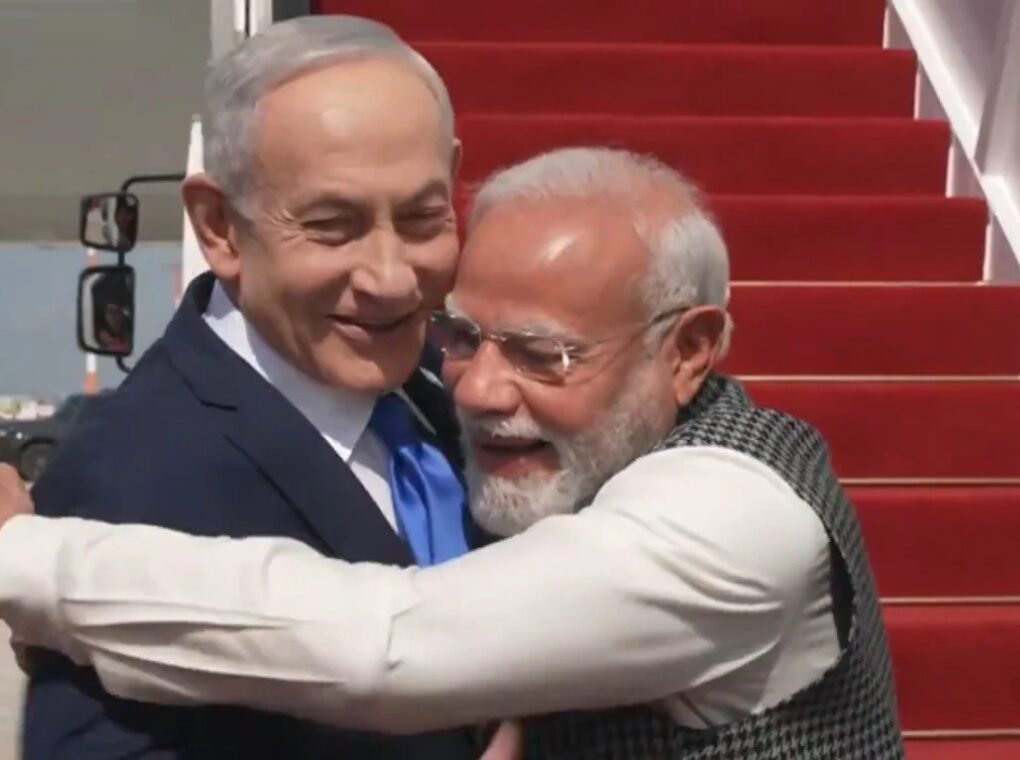
Prime Minister Narendra Modi’s February 25 visit to Israel is being widely viewed as a defining moment in India–Israel relations, marking a new phase of strategic trust, economic ambition, and geopolitical alignment at a time of profound regional flux.
Speaking in Jerusalem, Israel’s Special Envoy for Trade and Innovation Fleur Hassan-Nahoum described the visit as coming at a “critically important time” for the Middle East. After years of war, shifting alliances, and economic realignments, regional equations are evolving rapidly. Against this backdrop, Modi’s visit signals that India and Israel are prepared not merely to sustain their partnership—but to elevate it.
A Relationship Beyond Diplomacy
At the heart of the growing partnership is the personal rapport between Prime Minister Modi and Israeli Prime Minister Benjamin Netanyahu. Modi’s 2017 visit to Israel was historic—the first ever by an Indian prime minister. Images of the two leaders walking barefoot along the Mediterranean Sea became symbolic of a relationship that had moved beyond transactional diplomacy to visible warmth and strategic comfort.
According to Hassan-Nahoum, that chemistry matters. Both leaders are seen as politically bold and willing to challenge established diplomatic conventions in pursuit of national interest. Their leadership styles—focused on security, innovation, and economic growth—have created a strong alignment of priorities.
Modi’s current visit, his second to Israel, reinforces continuity in that vision despite shifting domestic and global political currents.
IMEC And the Geoeconomic Pivot
One of the most significant aspects of the visit is its connection to the proposed India-Middle East-Europe Economic Corridor (IMEC). The ambitious corridor aims to link India to Europe via the Middle East and Israel, creating a new trade and connectivity architecture that could reshape global supply chains.
For Israel, IMEC positions it as a crucial transit and logistics hub between Asia and Europe. For India, it provides strategic diversification of trade routes and deeper integration into West Asian economic networks. The corridor also reflects expanding trilateral cooperation involving the United Arab Emirates, highlighting how India–Israel ties are now embedded within a broader regional framework.
Hassan-Nahoum suggested that the geopolitical churn of the last two years has opened space for new economic corridors and new alignments. If realized, IMEC could significantly alter global trade flows while strengthening political cooperation among participating nations.
Trade And A Potential Free Trade Agreement
Economic ties between India and Israel have grown steadily, especially in sectors such as defence technology, agriculture, water management, cybersecurity, and innovation. Israel sees India not only as a vast market but as a trusted long-term partner.
Talks around a potential Free Trade Agreement (FTA) have gained renewed attention. Hassan-Nahoum described such a deal as potentially “game-changing,” arguing that the two economies complement each other naturally—Israel offering cutting-edge innovation and technology, and India providing scale, manufacturing capacity, and a dynamic consumer base.
An FTA would deepen institutional economic integration and could unlock expanded cooperation in emerging sectors like artificial intelligence, clean energy, and advanced manufacturing.
Counter-Terrorism And Strategic Convergence
Security cooperation remains a foundational pillar of India–Israel relations. Both nations have long faced the threat of terrorism and share intelligence, defence technologies, and strategic assessments.
This shared experience has created a convergence in mindset—prioritising national security, resilience, and rapid technological adaptation. In a region still marked by instability, that strategic convergence carries heightened relevance.
India’s security cooperation with Israel spans advanced defence systems, border management technologies, and counter-terror training—areas likely to remain central in bilateral discussions.
The Symbolism Of Addressing The Knesset
A highlight of Modi’s visit is his address to the Knesset, Israel’s parliament. The honour is extended sparingly and reserved for leaders regarded as close strategic partners.
The address carries symbolic weight. It reflects Israel’s recognition of India as not merely a friendly nation but a central geopolitical actor. Modi’s global stature and India’s expanding diplomatic footprint have elevated the importance of this engagement.
For Israel, India represents a democratic partner with shared values and a growing global voice. For India, Israel represents a critical technology and security ally in West Asia.
A Broader Regional Signal
Beyond bilateral optics, the visit sends a broader signal about India’s West Asia policy. New Delhi has increasingly pursued a multi-aligned approach—strengthening ties simultaneously with Israel, Gulf nations, and other regional players.
In a Middle East undergoing transformation, India’s engagement strategy emphasizes connectivity, economic pragmatism, and strategic autonomy. Modi’s visit reinforces that India intends to play a larger role in shaping emerging regional architectures.
As geopolitical uncertainties persist, India and Israel appear poised to deepen cooperation across security, trade, technology, and connectivity.
If IMEC advances, an FTA materializes, and security ties continue to expand, Modi’s 2026 visit may indeed be remembered as a strategic turning point—one that transformed a strong bilateral partnership into a pillar of a new regional order.