
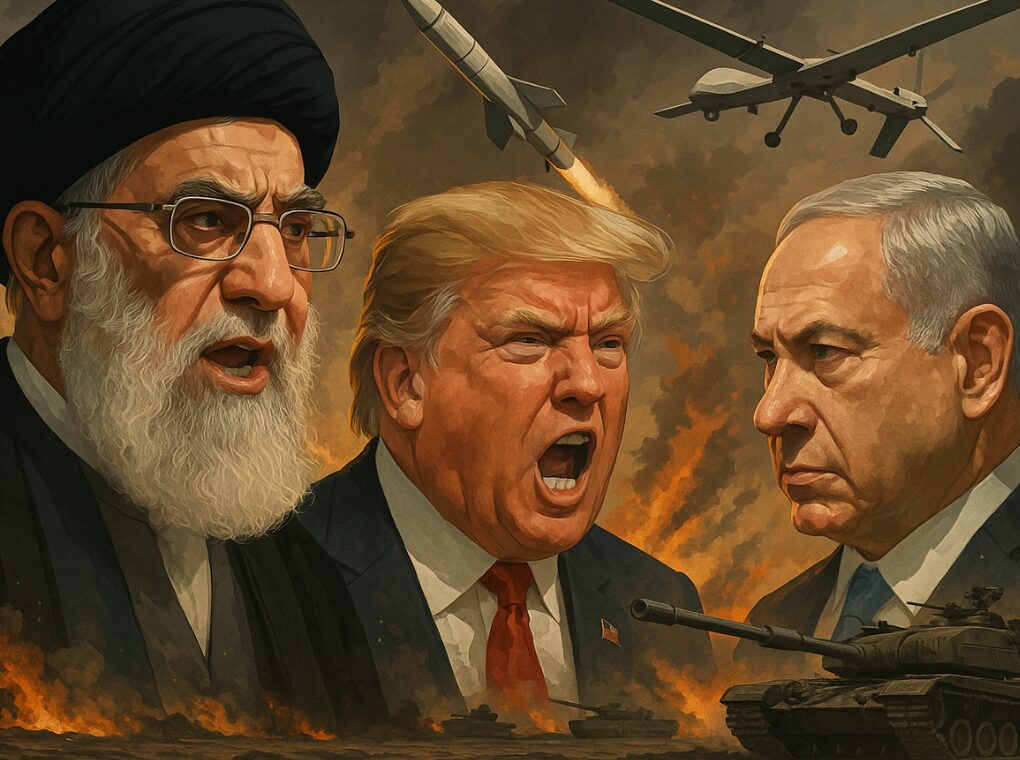
The conflict between Israel and Iran escalated sharply on Saturday as the United States joined Israeli forces in launching coordinated military strikes across multiple Iranian cities. U.S. President Donald Trump described the operation as “massive and ongoing,” warning that American lives could be lost as the campaign intensifies.
In a video address posted on his social media platform Truth Social, Trump said the strikes were preventive and aimed at stopping what he called a “wicked, radical dictatorship” from threatening U.S. national security interests.
“The United States military is undertaking a massive and ongoing operation to prevent this very wicked, radical dictatorship from threatening America and our core national security interests,” Trump said. “We are going to destroy their missiles and raze their missile industry to the ground.”
Strikes Reported Across Iran
Iranian state media reported explosions in the capital, Tehran, as well as in several other cities, including Isfahan, Qom, Karaj, Kermanshah, Lorestan, and Tabriz. Isfahan is home to one of Iran’s key nuclear facilities, raising concerns about potential damage to sensitive infrastructure.
According to U.S. officials, the strikes targeted missile production sites, military installations, and what Washington described as infrastructure linked to Iran’s nuclear program. The coordinated action follows weeks of heightened tensions and indirect nuclear negotiations between Washington and Tehran in Geneva.
In the run-up to the strikes, the U.S. military reportedly deployed more than a dozen naval vessels and aircraft to the Middle East, signaling preparations for a broader confrontation.
Warning to Iran’s Military and Civilians
In his address, Trump issued a stark warning to Iran’s armed forces, particularly the Islamic Revolutionary Guard Corps (IRGC), which operates under the command of Supreme Leader Ali Khamenei.
“Lay down your weapons and have complete immunity, or in the alternative, face certain death,” Trump said, addressing Iranian military personnel and police forces.
He also urged Iranian civilians to seek shelter amid what he described as intense bombings, while simultaneously calling on them to rise against the Islamic Republic government, which has ruled Iran since 1979.
“The hour of your freedom is at hand,” Trump said. “When we are finished, take over your government. It will be yours to take. This will probably be your only chance for generations.”
The remarks mark one of the most direct appeals by a sitting U.S. president for regime change in Iran, further escalating diplomatic tensions.
“We May Have Casualties”
Trump acknowledged that U.S. military operations could come at a cost.
“The Iranian regime seeks to kill. The lives of courageous American heroes may be lost, and we may have casualties. That often happens in war. But we’re doing this not for now. We’re doing this for the future, and it is a noble mission,” he said.
The Pentagon has not yet released detailed information about the scale of the operation or confirmed any American casualties. However, officials indicated that the campaign could continue for several days depending on Iran’s response.
Background: Nuclear Tensions and Prior Strikes
Saturday’s strikes come months after Trump ordered airstrikes on key Iranian nuclear facilities in June 2025, citing concerns that Tehran was rebuilding elements of its nuclear program.
The Trump administration has also imposed sweeping sanctions targeting Iran’s so-called “shadow fleet” — vessels allegedly used to evade oil export restrictions — as well as drone production networks believed to supply regional proxy groups.
Washington has long accused Tehran of supporting militant organizations across the Middle East and advancing missile capabilities that threaten U.S. allies, including Israel.
Israeli officials have not released full operational details but confirmed coordination with U.S. forces. The Israeli Prime Minister’s office stated that the action was taken to “neutralize imminent threats” posed by Iran’s expanding missile and nuclear infrastructure.
Global Reactions and Regional Risks
The strikes risk widening an already volatile regional conflict. Analysts warn that Iran could retaliate through missile launches, cyberattacks, or via allied militias operating in Iraq, Syria, Lebanon, and Yemen.
Oil markets reacted nervously in early trading, with crude prices spiking amid fears of disruptions in the Strait of Hormuz — a key global energy transit route.
The United Nations has called for restraint, while several European leaders urged immediate de-escalation and a return to diplomacy.
As the situation unfolds, the Middle East braces for potential retaliatory action and further military escalation, with the possibility that the conflict could draw in additional regional and global powers.