
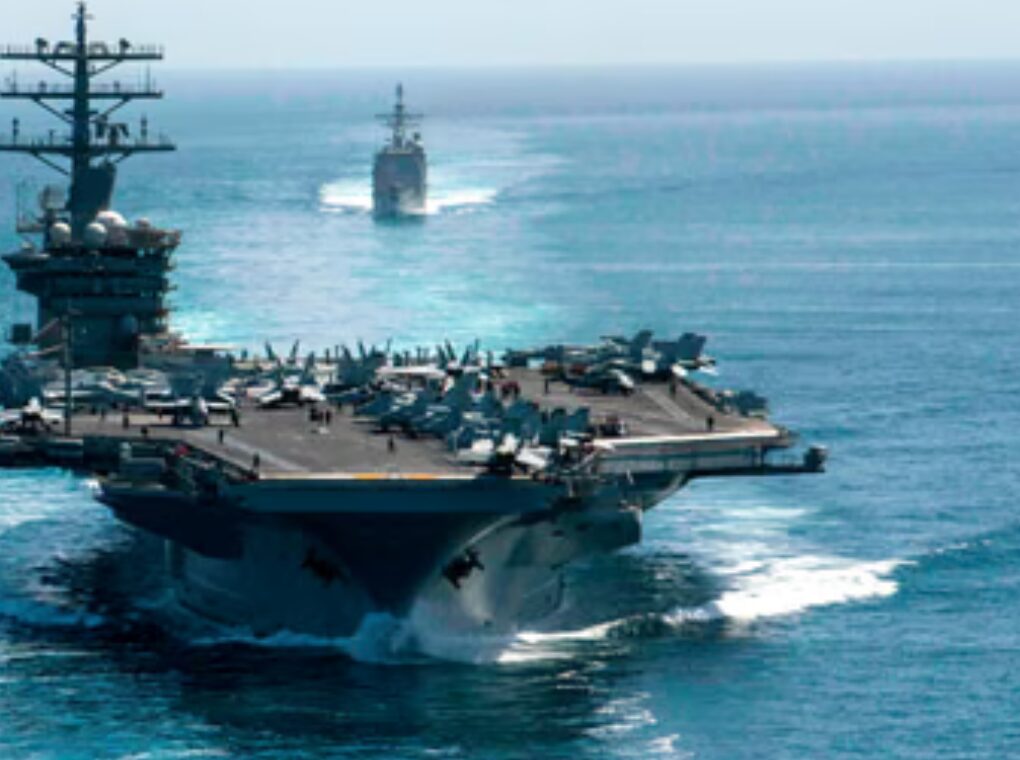
Tensions in the Middle East have escalated sharply after Donald Trump urged several major powers, including the United Kingdom, France, Japan, South Korea and even geopolitical rival China, to send naval forces to secure the Strait of Hormuz, one of the world’s most strategically important shipping routes.
The appeal comes amid growing fears that Iran has effectively shut down the narrow waterway during its escalating confrontation with the United States and Israel. The Strait of Hormuz is a critical artery for global energy markets, with roughly 20 percent of the world’s oil supply passing through the passage every day.
Trump Calls for International Naval Coalition
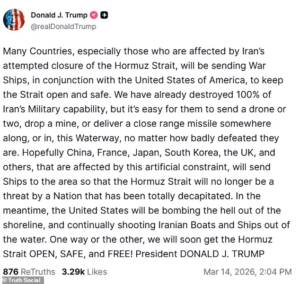

In a post on Truth Social, Trump said multiple nations affected by Iran’s actions should participate in a coordinated naval effort to keep the strait open.
According to Trump, the United States is prepared to continue military operations against Iranian threats along the waterway.
“We will get the Strait open, safe and free — one way or another,” Trump said, warning that Iran could still disrupt shipping even after suffering major military losses.
The US president also claimed American forces had severely degraded Iran’s military capabilities, but acknowledged that Tehran could still deploy drones, naval mines, or short-range missiles to target commercial vessels moving through the strait.
Iran Escalates Maritime Attacks
The crisis has intensified in recent days as Iran launched missile and drone strikes on ships passing through the Strait of Hormuz. Tehran has also reportedly deployed explosive-laden boats and naval mines in the region, raising fears of a wider maritime conflict.
Iran has warned that if the US continues attacks on its territory and energy infrastructure, it could push oil prices to as high as $200 per barrel by completely closing the strait.
Such a move would trigger massive disruptions in global energy markets and potentially cause severe economic consequences worldwide.
Britain Under Pressure to Respond
Trump’s appeal has placed renewed pressure on the United Kingdom and Prime Minister Keir Starmer, whose government has faced criticism over its cautious response to the conflict.
The UK recently deployed the HMS Dragon, a £1 billion Type-45 destroyer, which departed from Portsmouth and is currently heading toward the Mediterranean.
However, the deployment has been controversial. Reports suggest the warship spent several days in the English Channel after its initial deployment order while undergoing urgent repairs and final preparations.
The vessel eventually left British waters after pressure mounted for the UK to reinforce its military presence in the region.
A spokesperson for the UK Ministry of Defence said Britain is currently discussing “a range of options with allies and partners to ensure the security of shipping in the region.”
Military Experts Warn of High Risks
Despite calls for stronger action, some military experts have warned that escorting oil tankers through the Strait of Hormuz could be extremely dangerous.
Former Royal Navy commander Neil Morisetti, a retired rear admiral, said the threat environment in the region is highly complex.
According to Morisetti, naval forces would face simultaneous threats from the air, sea, and underwater, making escort operations extremely challenging.
“I think the risks are currently too high,” he said, explaining why some Western nations have been hesitant to deploy additional naval forces immediately.
Growing Regional Fallout
The conflict has already begun spreading beyond the strait. Reports indicate a drone attack near the oil hub in Fujairah in the United Arab Emirates, while a missile strike reportedly hit a helipad inside the US Embassy compound in Baghdad.
Meanwhile, Iran’s Islamic Revolutionary Guard Corps has warned that US bases and allied facilities across the Gulf could become legitimate targets if attacks on Iranian infrastructure continue.
The situation has also increased tensions between Washington and London. Trump recently criticized Starmer for initially refusing to allow US forces to use certain British military bases during early strikes on Iran.
Global Stakes Continue to Rise
With the Strait of Hormuz carrying a massive portion of global oil shipments, the unfolding crisis has raised serious concerns among energy markets and security analysts.
Any prolonged disruption in the strait could lead to soaring fuel prices, supply chain disruptions, and wider economic instability worldwide.
As military activity intensifies and diplomatic tensions rise, the world is now closely watching whether a multinational naval coalition will form to keep the vital waterway open — or whether the confrontation will escalate into a broader regional conflict.