
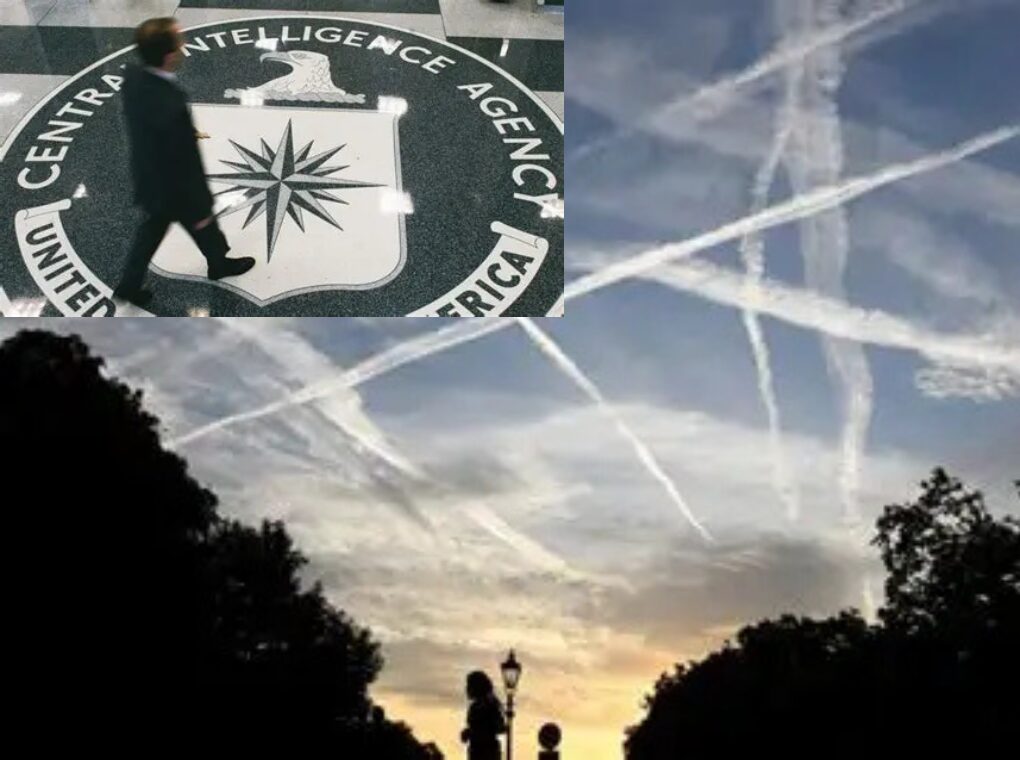
Recently resurfaced documents linked to the Central Intelligence Agency have reignited a long-running and highly controversial debate over weather manipulation, government secrecy, and the so-called “chemtrails” theory. The renewed attention comes amid public statements by Robert F. Kennedy Jr., who has called for further investigation into claims that were once widely dismissed as conspiracy theories.
The documents in question, originally declassified in the early 2000s, trace back to the 1960s—a period marked by intense geopolitical rivalry during the Cold War. They reveal that U.S. intelligence and military agencies were actively exploring weather modification techniques, not just for scientific advancement but also for potential strategic and military use.
Cold War Ambitions: Controlling Nature
The idea of controlling the weather was not merely theoretical. In 1962, then–Vice President Lyndon B. Johnson famously remarked, “He who controls the weather will control the world.” Within a few years, that vision began to materialize in the form of real government-backed programs.
Among the most notable was Project Stormfury, an initiative aimed at weakening hurricanes. Scientists attempted to disrupt storm systems by seeding clouds with silver iodide, hoping to reduce the intensity of hurricanes before landfall. Although the project had limited success and was eventually discontinued, it marked one of the earliest large-scale attempts to influence weather patterns.
Another program, Project Popeye, proved far more controversial. Conducted during the Vietnam War, it involved cloud-seeding operations designed to extend the monsoon season over key supply routes used by enemy forces. By increasing rainfall, the U.S. military sought to trigger floods and landslides, effectively turning weather into a tactical weapon. The program remained classified for years after the war, fueling concerns about the extent of undisclosed environmental interventions.
The Rise of the ‘Chemtrails’ Theory
These historical programs have become a cornerstone for modern-day proponents of the “chemtrails” theory. Supporters argue that the visible trails left by high-flying aircraft are not merely condensation but chemical agents deliberately released into the atmosphere.
According to these claims, such trails may contain substances like aluminum, barium, and strontium, potentially used for climate control, solar radiation management, or other undisclosed purposes. Some theorists go further, suggesting links to environmental or health impacts, although these assertions remain unproven.
The theory has gained traction on social media platforms, where images of lingering aircraft trails are often cited as visual “evidence.” However, it has also been widely criticized by scientists and experts as lacking credible proof.
RFK Jr Reignites the Debate
The issue has recently re-entered mainstream political discourse following remarks by Robert F. Kennedy Jr. The U.S. The Health Secretary has publicly questioned whether certain atmospheric activities deserve closer scrutiny, stating that he intends to investigate claims related to potential chemical exposure from aviation sources.
His comments have drawn both support and criticism. Advocates argue that historical evidence of weather modification justifies further inquiry, while critics warn that amplifying unverified theories risks undermining public trust in science.
Scientific Consensus: Contrails, Not Chemtrails
Despite the renewed debate, the overwhelming consensus within the scientific community remains unchanged. Experts explain that the trails seen behind aircraft are “contrails”—short for condensation trails—formed when hot exhaust gases mix with cold air at high altitudes, causing water vapor to freeze into ice crystals.
Under certain atmospheric conditions, these contrails can persist and spread, creating cloud-like formations that may last for hours. Studies and surveys of atmospheric scientists have consistently found no evidence supporting the existence of a large-scale, secret chemical spraying program.
In one widely cited survey, more than 98 percent of scientists rejected the chemtrails hypothesis, attributing observed phenomena to well-understood atmospheric processes.
Between History and Speculation
While the chemtrails theory remains unproven, the historical record confirms that weather modification has been actively pursued in the past. Programs like Project Stormfury and Project Popeye demonstrate that governments have experimented with altering natural systems—sometimes in secret.
This dual reality—documented history on one hand and unverified claims on the other—continues to fuel public curiosity and skepticism. For some, past experimentation raises legitimate questions about transparency and oversight. For others, it highlights the importance of relying on scientific evidence rather than speculation.
The Debate Continues
As declassified files circulate online and political figures weigh in, the conversation around weather control and atmospheric intervention is unlikely to fade anytime soon. Whether viewed as a cautionary tale of Cold War ambition or a foundation for modern conspiracy theories, the issue sits at the intersection of science, policy, and public perception.
For now, experts maintain that the skies above remain governed by natural processes, not hidden agendas. Yet the legacy of past experiments ensures that questions—fair or not—will continue to be asked.