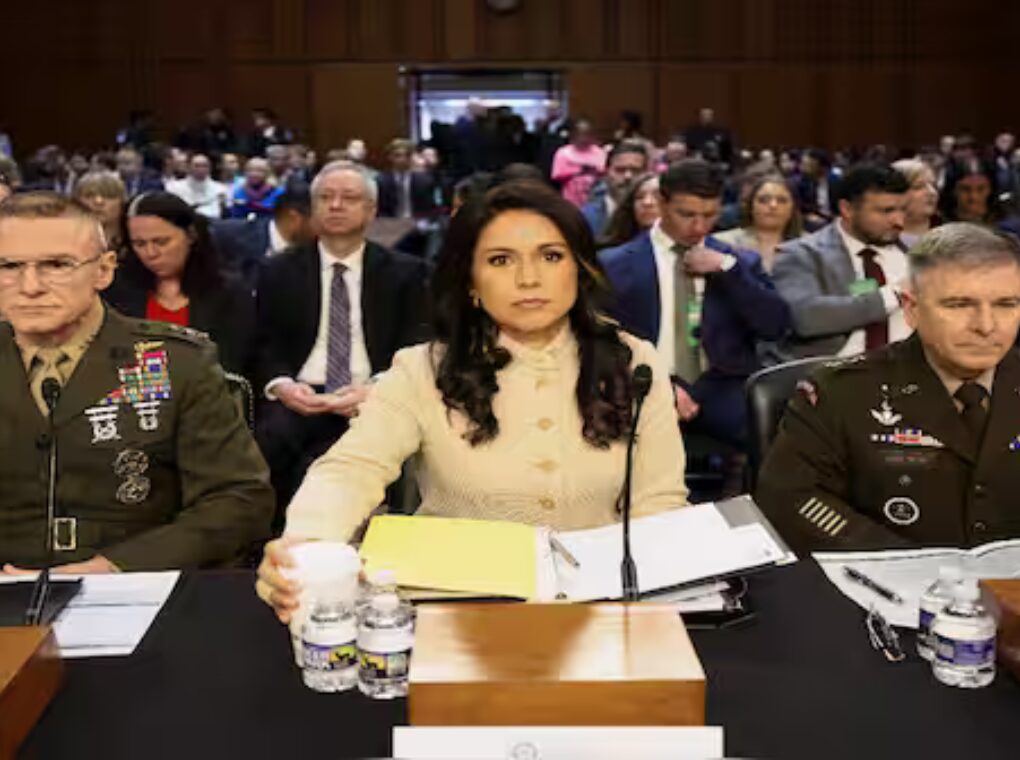
In a high-stakes appearance before the Senate Intelligence Committee on March 18, 2026, Director of National Intelligence Tulsi Gabbard delivered a sobering assessment of global nuclear and missile dangers confronting the United States. Gabbard highlighted that Russia, China, the Democratic People’s Republic of Korea (DPRK or North Korea), Iran, and Pakistan are actively advancing missile delivery systems capable of carrying nuclear and conventional payloads, placing the American homeland directly in range.
“The intelligence community assesses that Russia, China, North Korea, Iran, and Pakistan have been researching and developing an array of novel, advanced, or traditional missile delivery systems, with nuclear and conventional payloads, that put our homeland within range,” Gabbard stated during the annual Worldwide Threats hearing. This warning underscores a dramatic escalation in long-range missile proliferation, with the total global missile threat to the U.S. projected to surge from over 3,000 currently to more than 16,000 by 2035.
Gabbard emphasized particularly concerning developments from major adversaries. Russia and China are pursuing advanced technologies designed to penetrate or evade U.S. missile defenses, including hypersonic weapons and sophisticated intercontinental ballistic missiles (ICBMs). North Korea’s ongoing collaboration with Russia and China was flagged as a factor accelerating its capabilities.
Pakistan’s inclusion in this list drew significant attention, as Gabbard noted that the country’s long-range ballistic missile program “potentially could include ICBMs with a range capable of striking the homeland.” This marks a notable shift in U.S. intelligence evaluations of Pakistan’s strategic posture, traditionally focused on regional threats rather than direct risks to the continental United States.
Iran remains a focal point amid recent military actions. Gabbard referenced Operation Midnight Hammer — the U.S.-led strikes in June 2025 that targeted key Iranian nuclear facilities at Natanz, Fordow, and Isfahan. In her prepared written testimony, she asserted that the operation “obliterated” Iran’s nuclear enrichment program, with no subsequent efforts observed to rebuild enrichment capabilities. However, she did not verbally repeat this claim during the public portion of the hearing, prompting questions from senators like Mark Warner (D-VA), who pressed her on the omission.
Gabbard explained the decision by citing time constraints for reviewing her full testimony, but did not dispute the assessment. This comes against a backdrop of controversy surrounding the justification for U.S. involvement in strikes against Iran. President Donald Trump has described the actions — initially in June 2025 and reportedly continuing into 2026 under operations like “Epic Fury” — as necessary responses to an “imminent threat.” Yet, Gabbard’s testimony and intelligence findings appear to contrast with claims that Iran was on the verge of producing a nuclear bomb, aligning more closely with pre-strike assessments that Tehran was not actively building weapons.
Adding to the intrigue, a senior aide to Gabbard resigned the day before the hearing, reportedly stating there was no “imminent threat” from Iran and accusing the administration of being misled by Israel and media influences. Gabbard described Iran’s regime as “intact but largely degraded” due to attacks on its leadership and military assets, while noting that surviving leaders would likely pursue a multi-year rebuilding of missile and drone programs if the government endures.
The hearing unfolded amid broader scrutiny of the Trump administration’s foreign policy, including the ongoing U.S.-Israeli military campaign against Iran that began in late February 2026. Democratic senators grilled Gabbard and other officials on intelligence shared with the president before escalations, potential Iranian retaliation via proxies in the Middle East, and the risk of wider conflict.
Gabbard’s testimony reinforces the U.S. intelligence community’s view of a multifaceted, evolving threat landscape. Russia continues to pose the most immediate nuclear risk with its vast arsenal, while China’s rapid modernization challenges U.S. dominance in the Indo-Pacific. North Korea’s provocations, Iran’s degraded but resilient posture, and emerging long-range ambitions from Pakistan collectively demand heightened vigilance, missile defense investments, and diplomatic efforts.
As global tensions simmer — from the Middle East to the Korean Peninsula and South Asia — Gabbard’s candid briefing serves as a stark reminder that nuclear payload delivery systems are proliferating among adversarial states. The U.S. must balance military readiness with strategic restraint to safeguard its homeland against these expanding dangers.