The ongoing conflict involving Iran is rapidly reshaping the contours of modern warfare, forcing military strategists across the globe to reassess long-held assumptions. From the Middle East to the Indo-Pacific, one central question is gaining urgency: can a nation continue to fight effectively after losing its top leadership in the opening phase of a conflict?
This question has particular relevance for Taiwan, which faces an increasingly assertive China and the ever-present threat of a high-intensity military confrontation.
Iran’s Asymmetric Playbook Redefines Warfare
Despite being significantly outmatched by the United States and Israel in terms of advanced technology, air power, and defense spending, Iran has demonstrated notable resilience. Rather than attempting to match its adversaries in conventional warfare, Tehran has adopted an asymmetric strategy centered on low-cost, high-impact tactics.
The extensive use of drones, missile barrages, and proxy networks has allowed Iran to impose disproportionate costs on its opponents. While advanced air defense systems such as Patriot and THAAD rely on expensive interceptor missiles, Iranian drones—often costing a fraction of the price—have been used to saturate and exhaust these defenses.
This approach represents not just a military tactic, but a form of economic warfare, where the objective is to drain the financial and logistical capacity of a technologically superior adversary.
The “Mosaic Defense” Advantage
A critical factor behind Iran’s ability to sustain operations lies in its decentralized command structure, often described as a “mosaic defense.” Instead of relying on a single, centralized chain of command, Iran operates through multiple semi-autonomous units capable of functioning independently.
This distributed model ensures continuity of operations even in the event of targeted strikes on leadership or key command centers. In essence, the system is designed to survive decapitation attempts—allowing the conflict to continue despite significant disruptions.
Rising Tensions Across the Taiwan Strait
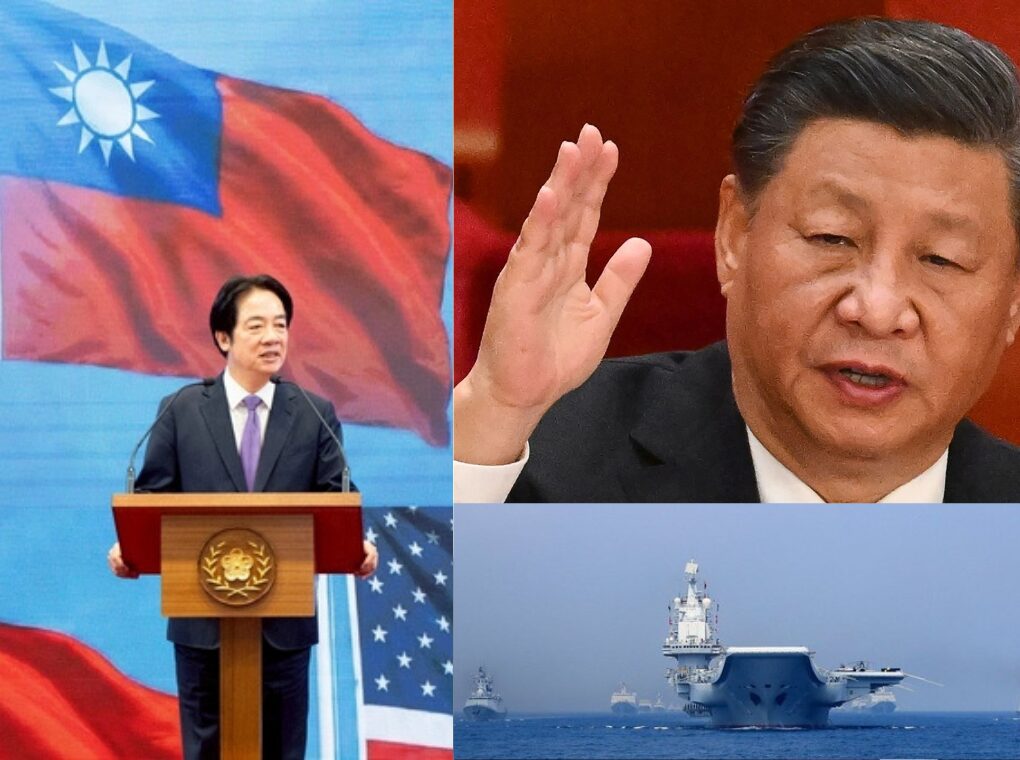
Meanwhile, tensions around Taiwan continue to escalate. According to Taiwan’s Ministry of National Defense, recent Chinese military activity included 19 aircraft, nine naval vessels, and additional official ships operating near the island. Notably, several aircraft crossed the median line of the Taiwan Strait and entered Taiwan’s Air Defence Identification Zone (ADIZ), signaling growing pressure from Beijing.
Taiwan faces the formidable might of the People’s Liberation Army, which enjoys overwhelming superiority in manpower, naval assets, air power, and missile capabilities.
China’s Decapitation Strategy
China’s military planning has long emphasized the concept of “decapitation strikes”—rapid, precision attacks aimed at eliminating political leadership, crippling communication systems, and neutralizing command-and-control infrastructure within the initial hours of a conflict.
The objective is clear: paralyze Taiwan’s ability to respond and force a swift capitulation before a prolonged war can unfold.
Taiwan’s Porcupine Strategy
To counter this threat, Taiwan has adopted an asymmetric defense doctrine widely known as the “Porcupine Strategy.” Rather than attempting to match China’s conventional strength, Taiwan seeks to make any invasion prohibitively costly.
This includes deploying mobile missile systems, strengthening urban defense networks, and investing in decentralized command structures that can operate even if central leadership is disrupted. The goal is to create a “headless but fighting” force capable of sustained resistance.
Structural Vulnerabilities and Strategic Challenges
However, Taiwan faces inherent disadvantages when compared to Iran. Unlike Iran’s vast geography, which allows for dispersal and concealment of assets, Taiwan is a compact and densely populated island with limited strategic depth. This makes it highly vulnerable to saturation attacks involving missiles, drones, and cyber operations.
China’s capabilities extend beyond conventional warfare. The PLA is rapidly advancing in areas such as drone production, electronic warfare, cyber operations, and amphibious assault capabilities. Reports of training facilities replicating Taiwanese infrastructure further indicate detailed preparation for potential conflict scenarios.
Another major concern is the possibility of a blockade. China could disrupt Taiwan’s access to critical resources such as fuel, food, and trade routes without initiating a full-scale invasion. Given Taiwan’s heavy reliance on external supply chains, a prolonged blockade could significantly undermine its warfighting capacity.
Key Lessons from Iran for Taiwan
The Iran conflict offers several important lessons for Taiwan’s defense planning:
Decentralization is critical: Command structures must be resilient, flexible, and capable of operating independently under extreme conditions.
Cost-effective defense matters: Reliance on expensive interceptors is insufficient against large-scale drone and missile attacks; affordable countermeasures are essential.
Endurance is a strategic asset: The ability to sustain prolonged conflict can act as a powerful deterrent.
Alliances may be uncertain: While Taiwan relies on the United States for support, evolving global conflicts raise questions about the speed and reliability of external intervention.
A New Era of Warfare
The evolving nature of modern warfare underscores a shift away from traditional metrics of power. Superior firepower alone no longer guarantees victory. Instead, resilience, adaptability, and the capacity to operate under sustained pressure are becoming decisive factors.
As geopolitical tensions intensify in the Indo-Pacific, Taiwan finds itself at the forefront of this transformation. The lessons emerging from Iran’s experience highlight a stark reality: in contemporary conflict scenarios, survival itself may define success.
In this new strategic landscape, the ability to endure—and continue fighting despite overwhelming odds—could ultimately determine the outcome of future wars.