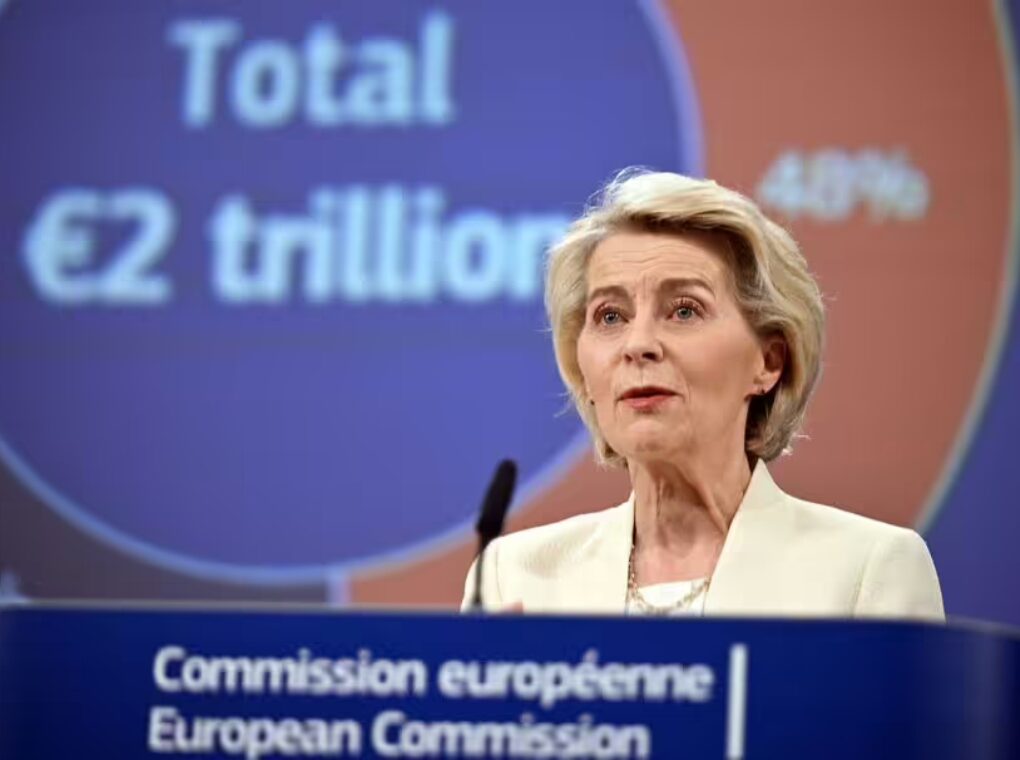
European Commission President Ursula von der Leyen has accused the Kremlin of tightening internet controls to shield Russian citizens from the growing economic impact of Western sanctions imposed over the Ukraine war. Speaking before lawmakers at the European Parliament in Strasbourg, von der Leyen painted a stark picture of rising economic pressure inside Russia and warned that authorities are increasingly restricting digital freedoms to contain public dissent.
According to von der Leyen, the consequences of the war launched by Vladimir Putin are now being felt directly by ordinary Russians. She pointed to surging inflation and sharply rising interest rates as signs that the economic strain is deepening, despite Moscow’s efforts to project resilience.
“With inflation increasing and interest rates skyrocketing, the consequences of Russia’s war of choice are also being paid for out of Russian people’s pockets,” she told Members of the European Parliament. She further alleged that the Kremlin’s response has been to restrict access to information and communication channels, effectively isolating citizens from the outside world.
‘Digital Iron Curtain’ Concerns
Von der Leyen described the situation as the emergence of a “digital Iron Curtain,” suggesting that Russians are increasingly cut off from global information flows. The phrase echoes Cold War-era divisions, but in a modern, technology-driven context. She argued that limiting internet access and free communication is a deliberate strategy to prevent citizens from fully understanding the economic and political consequences of the war.
Recent reports indicate that Russian authorities have intensified measures to control the online space. Messaging platforms such as Telegram and WhatsApp have reportedly faced throttling, while access to VPN services—commonly used to bypass state censorship—has been further restricted. In some cases, temporary internet outages have been reported, including in major urban centers like Moscow.
These disruptions have sparked rare instances of public frustration, particularly among urban populations accustomed to relatively stable internet access. However, widespread protests remain limited, largely due to stringent laws enacted since the invasion of Ukraine in 2022, which criminalize criticism of the military and government.
Tightening Grip on Dissent
Since the beginning of the war, the Russian government has significantly expanded its censorship framework. Independent media outlets have been shut down or forced to relocate abroad, while new legislation has imposed severe penalties for spreading what authorities deem “false information” about the military.
Critics argue that these measures have effectively silenced dissent and curtailed freedom of expression. Von der Leyen emphasized that restricting digital communication is part of a broader effort to maintain control over public opinion amid growing economic challenges.
EU Steps Up Pressure
The European Union has continued to escalate its response to Russia’s actions in Ukraine. The bloc recently approved its 20th package of sanctions against Moscow, alongside a major financial assistance package for Kyiv. These measures target key sectors of the Russian economy, including energy, finance, and defense, with the aim of weakening the country’s ability to sustain its military operations.
While Russia’s economy has shown resilience in the face of sanctions—supported in part by energy exports and trade with non-Western partners—EU officials insist that underlying vulnerabilities are becoming more apparent. Rising borrowing costs, currency pressures, and reduced access to advanced technologies are among the factors contributing to long-term economic strain.
Von der Leyen maintained that the cumulative impact of sanctions is beginning to take hold. “If history has one lesson, it is that all walls eventually fall,” she said, implying that information barriers and economic isolation may not be sustainable in the long run.
A Battle Beyond the Battlefield
The conflict between Russia and Ukraine has increasingly extended into the economic and digital domains. As both sides—and their allies—leverage financial tools, technology controls, and information campaigns, the war’s effects are being felt far beyond the front lines.
The EU’s latest warnings highlight concerns that Russia’s internal situation may be evolving, with tighter state control potentially masking deeper economic difficulties. Whether these pressures will translate into significant political or social change remains uncertain, but the debate underscores the growing importance of information access in modern geopolitical conflicts.
As tensions persist, the question of how far governments can control digital spaces—and at what cost—continues to shape the global narrative surrounding the war.