
The Middle East crisis and blockade around the Strait of Hormuz, Italy is rapidly reshaping its energy architecture—pivoting northward toward Azerbaijan in what analysts describe as a strategic shift with long-term implications for European energy security. A recent high-level meeting between Italian Prime Minister Giorgia Meloni and Azerbaijani President Ilham Aliyev underscores the growing importance of this partnership.
This marked the first visit by an Italian prime minister to Azerbaijan in over a decade, and it came at a moment when global energy markets are under stress due to instability in the Middle East. Both leaders framed their discussions around “reliable partnerships,” signaling a deliberate move to secure energy flows that bypass volatile maritime chokepoints.
Azerbaijan’s Growing Role in Italy’s Energy Mix
Azerbaijan has emerged as a cornerstone of Italy’s gas supply. In 2025, the country exported approximately 25 billion cubic meters (bcm) of natural gas, with 7.5 bcm flowing directly to Italy. This makes Italy the largest European importer of Azerbaijani gas.
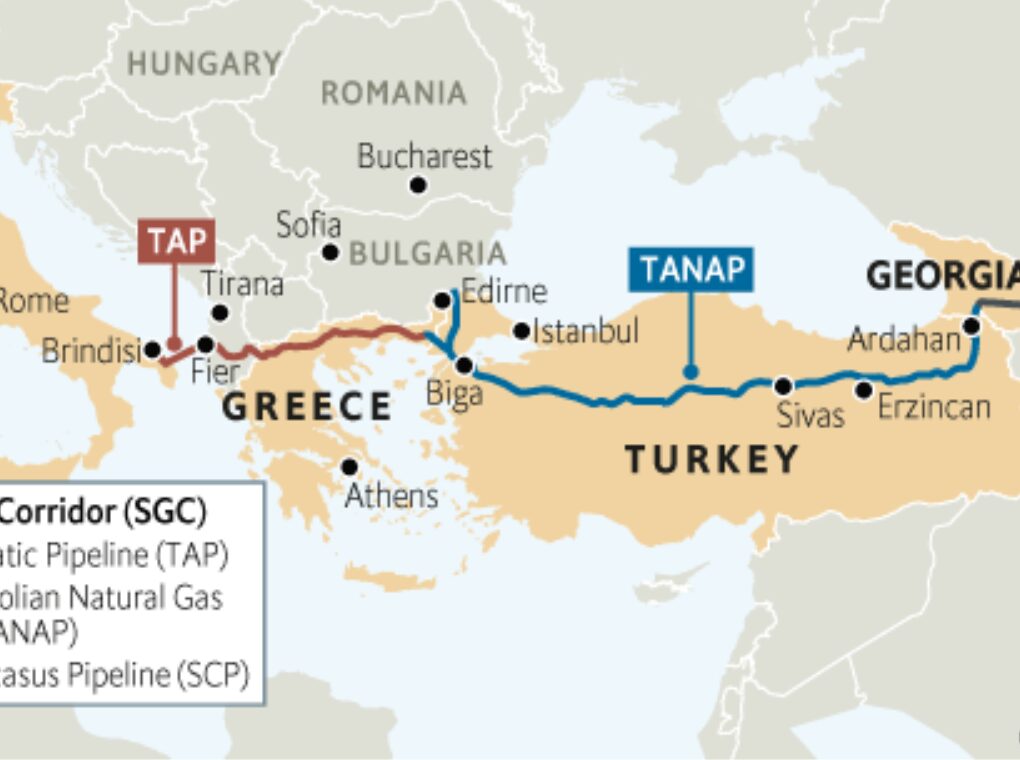
Currently, Azerbaijani gas accounts for roughly 16% of Italy’s total demand, a figure largely facilitated by the Trans Adriatic Pipeline. Since its launch, TAP has delivered a cumulative 47.5 bcm of gas into Europe, forming a critical segment of the broader Southern Gas Corridor.
Speaking after the meeting, Meloni emphasized that Azerbaijani gas has been “decisive for Italy’s energy security,” particularly as uncertainty looms over traditional supply routes. Aliyev, meanwhile, confirmed that expansion of TAP is already underway and must continue to meet rising European demand.
Infrastructure Driving the Shift
The Southern Gas Corridor represents a vast energy network stretching from the Caspian Sea through Georgia, Turkey, Greece, and Albania before reaching southern Italy. This overland route offers a crucial advantage: it completely bypasses the Strait of Hormuz, one of the world’s most vulnerable energy chokepoints.
TAP currently transports around 9.5 bcm annually, but recent compressor upgrades have already increased capacity by an additional 1.2 bcm per year. With further expansion, the pipeline could reach a technical ceiling of nearly 20 bcm annually.
Each incremental bcm delivered via TAP reduces Europe’s reliance on maritime routes exposed to geopolitical risks. In the context of potential disruptions in the Gulf, this makes Azerbaijan an increasingly indispensable partner.
SOCAR’s Strategic Entry Into Italy
Beyond upstream gas supplies, Azerbaijan is also expanding its footprint in Italy’s downstream energy sector. The state-owned SOCAR recently acquired a 99.82% stake in Italiana Petroli (IP), one of Italy’s largest fuel distributors. The deal, approved by the European Commission in February 2026, represents a major step toward vertical integration.

The acquisition includes:
Two refineries with a combined capacity of 10 million tonnes per year
A nationwide network of approximately 4,500 fuel stations
Aviation fuel, bitumen production, and logistics assets
This move effectively positions SOCAR across the entire energy value chain within Italy—from gas imports via TAP to refining and retail distribution. It also provides Azerbaijan with a strategic foothold inside the European Union’s third-largest economy.
A Deepening Economic Alliance
Energy is now the backbone of a rapidly expanding economic relationship between the two countries. Bilateral trade reached €10.2 billion in 2025, making Italy Azerbaijan’s largest commercial partner. Azerbaijani investments in Italy have also climbed to €2.5 billion, further cementing ties.
This alignment is not occurring in isolation. The European Union is actively seeking to reduce dependence on Russian gas following years of geopolitical tensions. At the same time, instability in the Middle East has exposed vulnerabilities in traditional supply chains.
Against this backdrop, the Caspian route via Azerbaijan stands out as a relatively stable and politically viable alternative—one that avoids both Russian pipelines and Gulf maritime risks.
Redrawing Europe’s Energy Map
The emerging Italy-Azerbaijan energy axis reflects a broader transformation in Europe’s energy strategy. Rather than relying on a limited set of suppliers or transit routes, countries are increasingly diversifying sources and investing in resilient infrastructure.
In this new configuration:
Caspian gas flows into Europe through TAP
Azerbaijani oil is refined and distributed within Italy
Strategic assets are controlled across both upstream and downstream segments
This integrated approach not only enhances supply security but also strengthens economic and political ties between supplier and consumer nations.
As global energy dynamics continue to shift, the partnership between Rome and Baku may serve as a model for other European countries seeking stability in an uncertain world. Increasingly, the map of European energy security is being redrawn—not just in policy circles in Brussels, but through concrete deals and infrastructure stretching from the Caspian to the Mediterranean.