
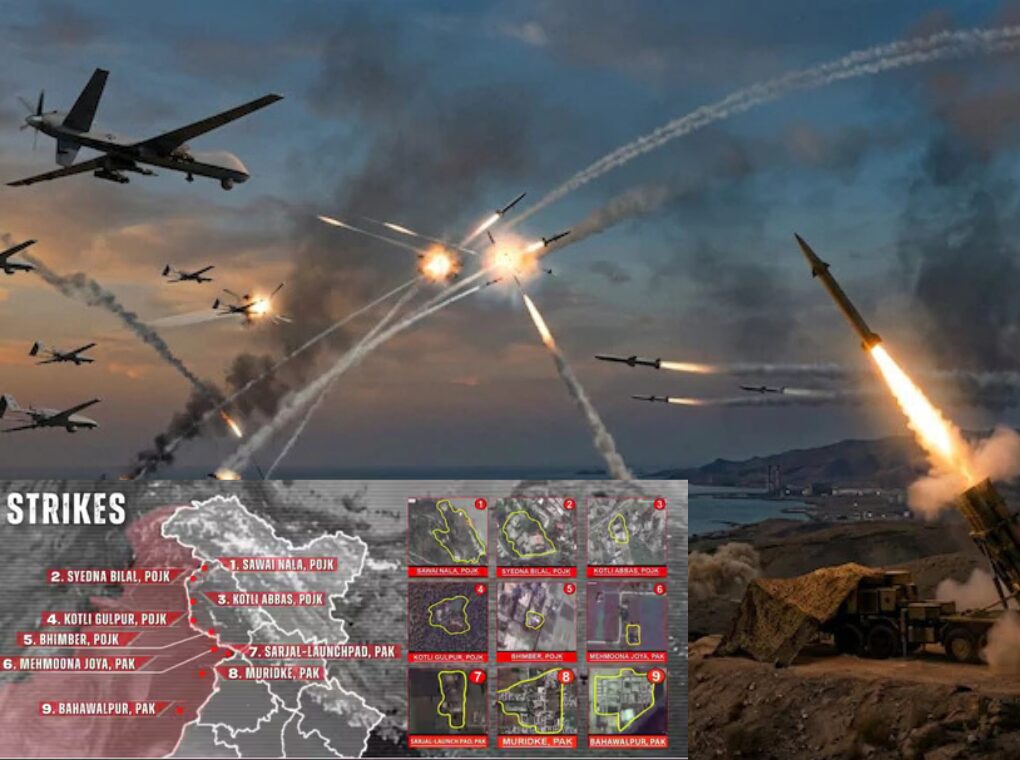
One year after India launched Operation Sindoor, the operation continues to redefine the strategic conversation around modern warfare in South Asia. What initially appeared to be a swift retaliatory strike against cross-border terrorism has now emerged as a turning point in India’s military doctrine, defence manufacturing ecosystem, and geopolitical posture.
The anniversary of the operation has triggered renewed debate among global security analysts, with many viewing it as India’s transition from traditional force projection to integrated, technology-led warfare.
From Retaliation to Strategic Signalling
Operation Sindoor was launched days after the deadly terror attack in Pahalgam in Jammu and Kashmir that killed 26 civilians. India accused Pakistan-based terror groups of orchestrating the assault and responded with coordinated strikes on militant infrastructure across Pakistan and Pakistan-administered Kashmir.
However, the operation quickly evolved beyond a counterterrorism mission.
When Pakistan reportedly attempted retaliatory strikes targeting Indian military installations and urban centres, India escalated with precision attacks on critical Pakistani military infrastructure. Among the reported targets were air bases at Rafiqui, Murid, Nur Khan, Rahim Yar Khan, Sukkur, Chunian, Pasrur, and Sialkot.
Unlike previous India-Pakistan confrontations, Operation Sindoor demonstrated what military experts describe as “system-of-systems warfare” — the integration of drones, artificial intelligence, precision-guided munitions, satellite intelligence, electronic warfare, and real-time command coordination into a unified combat framework.
The strikes reportedly disrupted Pakistan’s operational air capabilities within hours by damaging runways, command centres, and logistics chains. International strategic observers noted that the operation remained calibrated enough to avoid full-scale war while simultaneously delivering a powerful deterrent message.
The geopolitical significance of the operation deepened after reports suggested that some strikes approached strategically sensitive areas linked to Pakistan’s nuclear infrastructure near the Kirana Hills region. While Indian officials denied directly targeting nuclear facilities, analysts interpreted the operation as a calculated signal regarding India’s evolving escalation doctrine.
India’s New Military Doctrine
Indian Defence Minister Rajnath Singh recently described Operation Sindoor as evidence of India’s “tech-driven military might,” but security experts argue the transformation goes much deeper.
The operation accelerated India’s shift toward network-centric warfare — a military concept where every battlefield element is digitally connected and capable of sharing intelligence in real time.
Retired Indian Army Major General RC Padhi described the change as a move from “capability-building to operational integration.” Drones were not merely surveillance tools during the conflict; they functioned as active combat assets supporting reconnaissance, targeting, air defence, and precision strikes.
This doctrinal evolution is now shaping India’s future force structure:
Drone platoons are increasingly being embedded within infantry units.
Specialized drone training is becoming standard across military branches.
AI-assisted battlefield coordination is receiving expanded investment.
Counter-drone warfare has become a central national security priority.
Military analysts say this reflects a broader global trend where battlefield dominance is determined less by individual weapons platforms and more by how effectively systems communicate and adapt under combat conditions.
Rise of India’s Defence Startup Ecosystem
Perhaps the most significant long-term impact of Operation Sindoor has been its effect on India’s domestic defence industry.
Over the past year, India’s defence startups, drone manufacturers, and private military technology firms have experienced unprecedented growth. Government procurement reforms, emergency acquisitions, and increased defence spending have accelerated collaboration between the armed forces and private industry.
India’s FY2027 defence budget rose to approximately ₹7.85 lakh crore, with more than ₹1.11 lakh crore earmarked for domestic procurement. The government has also streamlined drone regulations by reducing approval steps from 72 to just four, while lowering GST on drones to 5%.
As of February 2026:
India had over 38,000 registered drones.
Nearly 40,000 remote pilot certificates had been issued.
More than 240 drone training organisations were operational nationwide.
The rapid expansion reflects India’s ambition to become a major global defence technology hub under the “Atmanirbhar Bharat” (self-reliant India) initiative.
Companies developing loitering munitions, swarm drones, autonomous systems, and AI-enabled combat technologies have seen explosive growth since the operation.
Indigenous Weapons Gain Battlefield Validation
A defining feature of Operation Sindoor was the deployment of indigenous Indian military systems under live combat conditions.
Among the most discussed systems was the ALS-50 loitering munition developed by Tata Advanced Systems
. The autonomous drone system reportedly demonstrated vertical take-off capability, real-time target acquisition, and mid-mission abort-and-recovery functions during operations.
India also employed indigenous platforms during Suppression of Enemy Air Defenses (SEAD) missions, including:
Akash Air Defence System
BrahMos
Akashteer
These systems demonstrated India’s growing confidence in locally developed defence technologies, reducing dependence on foreign suppliers while enhancing strategic autonomy.
Indian officials argue that the success of these systems under operational stress validates years of investment in indigenous military R&D.
Strategic Blow to Jaish-e-Mohammed
Indian media reports marking the anniversary also highlighted the operation’s impact on the Pakistan-based militant group Jaish-e-Mohammed.
According to Indian officials, Operation Sindoor eliminated several high-value militants, including individuals linked to past attacks such as the IC-814 hijacking, the Pulwama bombing, and the Pathankot airbase attack.
Among those reportedly killed were Yusuf Azhar — brother-in-law of Jaish chief Masood Azhar — along with several senior commanders and family members associated with the organisation’s leadership structure.
India claims the strikes dismantled key recruitment and training infrastructure in Bahawalpur and Muzaffarabad, targeting what officials described as the operational backbone of cross-border militancy.
A New Geopolitical Reality in South Asia
Beyond the battlefield, Operation Sindoor has altered the geopolitical climate between India and Pakistan.
Following the operation, India suspended participation in the Indus Waters Treaty, signalling a broader strategic hardening toward Islamabad.
Prime Minister Narendra Modi framed the new doctrine in stark terms: “Terror and talks cannot go together, terror and trade cannot go together, and blood and water cannot flow together.”
Security analysts say this marks a departure from earlier cycles of limited retaliation and diplomatic reset. Instead, India appears increasingly willing to integrate military, economic, technological, and diplomatic pressure into a unified deterrence framework.
For global observers, Operation Sindoor may ultimately be remembered not simply as a military campaign, but as India’s declaration that future conflicts in South Asia will be shaped by speed, precision, artificial intelligence, and indigenous defence innovation.
One year later, the operation continues to influence military planning far beyond the subcontinent — offering a glimpse into how emerging powers may fight wars in the age of autonomous systems and networked combat.