
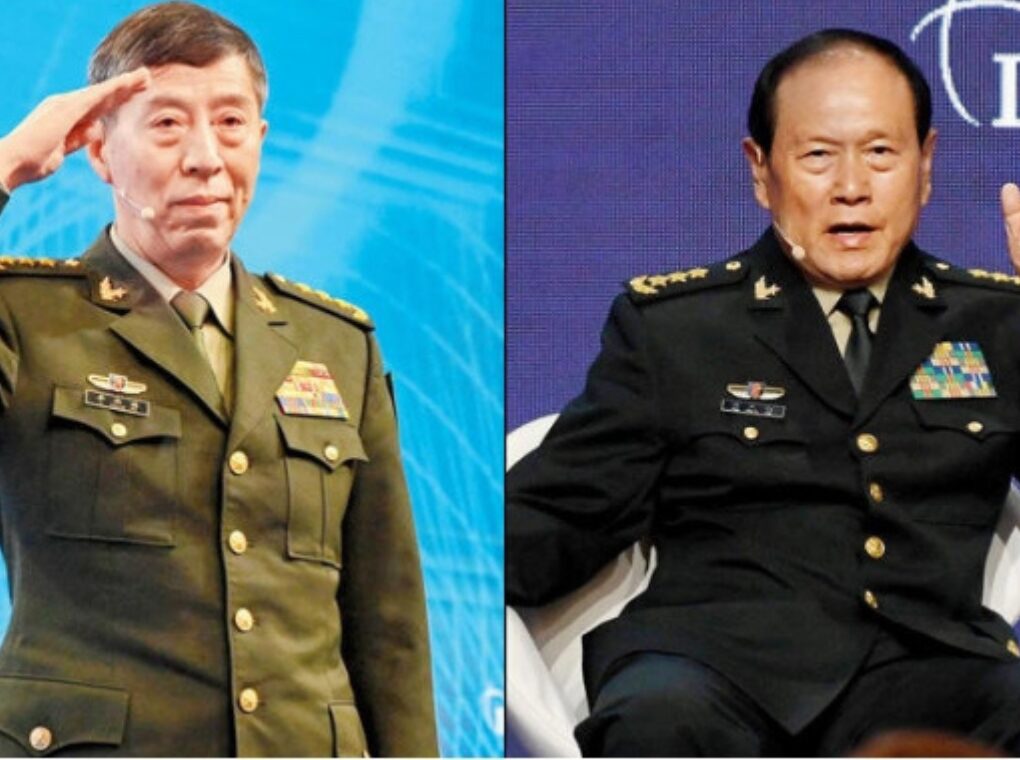
China’s military establishment is facing one of the biggest crises in its modern history. In a stunning development that has shaken the People’s Liberation Army (PLA), former Chinese Defense Ministers Wei Fenghe and Li Shangfu have been sentenced to death with a two-year reprieve over corruption charges.
According to Chinese state media reports released on May 7, both former ministers were convicted in major bribery and abuse-of-power cases linked to military procurement and defense administration. Under China’s legal system, a death sentence with a two-year reprieve is typically commuted to life imprisonment if the convicted individual does not commit further offenses during the suspension period. However, politically, the punishment sends a powerful signal across China’s military and Communist Party system.
The sentencing marks an unprecedented moment in Xi Jinping’s anti-corruption campaign, especially because both men once occupied the highest levels of China’s defense hierarchy. The case has intensified global scrutiny over corruption, internal instability, and possible loyalty concerns within China’s military leadership.
Two Former Defense Ministers Fall From Power
Li Shangfu was abruptly removed as defense minister in 2023 after disappearing from public view for weeks, triggering widespread speculation internationally. Before becoming defense minister, Li headed the PLA’s powerful Equipment Development Department, overseeing military procurement, weapons systems, and strategic defense projects.
Chinese investigators later accused Li of accepting and offering bribes, abusing his authority, and causing severe damage to the integrity of China’s military equipment development system.
Wei Fenghe, meanwhile, served as China’s defense minister between 2018 and 2023 and previously commanded the PLA Rocket Force — the branch responsible for China’s nuclear missiles and strategic deterrence capabilities. Authorities accused Wei of taking massive bribes in exchange for influencing defense-related decisions and promotions.
Both men were expelled from the Chinese Communist Party in 2024 before being formally prosecuted.
The Rocket Force Corruption Scandal
The deeper significance of the scandal lies in its connection to the PLA Rocket Force, one of China’s most sensitive military organizations.
The Rocket Force controls China’s nuclear arsenal, intercontinental ballistic missiles, hypersonic weapons, and long-range strike systems. It forms the backbone of Beijing’s deterrence strategy against the United States and plays a central role in any future conflict involving Taiwan or the Indo-Pacific.
Over the past three years, the Rocket Force has become the epicenter of an extraordinary anti-corruption crackdown.
Several senior commanders and political officers linked to the force have either been removed, investigated, or disappeared from public life entirely. Among the most notable names was Li Yuchao, who was removed amid corruption investigations. Reports also linked former deputy commanders and procurement officials to bribery and misconduct cases.
The scale of the purge shocked military analysts because the Rocket Force had long been considered one of the most elite and politically trusted branches of the PLA.
According to multiple reports, investigators uncovered evidence of bribery in weapons procurement, irregularities in military construction projects, and corruption involving equipment contracts. Some international intelligence-linked reports even alleged issues related to missile infrastructure and procurement fraud, raising questions about operational readiness inside China’s strategic missile forces.
Senior Generals Removed and Disappearances Raise Questions
The crisis has not been limited to defense ministers and Rocket Force commanders. Over the last two years, a growing number of senior military officials either disappeared from public events or were suddenly removed from office.
Among the most discussed cases was Miao Hua, one of the PLA’s top political figures, whose absence from key events triggered speculation about internal investigations.
Reports also circulated regarding scrutiny involving He Weidong and even concerns surrounding Zhang Youxia, a longtime ally of Xi Jinping.
Although Beijing rarely publicly discusses elite-level investigations until cases are finalized, the pattern of disappearances has become a recurring feature of Chinese politics. Senior officials often vanish from public life weeks or months before formal corruption charges are announced.
The purge has affected multiple branches of the military, including procurement agencies, strategic missile commands, and regional theater leadership structures.
Xi Jinping’s Expanding Anti-Corruption Campaign
Chinese President Xi Jinping launched his anti-corruption campaign shortly after taking power in 2012. Initially framed as a campaign to clean up the Communist Party and eliminate graft, it has since evolved into one of the largest political consolidation efforts in modern Chinese history.
The military became a major focus because corruption inside the PLA had reportedly become systemic during years of rapid expansion and modernization.
Investigations over the years uncovered widespread practices including:
- Bribery for military promotions
- Corrupt procurement contracts
- Fake bidding processes
- Misuse of military construction funds
- Political patronage networks inside the PLA
Xi has repeatedly emphasized that the Communist Party must maintain “absolute control” over the military. Analysts believe the anti-corruption drive serves a dual purpose: removing genuine corruption while simultaneously eliminating potential political rivals and enforcing loyalty to Xi’s leadership.
Concerns Over Military Readiness
The massive scale of the purge has sparked international debate over the actual condition of China’s military readiness.
China has spent decades modernizing the PLA into a force capable of competing with the United States in the Indo-Pacific. Beijing has invested heavily in aircraft carriers, stealth fighters, missile systems, cyber warfare capabilities, and naval expansion.
However, the repeated removal of senior officers raises concerns about command stability, operational trust, and institutional cohesion.
Military experts warn that corruption inside procurement and promotion systems can severely damage combat effectiveness. If officers obtain promotions through bribery instead of merit, or if defense contracts are influenced by corruption rather than quality standards, military capability may appear stronger on paper than in reality.
The situation has drawn comparisons to historical examples where corruption weakened powerful militaries from within, including late Soviet military structures and procurement scandals exposed during Russia’s war in Ukraine.
Espionage and Loyalty Concerns
Adding another layer of complexity are reports suggesting that some investigations may involve concerns about political loyalty and possible intelligence leaks.
International reports in recent years have claimed that certain Chinese military figures were suspected of leaking sensitive information to foreign intelligence agencies, including the United States. While Beijing has not officially confirmed espionage-related accusations publicly, Chinese political investigations often combine corruption allegations with broader concerns over “discipline violations” and disloyalty.
For Xi Jinping, maintaining absolute control over the PLA is considered essential to regime stability. Any indication of factionalism, divided loyalties, or unauthorized information sharing inside the military is treated as a serious national security threat.
A Deeper Crisis Inside China’s System?
The sentencing of two former defense ministers is not merely a corruption story. It reveals the scale of internal tensions inside China’s political and military establishment.
Beijing continues to project the image of a rising superpower capable of challenging the United States globally. Yet behind that image, the Communist leadership appears to be confronting serious structural problems inside its own defense system.
The purge demonstrates that corruption in China remains deeply entrenched despite years of anti-graft campaigns. It also highlights the paradox facing Xi Jinping: while aggressively purging officials may strengthen political control, constant investigations and disappearances can also create fear, instability, and uncertainty within military leadership circles.
For now, Xi appears determined to continue reshaping the PLA through loyalty-driven reforms and anti-corruption crackdowns. But the dramatic downfall of Wei Fenghe and Li Shangfu has already exposed one reality to the world:
China’s military challenge may not only come from external rivals like the United States, India, or Japan — but also from corruption and internal distrust within the system itself.