
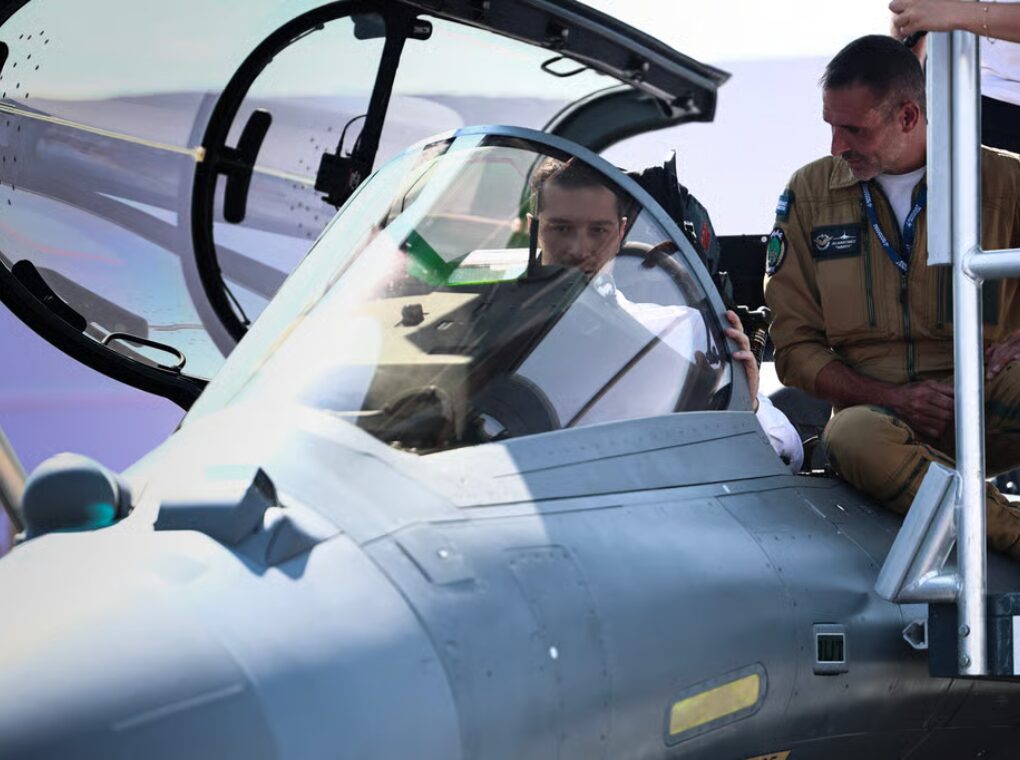
France’s rising right-wing leader Jordan Bardella has stirred fresh debate over Europe’s defense future by arguing that European allies seeking protection under France’s proposed nuclear umbrella should prioritize buying French-made fighter jets over American aircraft.
Speaking to French broadcaster LCI recently, Bardella said European countries interested in joining France’s expanding nuclear deterrence initiative should rethink their military procurement strategies.
> “Before asking France to extend its nuclear umbrella, our European partners must stop buying American-made F-35s and start buying Rafales instead,” Bardella stated.
The remarks come amid growing discussions across Europe over reducing dependence on the United States for security guarantees, especially following concerns about Washington’s long-term military commitment to the continent.
Bardella, who leads the Right-wing National Rally (Rassemblement National) alongside veteran politician Marine Le Pen, framed his comments as part of a broader effort to strengthen European strategic autonomy while simultaneously boosting France’s defense industry.
France Nuclear Umbrella Debate Gains Momentum
France has increasingly positioned itself as Europe’s key military power capable of offering an independent nuclear deterrent. President Emmanuel Macron has been pushing a broader European defense framework that could involve deeper nuclear cooperation between Paris and allied capitals.
According to reports, eight European countries — Germany, Poland, Greece, the Netherlands, Belgium, Denmark, Sweden, and Norway — are currently discussing enhanced nuclear cooperation with France. The proposed framework reportedly includes joint nuclear drills, intelligence and information sharing, and even the temporary deployment of French nuclear-capable fighter jets on allied territory.
At the center of this strategy is the Dassault Rafale, France’s flagship multirole combat aircraft capable of carrying nuclear weapons under France’s strategic deterrence doctrine.
For Bardella, military cooperation and procurement appear inseparable.
His argument suggests that nations seeking the benefits of France’s nuclear protection should contribute to strengthening the industrial and military ecosystem that sustains it — namely, by purchasing French defense equipment rather than relying on American alternatives.
A Direct Challenge to the F-35 Dominance
Bardella’s demand could complicate enthusiasm for France’s nuclear initiative because much of Europe has already invested heavily in the Lockheed Martin F-35, America’s fifth-generation stealth fighter.
Of the eight countries currently engaged in talks with Paris, seven have either purchased or committed to acquiring F-35 aircraft, making the U.S.-made platform central to Europe’s future air defense architecture.
Countries such as Germany, Poland, the Netherlands, Belgium, Denmark, and Norway have already integrated or are preparing to integrate F-35s into their air forces. Greece, while also operating French-made Rafales, has moved forward with plans to acquire F-35s. Meanwhile, Sweden continues to rely on its domestically produced Gripen fighter jets.
Critics argue that forcing allies to abandon F-35 programs in favor of Rafales could create friction within NATO and could further spoil relations with the U.S., considering the Trump administration’s policy.
Defense analysts have long pointed out that switching combat aircraft platforms involves high financial, logistical, and operational costs, making such demands politically difficult for governments that have already committed billions to American defense contracts.
Echoes of Charles de Gaulle’s Strategic Vision
Despite his criticism of Europe’s dependence on U.S. military equipment, Bardella emphasized that France should remain committed to the nuclear doctrine developed by former French President Charles de Gaulle,
He reaffirmed the Gaullist principle that “France’s vital interests do not end at its borders,” signaling support for a more outward-looking interpretation of French strategic power.
The statement aligns with an increasingly prominent discussion inside France over whether its nuclear deterrent — historically designed to protect French sovereignty alone — should evolve into a broader European security mechanism.
However, Bardella’s nationalist approach appears to blend strategic cooperation with economic nationalism, effectively tying French military protection to industrial loyalty.
Political Stakes Ahead of France’s Election
Bardella’s intervention also carries domestic political significance.
The 30-year-old politician is widely viewed as one of France’s most influential emerging leaders and is polling strongly ahead of next year’s French presidential election. His comments closely mirror warnings previously made by Marine Le Pen, who has also expressed skepticism toward European defense arrangements that could weaken French sovereignty.
By championing French-made military hardware and a stronger independent European deterrent, Bardella appears to be positioning himself as both a defender of national industry and a proponent of a Europe less dependent on Washington.
Still, whether European governments would accept such conditions remains uncertain.
For many allies, the appeal of France’s nuclear umbrella may lie in complementing — not replacing — existing NATO and U.S. security guarantees. Asking nations to abandon the F-35 in favor of Rafales could therefore prove politically sensitive and strategically divisive at a time when Europe faces mounting security concerns over Russia and regional instability.
As Europe debates the future of its defense architecture, Bardella’s proposal highlights a growing tension at the heart of the continent’s security strategy: should European defense independence come with a “buy European” requirement — or remain separate from national industrial interests?