
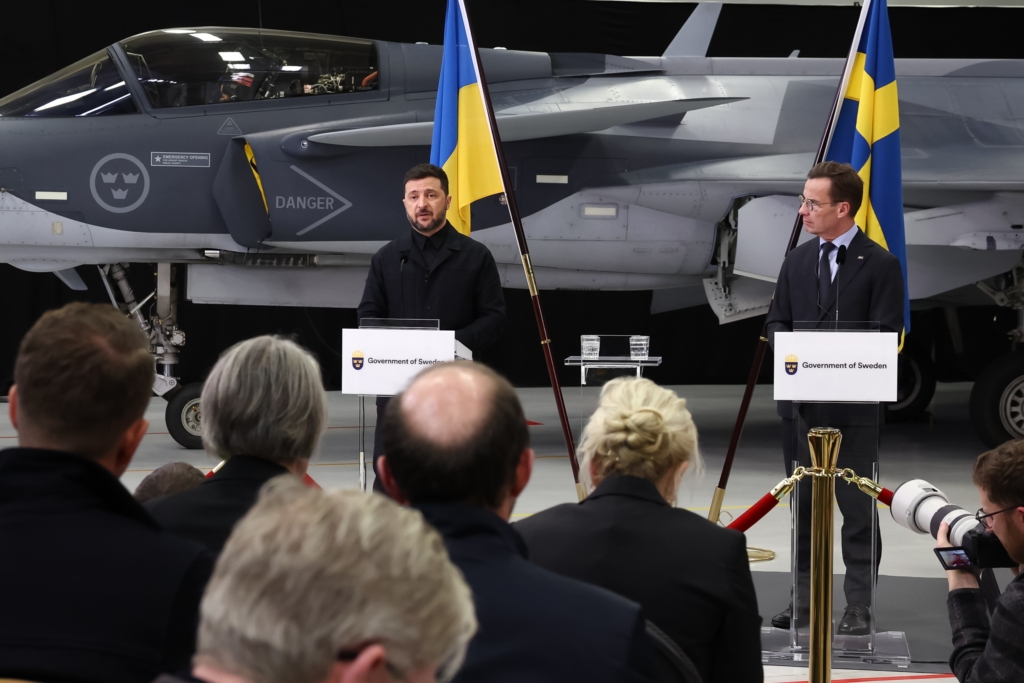
Ukraine has secured a long-awaited agreement with Sweden to obtain Saab Gripen fighter jets, marking one of Kyiv’s biggest air force upgrades since Russia’s full-scale invasion began in 2022. But despite the excitement surrounding the deal, military experts say the aircraft are unlikely to become a “game changer” overnight.
Sweden has agreed to donate 16 older Gripen C/D fighter jets to Ukraine, while Kyiv will purchase an additional 20 advanced Gripen E/F variants in a package worth €2.5 billion ($2.8 billion), funded through the European Union’s €90 billion defense loan initiative.
The first aircraft could arrive as early as 2027, according to Swedish Prime Minister Ulf Kristersson, while Ukrainian pilots are already reportedly undergoing training to operate the aircraft.
Ukraine’s broader ambition is even more ambitious: Kyiv hopes to eventually field between 100 and 150 Gripens, a number that would dramatically expand the size and capability of its current air force.
Why Are Gripen Fighter Jets So Important?
The Swedish-made Saab Gripen has long been viewed as uniquely suited for Ukraine’s wartime environment.
Unlike many Western fighter jets, the Gripen was specifically designed during the Cold War to survive attacks on air bases. The aircraft can operate from short runways and even highways, allowing them to be dispersed rather than concentrated at vulnerable military airports — a critical advantage in a war where Russia frequently targets infrastructure with missiles and drones.
Military analysts also highlight the aircraft’s maintenance efficiency. While advanced fighter jets require constant servicing, Gripens reportedly need significantly fewer maintenance hours than American-made F-16s, enabling faster operational turnaround.
Another major advantage lies in logistics and weapons supply. Unlike the F-16, which often depends heavily on U.S.-made systems, the Gripen can integrate European-made weapons such as the Meteor air-to-air missile. This reduces Ukraine’s dependence on Washington amid growing concerns over delays in Western arms deliveries.
The Meteor missile, believed to have a range of nearly 200 kilometers (124 miles), could potentially threaten Russian aircraft launching glide bombs near the border — a tactic Moscow has increasingly used to devastate Ukrainian cities and military positions.
Will Gripen Change the Battlefield?
Despite the significance of the agreement, analysts caution against expecting dramatic dogfights over Ukrainian skies.
The Russia-Ukraine war has evolved into a highly contested aerial battlefield dominated by missiles, drones, electronic warfare, and long-range strikes. Russian warplanes largely avoid entering deep Ukrainian airspace, instead launching glide bombs and missiles from safer distances inside Russian-controlled territory.
As a result, Ukraine’s Gripens are expected to play a largely defensive role.
The jets will likely join Ukraine’s growing fleet of Western aircraft — including F-16s and French Mirage 2000 fighters — in strengthening air defense, intercepting incoming missiles, and countering drone attacks.
Ukrainian President Zelensky has expressed hopes that Gripens equipped with Meteor missiles could help disrupt Russian glide bomb operations by forcing enemy aircraft to operate farther from the front line.
Military experts argue that while Gripens alone may not decisively shift the war, they could gradually increase pressure on Russian aviation and improve Ukraine’s ability to defend major cities and frontline positions.
Ukraine’s Growing Western Air Fleet
Ukraine’s Western fighter fleet has steadily expanded since the arrival of F-16s in August 2024.
According to Ukrainian officials, F-16s have already flown over 1,600 combat sorties and reportedly intercepted more than 1,000 aerial targets. However, Kyiv has also suffered losses, with several aircraft and pilots lost during operations.
Ukraine’s allies have pledged dozens more F-16s, though delivery schedules have slowed due to maintenance requirements, pilot training bottlenecks, and delays in replacement aircraft for donor nations.
Interestingly, Ukraine initially sought Gripens in 2022 but later shifted its lobbying efforts toward F-16s because they were more readily available among NATO allies.
Now, with Sweden finally opening the door to Gripen transfers, Kyiv appears set to diversify its air power strategy at a crucial moment — just as Russia intensifies missile strikes and peace negotiations remain stalled.
The Bigger Picture
The Gripen deal arrives at a politically sensitive moment for Europe and NATO. Recent Russian missile attacks, including reports involving the hypersonic Oreshnik missile, have heightened fears of escalation.
For Ukraine, the acquisition signals a growing European commitment to long-term military support. But for all the hype surrounding the Swedish fighter jet, its true impact may depend less on the aircraft itself and more on how quickly Ukraine can train pilots, secure weapons, and integrate the jets into a war that continues to evolve rapidly.
In short, the Gripen may not win the war for Ukraine — but it could help make Russia’s air campaign more difficult and costly.