
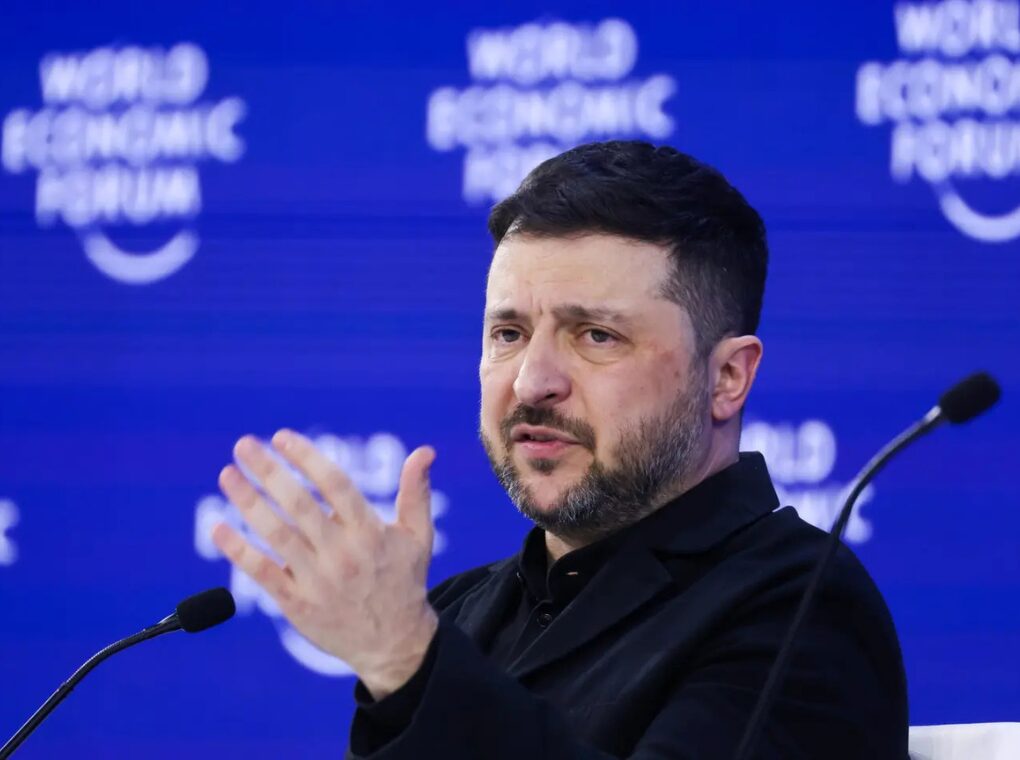
Ukrainian President Volodymyr Zelensky has revealed that a major defense technology agreement between Kyiv and Washington is fully prepared and awaiting only one final step — the signature of U.S. President Donald Trump. The proposed partnership, described by Zelensky as a potentially historic collaboration, could significantly deepen military cooperation between the United States and Ukraine through advanced drone warfare technology.
Speaking about the agreement, Zelensky indicated that the large-scale initiative would allow the United States immediate access to battle-tested Ukrainian drone systems and operational experience gained during more than four years of high-intensity war with Russia. According to reports, the deal is expected to involve multi-billion-dollar technological cooperation focused on integrating combat-tested drone innovation with American artificial intelligence capabilities.
The Ukrainian president emphasized that Kyiv has already finalized similar defense technology partnerships with several European and Middle Eastern countries, but the agreement with Washington remains strategically the most important.
“This project is of huge importance,” Zelensky reportedly said, underscoring the value Ukraine places on long-term military-industrial cooperation with the United States.
Ukraine’s Drone Expertise Meets American AI
The proposed framework is designed to combine two powerful strengths: Ukraine’s frontline combat experience and America’s technological superiority in artificial intelligence and advanced defense systems.
Since Russia’s invasion escalated into full-scale war, Ukraine has rapidly transformed into one of the world’s leading innovators in drone warfare. Ukrainian forces have relied extensively on unmanned systems for surveillance, artillery correction, long-range strikes, naval attacks, and precision battlefield coordination.
Years of combat against Russian forces have provided Kyiv with an enormous amount of real-world operational data — something military experts increasingly describe as invaluable in shaping the future of warfare.
At the same time, American companies remain global leaders in AI-driven defense technologies, autonomous systems, sensor integration, and battlefield analytics. Zelensky suggested that combining U.S. artificial intelligence expertise with Ukraine’s battlefield-tested tactics could produce a highly advanced combat ecosystem capable of redefining modern warfare.
According to the Ukrainian leader, Kyiv has already approved a framework for testing and integrating air, land, and naval drone systems under the partnership.
Defense analysts believe such a collaboration could offer Washington a rare opportunity to gain immediate access to lessons learned from one of the most technologically dynamic conflicts in modern military history. Ukraine’s rapid adaptation to electronic warfare, drone swarms, and low-cost precision strike capabilities has drawn increasing attention from NATO militaries and defense planners.
Why Trump’s Signature Matters?
Although Zelensky described the agreement as “ready,” its future now reportedly hinges on approval from President Trump.
The deal arrives at a delicate political moment in U.S.-Ukraine relations. Since returning to office, Trump has repeatedly emphasized burden-sharing among allies while signaling a preference for negotiated outcomes in global conflicts. However, his administration has also stressed the need to maintain America’s technological and military edge, especially as rivals such as China and Russia continue to expand their unmanned warfare capabilities.
For Kyiv, securing American participation would represent more than just military cooperation — it would also signal enduring U.S. strategic commitment to Ukraine at a time when questions remain over the long-term trajectory of Western support.
Military observers argue that the agreement could serve American interests as much as Ukrainian ones. The United States has invested heavily in autonomous defense systems, but Ukraine’s wartime innovations offer something difficult to replicate in laboratory conditions: direct battlefield validation under intense electronic warfare and combat pressure.
Drone War Intensifies Despite Diplomacy
Even as diplomatic discussions continue, the conflict on the battlefield shows little sign of slowing.
Ukraine has continued to conduct deep strikes on Russian military and energy infrastructure, using increasingly sophisticated drone operations to disrupt Moscow’s logistics and war economy.
On Monday, Ukraine’s General Staff reported a successful strike on a major oil refinery operated by Russian energy giant Rosneft in the Saratov region. Ukrainian officials claimed the facility played a direct role in supplying fuel to Russian military operations, making it a legitimate strategic target.
The reported attack triggered a significant fire, adding to a growing list of Ukrainian strikes aimed at damaging Russia’s industrial and logistical backbone far from the front lines.
Meanwhile, both Russia and Ukraine continue to exchange large-scale drone attacks almost daily, illustrating how unmanned systems have become central to the war’s evolving character.
As Kyiv waits for Washington’s decision, Zelensky appears determined to keep pressure on both the battlefield and the diplomatic front. If approved, the proposed drone partnership could become one of the most consequential defense technology agreements of the war — shaping not only Ukraine’s future security but also the next generation of global military strategy.