
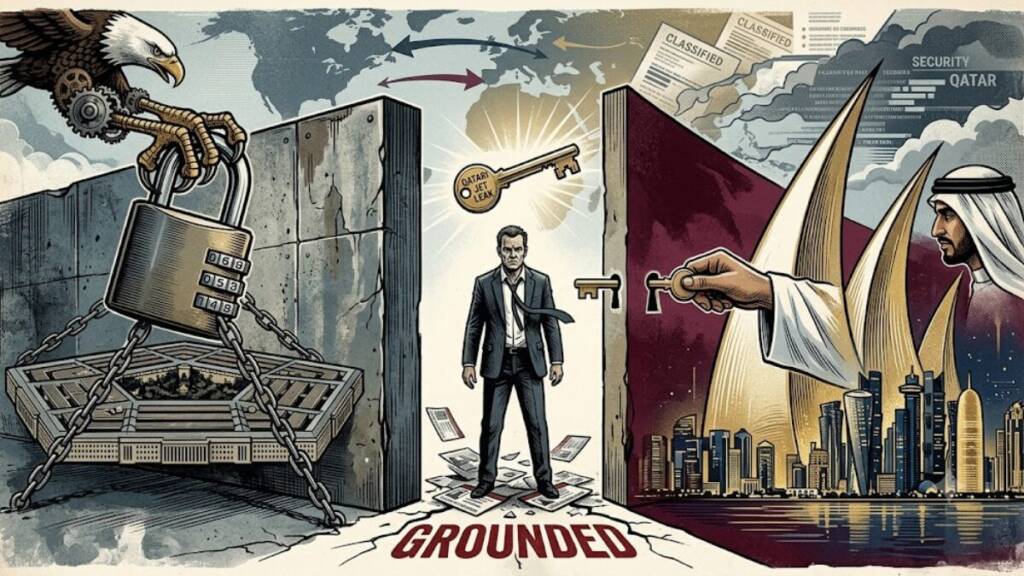
New Delhi: The Pentagon has revoked the security clearance of Frank Kendall, the air force secretary under Joe Biden, accusing him of handing classified details about Air Force One’s defences to a news outlet.
The chief Pentagon spokesman, Sean Parnell, announced the decision on X late on Friday, saying the Department of War had stripped Kendall of his eligibility to access classified information and of his ability to hold any sensitive position, with immediate effect.
“Safeguarding classified information is a non-negotiable duty,” Parnell wrote, adding that anyone who violates that trust forfeits both access and any job requiring it. Parnell did not name the outlet involved.
The leak that infuriated the White House
The accusation follows a run of reporting last month on the Qatari-donated Boeing 747-8 now flying as Air Force One. On July 8, the New York Times reported, citing anonymous sources, that the Secret Service had urged the US president, Donald Trump, not to use the gifted jet when leaving the Nato summit in Turkey. The following day the paper reported the aircraft lacked defensive countermeasures fitted to the older model, including its advanced antimissile systems.
The timing could hardly have been worse. That week American forces struck Iran and Tehran hit back at three Gulf Arab states. In other words, the specifications of the president’s aeroplane appeared in print while the president was flying through a live shooting war.
UPI reported that Parnell identified Kendall as the man who told reporters the jet was missing certain security features. And Kendall’s fingerprints are not hard to find in the coverage: on July 25 the Times quoted him by name saying the donated plane had considerable shortfalls next to the old Air Force One and that this added “a measure of risk”.
‘Completely mystified’
Kendall, who led the air force from 2021 until January 2025 and is now a senior fellow at the Center for American Progress, told the Associated Press he was “completely mystified” by the revocation.
“I’ve always been extremely careful to not say anything classified, and as far as I know I have not,” he said, adding that nobody had told him what he was supposed to have revealed. He said he had been comfortable talking to reporters and appearing on television about the Qatari 747 precisely because he was confident he had not crossed a line.
Fox News noted that in 2015, as the Pentagon’s acquisition chief, Kendall helped settle on the Boeing 747-8 as the platform for the next presidential aircraft, the programme that ran years late and left Trump inheriting jets built in the Reagan era. The gifted Qatari plane exists because that programme failed to deliver.
Part of a wider clampdown
Friday’s move fits a pattern. On July 13, the defence secretary, Pete Hegseth, announced a joint Pentagon-Justice Department task force to identify and prosecute leakers, giving the department’s general counsel sweeping powers to demand records and a two-day deadline for responses. “Leaked information risks lives,” Hegseth said. Reporters have already lost most of their freedom to roam the building.
The administration has revoked clearances before — 37 serving and former national security officials last year, plus the retired General Mark Milley’s clearance and protective detail.
The awkward bits
The Justice Department subpoenaed four Times journalists over the story, with federal agents turning up at their homes, and later sought phone records belonging to reporters and some of their relatives. The paper’s lawyer, David McCraw, said the sight of agents on reporters’ doorsteps should shock the conscience of any American. The subpoenas were withdrawn last month after a judge criticised the department’s legal work. Even the Washington Times editorial page argued this was not a fight the administration should be waging.
Parnell also declined to say whether Kendall faces prosecution, and the Pentagon would not elaborate. Accusations this serious normally travel with an Espionage Act referral. Without one, the punishment lands but the case is never tested.
For its part, the air force insists the rapid conversion was done “without accepting any risk regarding security, safety, or secure communications”, while conceding that several complex modifications planned for the American-built replacement were deliberately left out of the Qatari aircraft. The retrofit cost the taxpayer $400 million.
Kendall keeps his think-tank desk. What he has lost is the badge.