
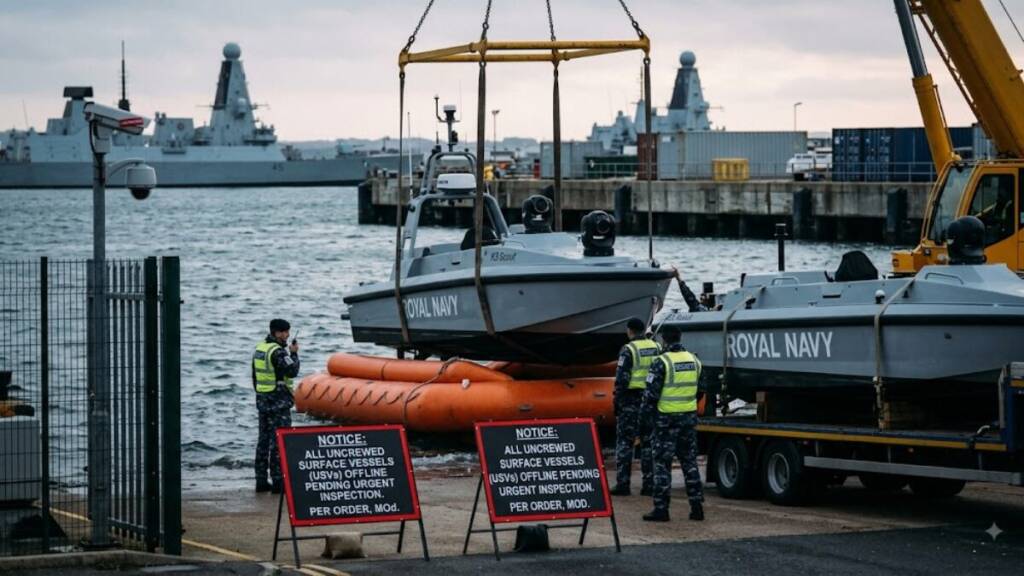
Cameras fitted to Royal Navy surveillance drones were secretly sending signals to a device in China, forcing the Ministry of Defence to strip internet connectivity from every unit in the fleet, The Telegraph revealed on 9 August.
The affected vessels — K3 Scout uncrewed boats operated by the Royal Marines since March — are Britain’s flagship drone-boat programme, built under a £12.3m contract known as Project Beehive. The discovery has rattled confidence in a platform the government was banking on to project a “pro-Britain” procurement message, and one now also in service with US Special Operations Command and on trial with NATO.
What Was Actually Sent
The MoD says the transmissions were “heartbeat communications” — brief, automated pings that simply confirm a device is powered on and functioning. No footage, faces, or mission files were transmitted, officials say.
What alarmed investigators wasn’t the content, but the destination: an internet address in China.
The issue surfaced during a routine cyber-vulnerability check. A department spokesperson said the review found no evidence that MoD data or systems were accessed, compromised, or transmitted externally, and that the fault had been caught by the MoD’s standard testing regime, which it says is designed to catch exactly this kind of issue.
A British Boat, Built on Foreign Parts
The K3 Scout is made by Kraken Technology Group, a Hampshire-based firm (variously reported as based in Fareham or Portsmouth) that won the contract only four years after its founding — beating 11 competitors, including BAE Systems.
Kraken didn’t manufacture the compromised cameras itself. It sourced them from a third-party supplier that had certified the parts as compliant with the US NDAA security standard. That certification, a subsequent audit found, didn’t hold up: the units contained a small number of components made outside the UK.
A Kraken spokesman said the company was confident no sensitive information had been shared outside intended channels, and that the vulnerabilities identified in the joint audit with the Royal Navy had since been closed.
The Timing Problem
The breach lands awkwardly. In May, Defence Secretary John Healey unveiled a British package for the Strait of Hormuz that included Kraken drone boats alongside autonomous mine-hunters and Typhoon jets — with HMS Dragon already deployed to the region.
Defence sources told the Sunday Telegraph that planning for those Gulf operations had been recorded on the same compromised devices. Those sources described the episode as a failure to properly vet component origins, and said confidence in the platform “had gone.”
The Fleet at a Glance
The programme, known as Project Beehive (and sometimes referred to as Operation Beehive), covers 20 vessels under a contract confirmed at £12.3m, though widely reported in the press as costing “£12m”. Each boat can reach speeds of up to 55 knots, stay at sea for up to 30 days, and carry a 600kg payload — anything from sensors and cargo to troops, tube-launched missiles, or explosives. Beyond the Royal Navy, the same vessel is already in service with US Special Operations Command and has been trialled by NATO.
A Familiar Pattern
Modern military hardware increasingly relies on commercial off-the-shelf parts — cameras, chips, radios bought on the open market and integrated into defence platforms. That leaves room for hidden telemetry to sit buried in firmware, well below the level most inspections reach.
This isn’t a new warning. UK government departments were ordered in 2022 to remove Chinese-made surveillance cameras from sensitive sites, and MI5 has repeatedly flagged Chinese intelligence activity targeting British institutions.
The Conservatives are now calling for an urgent audit of military equipment to root out hidden Chinese-made components — a test for a government that has pledged £5 billion to drone technology and promised procurement that is “unashamedly pro-Britain.” The K3 Scout was supposed to be the proof of that promise: British-designed, British-built, British-badged. Instead, a single bought-in sub-assembly has shown how far back the supply chain can reach. Engineers are now isolating the affected hardware unit by unit, by hand.