
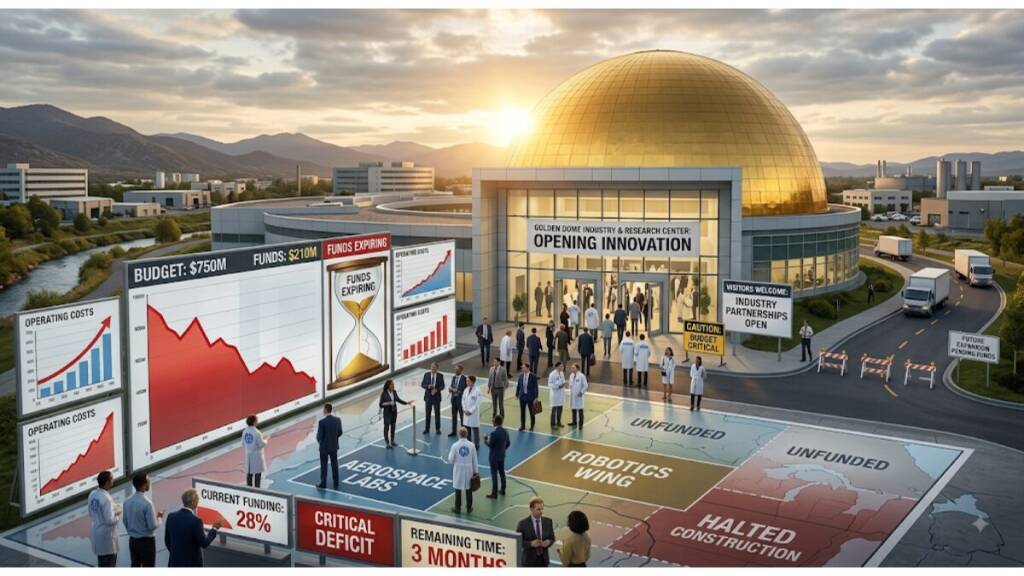
The United States Department of War opened a new digital front door to private industry on 11 August, aiming to speed up Golden Dome, the homeland missile defence shield promised by President Donald Trump.
General Michael Guetlein, director of Golden Dome for America, announced the launch at the annual Space & Missile Defense Symposium in Huntsville, Alabama — and at the very same event, warned that the whole programme could halt. “If they don’t figure it out, there is no Golden Dome because there is no funding,” he said.
What the New Hub Does
The platform, called the Golden Dome for America Ecosystem Hub, is live now at hub.goldendome.mil. According to the department, it gives defence contractors, commercial technology firms, venture capital investors, universities, laboratories and start-ups one place to register and pitch, letting firms upload concepts and send designs straight to programme decision-makers. The hub also publishes unclassified “demand signals” — a live list of the capability gaps the programme wants filled.
Guetlein framed the launch as a break with Pentagon habit. “We are dismantling the historical walls separating commercial innovation from national defense,” he said, arguing that competition and off-the-shelf technology would hold costs down. The department says the hub should widen the supplier base, prevent vendor lock-in and shore up fragile sub-tier supply chains.
So What Is Golden Dome?
Trump ordered the shield in Executive Order 14186 on 27 January 2025, first calling it the Iron Dome for America after Israel’s rocket-interception system before renaming it. The order tells the Pentagon to defend the homeland against ballistic missiles, hypersonic weapons, advanced cruise missiles and other next-generation aerial attacks — not only from rogue states, but from peer rivals such as Russia and China.
Golden Dome is therefore not one machine but a “system of systems”: radars, satellites, a space data network, command-and-control software, ground launchers and, most controversially, interceptors parked in orbit. Trump appointed Guetlein to run it in May 2025 and said the shield should be finished within roughly three years, with operational elements due to start arriving in mid-2028.
Real Progress on the Ground
Guetlein listed concrete movement. Radars, launchers, space-based interceptors, a hypersonic tracking system and the space data network all sit under contract, he said, construction contracts have been awarded, and crews are “digging dirt” at a first operational site, though he declined to say where.
He also pointed to two tests already completed. One ran this summer at White Sands Missile Range in New Mexico, assembled by the Missile Defense Agency in six months and, he said, met every objective — the most complex integrated missile defence test the country has attempted. Next year’s test, he added, will be harder still.
The Budget Trap
The trouble lies in how Congress has paid for the work. Core money has arrived through reconciliation, a special legislative route, rather than the regular defence budget, which means Golden Dome has no “top line” of its own.
That distinction now bites. Congress is assembling a stopgap spending bill, or continuing resolution, to keep the government open — but such bills fund agencies as a share of existing budget lines. “A CR doesn’t help me under Golden Dome because I don’t have a top line to fall back to,” Guetlein explained.
So far, he said, $22.5 billion has been appropriated, with 95 per cent of that already committed. Congressional researchers cite a slightly different figure — $24.4 billion provided through the 2025 reconciliation law — though the two counts aren’t measuring quite the same thing. Meanwhile, senior Republicans have signalled that the well is dry. “I think it’s safe to conclude there will not be another reconciliation bill,” Senator Mitch McConnell of Kentucky said in June.
The Cost Fight
Guetlein insists the shield can be delivered for $185 billion, up from the $175 billion Trump first quoted. Independent analysts disagree sharply. The Congressional Budget Office suggested up to $542 billion in May 2025, then raised that estimate in May 2026 to nearly $1.2 trillion over 20 years, assuming 7,800 interceptors in orbit at any one time. Guetlein rejects the comparison, saying those estimates are “not estimating what we are building.” Notably, the CBO itself has said a lack of public detail about the design hampered its analysis.
What Happens Next
The Pentagon is studying fallbacks. The Space Force could absorb some overlapping space programmes, and combatant commands already want several of the same capabilities. Even so, Guetlein stressed that no decisions have been made.
For now, the hub asks industry to invest. The budget, meanwhile, promises nothing in return.