
An Alberta court has cleared the University of Alberta to terminate a C$30,000 research endowment named after Yaroslav Hunka, the Ukrainian-Canadian veteran who was applauded in Canada’s Parliament in 2023 before his Waffen-SS past emerged. Justice Debra Yungwirth of the Court of King’s Bench issued the ruling on 7 August, and the university confirmed the outcome this week.
The decision settles far less than the headline suggests, however. It also reopens an older and harder question: how deeply is the legacy of Ukraine’s wartime nationalist formations embedded in Canadian institutions?
What the Judge Actually Decided
The court did not declare the money a “Nazi fund.” Instead, it answered a narrow legal question: could a university lawfully end a charitable trust it had accepted?
Martin Hunka created the Yaroslav and Margaret Hunka Ukrainian Research Endowment Fund in October 2019 in honour of his parents. The gift went to the university’s Canadian Institute of Ukrainian Studies (CIUS), funding research into the Ukrainian Catholic Church. After the 2023 scandal, the university moved to close the fund and return the money, prompting the family to go to court. Martin Hunka argued that the university had known about his father’s wartime service when it accepted the donation, and that Alberta’s Trustee Act does not permit charitable trusts to be wound up at all.
Yungwirth rejected that reading, finding instead that the reputational fallout justified termination. Crucially, though, she stressed that the university had not acted because it considered Hunka to be “a war criminal or anti-Semitic” — rather, the conflict between the university’s duty as trustee and its wider obligations decided the case.
Hunka’s lawyer, Julian Savaryn, said his client was disappointed and was weighing an appeal.
How a Standing Ovation Became an International Incident
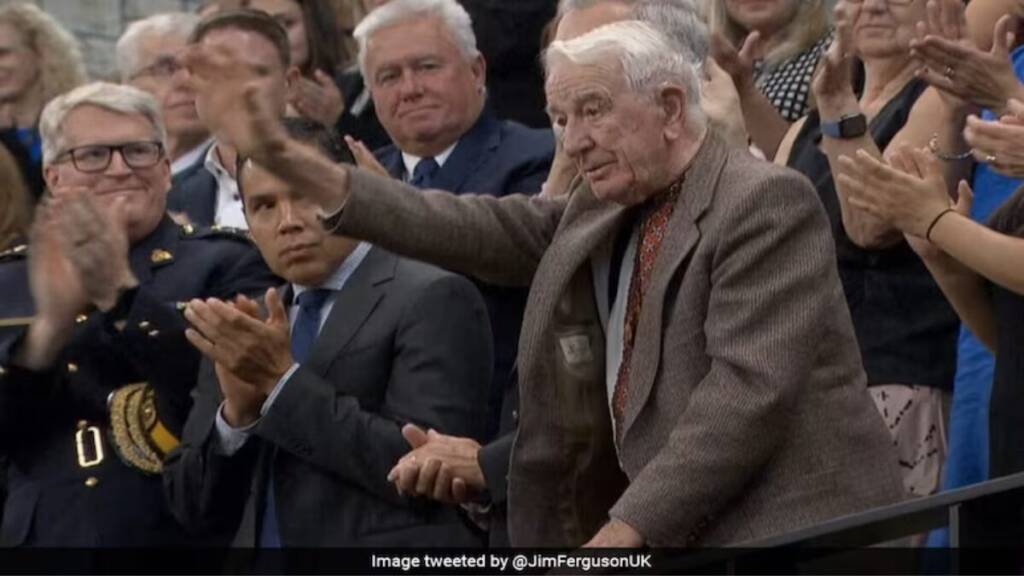
Rewind to September 2023. Ukrainian President Volodymyr Zelenskyy addressed the House of Commons, and Speaker Anthony Rota introduced Hunka, then 98, as a hero of both Ukraine and Canada. MPs rose. Prime Minister Justin Trudeau applauded. So did Zelenskyy.
Afterwards, the record surfaced. Hunka had served in the 14th Waffen Grenadier Division of the SS, better known as the Galicia Division — a unit Nazi Germany raised in 1943, largely from Ukrainian volunteers, which historians link to anti-partisan operations in Poland and Soviet Ukraine.
The fallout was swift. Rota resigned, Trudeau apologised, and Jewish organisations condemned the ovation. Within days, the university announced it was returning the Hunka donation, with Verna Yiu, then interim provost, saying the institution “recognizes and regrets the unintended harm caused.”
The Funds Nobody Is Touching
Here the story widens considerably. Reporting by the Progress Report in October 2023 found that CIUS held well over C$1.4 million in endowments named after men tied to the Galicia Division or the Ukrainian Insurgent Army. Peter Savaryn, a CIUS co-founder, served as the university’s chancellor from 1982 to 1986 and was himself a Galicia Division veteran; he received the Order of Canada in 1987, and the Governor General’s office later apologised for it. Separate reporting by The Maple identified further endowments named after division veterans.
The Hunka family raised precisely this point in court, saying nine other endowments were associated with Galicia Division members and that none had been closed. Yungwirth acknowledged the problem, writing that her ruling “may also impact other charitable endowments administered by CIUS.” Yet the university has already signalled its answer: a spokesperson told the Edmonton Journal it would not pursue the costly court applications needed to alter or terminate the others.
So one fund closes. The rest stay open. The standard applied to Hunka, as a result, looks less like a principle and more like a response to publicity.
Hunka is now 101. The endowment is gone. The archive of monuments, awards and named funds across Canada, however, remains largely intact.
An appeal may follow. Either way, the argument has moved off the battlefield. It is now a contest over memory, and over who gets to write it.