
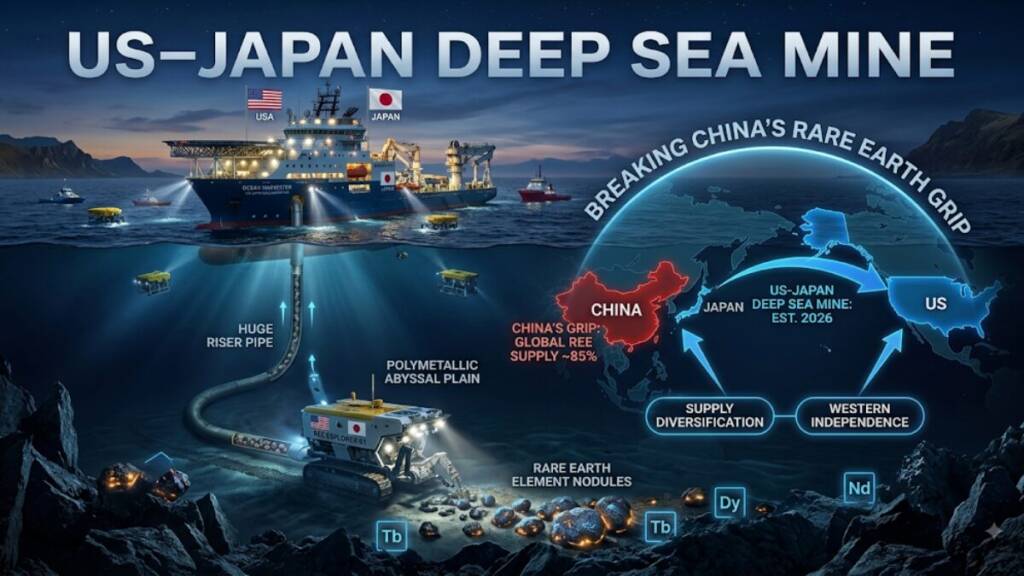
Washington and Tokyo are preparing to dig the deepest mine ever attempted — almost six kilometres beneath the Pacific, in mud around Minamitorishima, a flat speck of Japanese territory roughly 1,900 kilometres south-east of Tokyo. Plans for the project are finally taking shape, it was reported on 12 August. The prize is rare earths. The rival, unmistakably, is China.
No country has ever mined the seabed at commercial scale. The deepest offshore oil wells today reach only about half this depth, and water pressure at the site runs roughly 600 times that at the surface.
Why They’re Doing It
China controls the market, supplying around 90 per cent of the world’s refined rare earths — which means Beijing can turn off the taps at will, and it has.
Japan learnt that lesson first in 2010, and learnt it again last winter. After Prime Minister Sanae Takaichi suggested in November that a Chinese attack on Taiwan could trigger a Japanese military response, Beijing restricted supplies. According to various reports, Chinese exports of dysprosium and terbium to Japan have sat at zero all year — both metals go into the high-performance magnets that drive electric vehicles.
Japan still imports roughly two-thirds of its rare earths from China, and nearly all of its heavy rare earths. Washington faces a similar squeeze, after Beijing imposed export controls on the United States in retaliation for President Donald Trump’s tariffs.
Hence the alliance. Trump and Takaichi signed a Memorandum of Cooperation on deep-sea mineral resource development at the White House on 19 March, creating a bilateral working group and opening the door to American companies. A White House fact sheet claimed the deposits could meet “centuries’ worth of industrial demand.”
What Lies in the Mud
The numbers explain the excitement. A University of Tokyo team led by Professor Kentaro Nakamura estimated in 2018 that the seabed south of Minamitorishima holds more than 16 million tonnes of rare earth minerals, with yttrium alone potentially covering 780 years of global demand.
Recent tests support the theory. In February, the drilling vessel Chikyu pumped rare earth mud from around 6,000 metres, and Japan’s Cabinet Office has since confirmed significant levels of yttrium, gadolinium and dysprosium. Notably, the samples carried little radioactivity, which makes processing simpler than at many land-based mines.
Crucially, the deposits sit inside Japan’s exclusive economic zone, meaning Tokyo avoids the deadlocked rules of the International Seabed Authority, whose mining code remains unfinished and contested.
The China Factor
Beijing has been circling. Chinese survey ships have mapped the seabed right up to the edge of Japan’s zone in recent years, a Bloomberg analysis of ship-tracking data found, and China also holds exploration rights from the International Seabed Authority in blocks near both Minamitorishima and Guam, secured decades ago.
Then came the warship. In June 2025, a Chinese aircraft carrier entered the island’s economic zone for the first time, prompting a protest from Tokyo. “That felt almost like someone pointing a blade at us,” Shoichi Ishii, programme director for the rare earth project at Japan’s Cabinet Office, told Bloomberg.
Japan has responded on the ground, moving a Type 12 anti-ship missile launcher to the island for live-fire testing, alongside an electronic warfare system and a drone, with additional radar and harbour facilities under consideration. China’s foreign ministry rejected the framing, saying its marine research is peaceful and that its warships operate lawfully.
The Obvious Problems
Sceptics are not short of material. The project would likely swallow billions of dollars over more than a decade, with production costs estimated at roughly three times those of land-based mining in China.
Environmental groups object as well. Around 40 countries now back a moratorium or pause on deep-sea mining, according to Pew, citing thin science on seabed ecosystems — little is known about what lives six kilometres down.
Politics may bite too. Some Japanese officials privately concede the mine cannot start during the remainder of Trump’s term, and American enthusiasm could fade.
What Happens Next
A full-scale, month-long mining test is scheduled for February 2027, including refining and smelting. A commercial feasibility assessment should follow a year later.
Takaichi has staked money on it. Her growth strategy earmarks about $5.7 billion in public and private funding for deep-sea resource development by 2040.
Nakamura, meanwhile, argues the engineering is solvable. The real obstacles, he told Bloomberg, are political will and pressure from China.