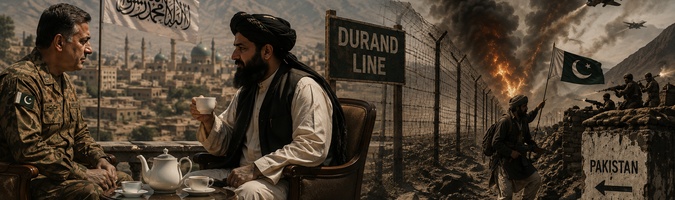
In September 2021 a Pakistani spymaster took tea in a Kabul hotel lobby. Cameras found Lieutenant General Faiz Hameed at the Serena. A reporter asked what awaited Afghanistan. “Everything will be okay,” he answered. The footage circled the globe before nightfall. It played as a victory lap, not as the opening scene of the Pakistan Taliban conflict.
Five years on, very little is okay. A Pakistani military court sentenced Hameed to 14 years in December 2025. Pakistani jets bomb Kabul. Taliban fighters overrun Pakistani border posts. And India, the rival Islamabad spent decades trying to shut out, runs an embassy in the Afghan capital.
The Prize Islamabad Wanted
Taliban columns entered Kabul without a fight on 15 August 2021. The movement marks the date each year as Victory Day. Pakistan’s establishment made little effort to conceal its satisfaction. Hameed’s tea said more than any statement could.
The habit was decades old. After 1979, ISI officers handed American and Saudi money to Afghan Islamist commanders. The network survived the Soviet withdrawal intact. Pakistan then sponsored the first Taliban government in 1996. Former officials and Western diplomats trace the movement’s rise straight back to Pakistani patronage.
Pakistan’s generals gave the project a title: strategic depth. The doctrine offered an obedient Kabul and a settled western frontier. It also dangled Central Asian trade and an Afghanistan closed to India. Two fears drove it: Pashtun militancy at home, and the contest with New Delhi.
Islamabad expected the 1990s to repeat themselves. Pakistan in the past had used Afghan sanctuaries to push terrorists towards Kashmir. Planners assumed a thankful emirate would oblige a second time. The emirate thought otherwise.
Pakistan’s Taliban Problem Comes Home
The Tehreek-e-Taliban Pakistan presented the first bill. Pakistani operations had chased the group over the border years before. Its fighters filtered back into Khyber Pakhtunkhwa after August 2021. Kabul chose not to pursue them.
That refusal has its own cold arithmetic. Pressure on the TTP risks driving hardliners towards ISKP, the Taliban’s most dangerous competitor. So, Kabul recites one sentence. Pakistani militancy, it says, belongs to Pakistan.
The figures record the consequence. Militant violence inside Pakistan has climbed every year since the takeover. Subsequently, the Pakistan-Taliban conflict has expanded into kinetic actions.. The International Crisis Group counts more than 3,500 deaths from TTP attacks since 2021. Last year was the bloodiest in more than a decade. Pakistan’s own researchers logged 3,413 combat deaths and 1,066 militant attacks. Suicide bombings jumped 53 per cent. Militants now steer explosive quadcopters into checkpoints. One such attack killed 11 policemen at Hangu in July 2026.
Balochistan widens the injury. Islamabad accuses Kabul of sheltering separatists who strike Chinese projects. Beijing watches its corridor investments with growing unease.
The Pakistani grievance is real enough. Fighters do slip across a leaky frontier of some 2,600 kilometres. But Islamabad laid that road, and the traffic now moves in both directions.
The Pakistan Taliban Conflict Turns into Open War
October 2025 buried the language of brotherhood. Pakistani aircraft hit Kabul. Taliban units hit back along the Durand Line. Qatar and Turkey negotiated a ceasefire in Doha on 19 October. The follow-up round in Istanbul fell apart within days.
February 2026 finished the truce. Afghan forces mounted a cross-border offensive on 26 February. Pakistan bombed Kabul, Kandahar and the frontier a day later. Defence Minister Khawaja Asif described the fighting as an open war.
On 16 March a Pakistani strike landed on a Kabul drug rehabilitation hospital. The UN mission counted at least 269 dead. Taliban officials put the toll above 400. Pakistan denied aiming at civilians and spoke of an ammunition dump. UNAMA logged 372 Afghan civilian deaths across three months, the worst quarterly figure since 2011. The fighting also drove more than 115,000 people from their homes.
China then called both delegations to Urumqi. Beijing came away with promises rather than peace. Pakistani jets returned in June. Kabul said those raids killed 13 people, 11 of them children.
Kabul Turns East to Delhi
While the border burned, Amir Khan Muttaqi boarded a flight to India. The Afghan foreign minister spent six days there in October 2025, after a UN committee lifted his travel ban for the visit. S Jaishankar promptly upgraded India’s mission in Kabul to a full embassy.
Then came the line that infuriated Islamabad. The joint statement located Pahalgam in “Jammu and Kashmir, India”. Pakistan summoned Kabul’s envoy the following day. The Taliban had already condemned the Pahalgam massacre in April 2025.
More delegations followed. Commerce, health and agriculture ministers retraced Muttaqi’s route. Mufti Noor Ahmad Noor took over Kabul’s embassy in Delhi in January 2026. India sent a chargé d’affaires the other way. The two governments now talk about mining, visas and air corridors. Afghan traders increasingly move cargo through Iran’s Chabahar port rather than Karachi.
New Delhi’s reasoning is unsentimental. A working line into Kabul buys intelligence, influence and goodwill. It also strips Pakistan of the buffer it spent thirty years building.
India still withholds formal recognition. Only Russia has recognised the emirate outright. Indian officials call their policy engagement, never endorsement.
Islamabad Blames Delhi
Pakistan has replied with accusation. Asif says the Taliban sit “in India’s lap” and calls Afghanistan an Indian proxy. He has offered no public evidence. Kabul reads the charge as deflection.
Ordinary Afghans have paid for the quarrel. Pakistan expelled more than a million people during 2025. The convoys kept moving through 2026 even as shells landed. Some days sent over 4,000 returnees across a single crossing. Families arrive at Torkham with bundles, children and almost nothing else. Many have never lived in Afghanistan at all.
Commerce suffered next. Repeated closures strangled trade at Torkham and Chaman for months. Khyber traders put daily export losses at close to $2.5 million. Both economies bleed while both capitals talk about sovereignty.
The Kashmir That Never Came
Pakistan wanted Afghan fighters for Kashmir. It got Afghan artillery on its own posts instead. The Taliban still refuse to accept the Durand Line as a border. They still refuse Islamabad’s demand to destroy the TTP. And they have implicitly conceded India’s claim over Kashmir.
Pakistan’s so-called strategic depth has now become a strategic liability. Burzine Waghmar of the University of London is blunt about it. “Taliban 2.0 is a different kettle of fish,” he said. Proxies seldom stay grateful once they hold a capital.
Victory Day, Five Years On
Taliban delegates packed Kabul’s Loya Jirga Hall on 15 August 2026. Vendors sold flags along the roadside. A senior UN official marked the anniversary with a warning about rights. The World Bank counts roughly 14 million people facing acute hunger. Scattered armed fronts challenge the Taliban, though none endangers Kabul.
The emirate has won something Pakistan never intended to hand over. It has options. It trades with Iran, courts India and hosts Chinese mediators.
Regional powers now approach Kabul one by one. Pakistan holds no veto over that traffic. Islamabad guards a frontier it once treated as a corridor. Hameed’s tea went cold long ago. His 14-year sentence runs deep into the 2030s. The Pakistan Taliban conflict will probably outlive it.Pakistan Taliban conflict